Build a practical departure list from the trip you are actually taking. The tool suggests quantities and prompts; it does not replace airline, border, employer or medical requirements.
Your generated list
Check each item before departure
Documents and access
Passport or accepted travel ID
Tickets, booking references and accommodation details
Employer travel contacts and insurance details
Payment cards plus an independent backup
Required visas, permits and destination documents checked against official guidance
Work equipment
Work laptop and approved charger
Laptop sleeve or protected compartment
Phone, charging cable and power source
Headphones or headset for calls
Presentation adapters or security keys required by the itinerary
One labelled pouch for cables and small accessories
Clothing for 3 days
4 work tops or shirts
2 work bottoms
3 sets of underwear and socks
Sleepwear and weather-appropriate outer layer
Work shoes; pack a second pair only if the itinerary needs it
Health and in-transit essentials
Medication in suitable original packaging, with supporting documents where required
Basic toiletries within the applicable security limits
Reusable water bottle to fill after security
Before leaving
Measure and weigh the cabin bag against the operating airline’s current allowance
Check plugs, voltage and charger compatibility for the destination
Follow employer rules for devices, data and confidential material
Save the checklist for the return journey
Recheck live travel, security and airline information
Research and worked examples · Reviewed 29 September 2026
By Benjamin Dickman. Illustrative scenarios, not hands-on product testing.
A two- or three-day business-trip packing list should start with the meetings, dress code, travel route and work equipment you actually need.
Pack complete outfits and a verified charging kit, then measure and weigh the finished bag against the operating airline or transport provider's current rules. A generic list of travel accessories is not a substitute for that final check.
Use the interactive checklist on this page to create a starting list, then adapt it with the worked examples below. All weights are hypothetical planning allowances, not measurements of named products or a guarantee of airline acceptance.
Check official travel, security and employer requirements shortly before departure.
Define the trip before choosing the bag
Write down the number of travel days, nights and working sessions. A two-day trip with one overnight stay needs a different clothing plan from two full days of meetings plus separate travel days.
Include a formal dinner, site visit, exercise session or other activity only if it is genuinely on the itinerary.
Record the strictest baggage requirement across the journey, including connecting flights and the return leg. The operating airline and ticket conditions matter.
A bag sold as cabin-sized is not universally accepted, and wheels, handles and packed bulges can affect the measured dimensions.
Check whether the employer provides equipment, adapters or destination support. A meeting room may have a known connection arrangement, while a client site may require specific access credentials or clothing.
Confirm these details rather than packing several speculative backups which add weight without resolving the actual uncertainty.
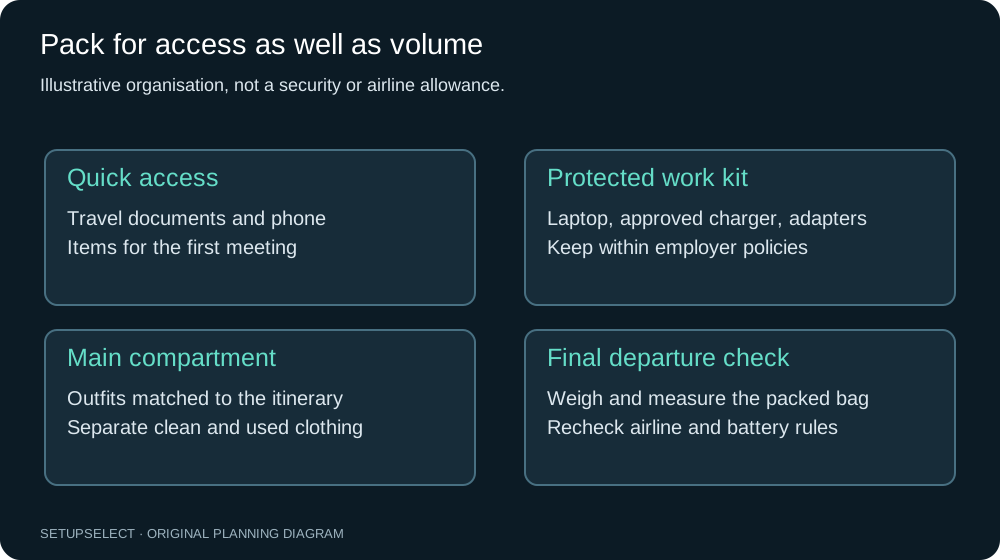
Illustrative packing zones: documents and immediate essentials remain accessible, work equipment is protected, and clothing forms a separate main compartment. This is an organisation example, not an airline-approved bag layout.
Build complete outfits
Choose clothing around the confirmed dress code and expected conditions, then assemble complete outfits rather than counting unrelated items.
Reuse compatible layers where appropriate and include a practical plan for creases, wet weather and temperature changes. The right quantity depends on the itinerary and access to laundry, not a fixed universal rule.
For a one-night trip, consider what is worn during travel and what must be packed for the next work session. Keep essential replacement items accessible if a delay would otherwise leave you unable to attend a meeting.
Do not rely on unconfirmed hotel laundry or assume an iron will be available.
Shoes can occupy disproportionate space and weight. Pack a second pair only when the activities or conditions justify it, and consider how the pair will be separated from clean clothing.
Comfort and suitability for the actual travel route matter more than achieving an artificially minimal item count.
Two-day worked list
Imagine travelling on the first morning, attending meetings, staying one night and returning after meetings the next day. The dress code is business casual, the weather is moderate and the laptop is required.
Start with the outfit worn in transit, then pack the next work outfit or compatible changes, sleepwear, underwear and essential toiletries.
Add the laptop, its approved charger, phone, necessary cables and any confirmed presentation adapter. Include documents, access credentials, medication and personal essentials according to official guidance and individual needs.
A spare charging cable may be justified for a critical device; several duplicate chargers usually need a clearer reason.
The important check is whether the first meeting can proceed if the journey is delayed or the main bag becomes inaccessible. Keep immediate work essentials and required documents where they can be reached without unpacking clothing in a public space.
Three-day worked list
For two overnight stays and three workdays, build a small set of interchangeable clothing rather than three entirely unrelated outfits. Confirm whether the same shoes and outer layer suit all activities.
If there is a formal event, treat it as a specific requirement and allow for transport and garment care.
Do not automatically multiply every accessory by the number of days. Charging hardware, toiletries and work tools may remain the same, while clothing and consumables change.
Conversely, do not assume that one small battery will cover several days without access to charging; plan around the actual device use and available power.
If laundry access is confirmed, it may reduce clothing needs, but include the time and method. A theoretical washing opportunity that conflicts with meetings is not a dependable part of the plan.
Keep a modest contingency for disruption without turning it into a second complete suitcase.
Work equipment by task
List what each meeting requires: laptop, presentation output, headset, security key, specialist device or printed material. Confirm compatibility with the destination where possible.
A universal adapter collection can be heavier and less reliable than one verified connection that matches the room.
Follow employer rules for devices, data and confidential information. This packing guide does not authorise personal storage, unapproved adapters or changes to security settings.
If a device requires a managed connection or travel approval, resolve that through the employer before departure.
Protect equipment against normal handling and keep critical items accessible. A sleeve's external dimensions add to the laptop's footprint, while a rigid organiser can consume more volume than expected.
Measure the packed configuration rather than the bare computer when choosing the bag.
A charging kit that matches the devices
Record the charging input and connector for each device, then identify which must charge simultaneously. A multi-port charger's headline wattage may be shared across ports.
Check the actual output combination, cable ratings and laptop compatibility instead of assuming the total applies independently to every socket.
Separate plug shape from voltage compatibility. A travel adapter generally changes the physical connection; it should not be assumed to convert voltage. Check each device's input label and the adapter's supported use.
Keep battery rules distinct from charging convenience. For UK aviation guidance, the CAA Pack Right resource explains battery carriage considerations.
Airline conditions can be tighter or change, so confirm the current rules for the actual journey rather than relying on this article as a boarding guarantee.
Two illustrative weight budgets
The following figures demonstrate addition and prioritisation. They are not weighed product tests, recommendations for a particular allowance or evidence that an airline will accept the bag. Replace every line with your own measured packed weight.
Component
Two-day example
Three-day example
Empty bag
1.1kg
1.1kg
Laptop and protective sleeve
1.6kg
1.6kg
Charger, cables and required accessories
0.6kg
0.6kg
Packed clothing
1.2kg
1.7kg
Toiletries and personal essentials
0.5kg
0.5kg
Other required items
0.4kg
0.5kg
Example total
5.4kg
6.0kg
The 0.6kg difference here comes from the assumed clothing and other items, not from a rule that a third day always adds that amount. An extra pair of shoes, a heavier laptop or specialist work equipment can change the result substantially.
Weigh the finished bag, including its own mass, rather than trusting a spreadsheet alone.
Pack for access as well as capacity
Put documents and items needed at security or during the journey in accessible locations, consistent with current requirements. Keep cables from becoming a tangled layer over the laptop.
A bag can be efficiently filled yet frustrating to use if every checkpoint requires removing half its contents.
Separate clean clothing from footwear and damp items. Avoid placing liquids where leakage would reach electronics, and follow the applicable security rules for containers and screening.
Requirements can differ by airport and route, so use current official information rather than a universal allowance copied from an old checklist.
Plan for the possibility that a cabin bag is taken at the gate. Keep items that must remain with you, including relevant batteries and essential documents, in an arrangement that can be removed promptly in accordance with airline instructions.
Do not assume a cabin-sized bag will always stay in the cabin.
Documents, health and personal essentials
Check passport or accepted identity requirements, booking references, destination entry conditions and any employer documentation through official channels.
Do not infer that a previous trip establishes the requirements for a different nationality, route or purpose of travel.
Medication and health-related items need individual planning and may have documentation or transport requirements. Consult the relevant official guidance and a qualified professional where necessary.
This article does not provide medical advice or determine whether an item is permitted in a destination country.
Keep appropriate emergency and employer contacts accessible without exposing confidential information unnecessarily. A packing list should support the journey while respecting the organisation's data-handling rules.
Avoid storing sensitive work information in an unapproved app simply because it makes a checklist convenient.
Test the exact packed bag
Pack the proposed list fully, close the bag and measure its external dimensions at the widest points. Include wheels, handles and any expanded sections according to the carrier's measurement method.
A soft bag may change shape when filled, so empty product dimensions are not enough.
Weigh it on a suitable scale and leave a sensible margin for measurement differences and items added before travel. Then carry it through a realistic route: stairs, a walk, a station platform or the distance you expect at the destination.
Do not judge carrying comfort solely by lifting it once from the floor.
Check whether the bag can be opened and repacked easily, whether the laptop remains protected and whether the daily essentials are reachable.
The trial can reveal that a lighter or simpler packing arrangement is more useful than a more elaborate organiser system.
Return-trip planning
Leave space for the same items in a less perfectly folded state, and consider paperwork or small purchases genuinely expected on the trip. Do not rely on compressing everything more aggressively on the return journey.
Dirty or damp clothing may need separation, which changes how the available volume is used.
Keep a return checklist for chargers, adapters, security keys and items left in meeting rooms or hotel sockets. Group small equipment in a repeatable pouch and count the required components before leaving each location.
A clear inventory is more useful than adding trackers to every object without a packing routine.
After the trip, record what was unused and what was missing. Improve the next list using actual experience, but do not remove an essential contingency merely because it was not needed once.
Distinguish optional comfort items from items required for the itinerary or by official guidance.
Common mistakes
Packing for an imagined formal event, taking duplicate chargers without checking port sharing, and choosing a bag before checking the ticket allowance all add avoidable uncertainty.
So does counting only clothing weight while ignoring the laptop, empty bag and accessories.
Another mistake is treating a manufacturer's cabin label as universal approval. Airline and airport requirements are separate from the bag's marketing.
Check the cabin-bag tool as a research aid, then verify the live official allowance for the operating carrier and fare.
Rehearse the first hour after arrival
Imagine arriving with limited time before the first meeting. Identify what must be accessible without opening the main clothing compartment: travel documents, phone, meeting address, work device and any required adapter.
Put those items in their intended compartments and check that the bag still closes comfortably.
Then repeat the exercise for the return journey. Used clothing, receipts, a damp wash bag or printed materials can occupy space that did not exist on departure.
Leave a deliberate location for them rather than assuming the outward packing arrangement will work unchanged.
For a team trip, do not assume somebody else has the presentation cable, booking reference or room access information.
Confirm shared responsibilities explicitly, while keeping critical personal documents and employer-approved access methods under your own control.
This rehearsal can reveal more than a longer universal packing list. Remove items with no clear role in the actual itinerary, but do not remove required medication, accessibility equipment or essential work items simply to meet an arbitrary minimalist target.
Final checklist and sources
Confirm travel days, meetings, dress code and specific work requirements.
Check current transport, entry, security and employer conditions.
Build complete outfits and a verified charging kit.
Replace the example weights with measurements of your own packed items.
Measure and weigh the closed bag, including external projections.
Keep immediate essentials accessible and plan the return reset.
Use the checklist generator on this page and the carry-on planner together.