Buying guide
Battery vs corded lawn mower: access, charging and complete cost
A battery lawn mower is worth considering when a cable would complicate the route around your garden. A corded mower remains a reasonable option when a suitable supply and safe cable layout cover the entire lawn.
The useful comparison is not modern versus old-fashioned: it is charging and battery ownership versus cable management at your property.
Start by sketching the lawn, socket, storage and obstacles. Then compare complete packages, including any required charger, batteries and suitable electrical accessories.
The examples below are fictional planning cases, not measured product performance or current retail offers.
The practical difference at a glance
| Decision | Battery mower | Corded mower |
|---|---|---|
| Working connection | No mains lead attached during mowing | Cable must be managed throughout the session |
| Session preparation | Charge approved batteries and check availability | Inspect equipment and arrange the appropriate supply |
| Coverage constraint | Exact machine, pack configuration and conditions | Reach and suitability of the entire cable arrangement |
| Interruption planning | Spare approved battery or a charging break | Cable repositioning, socket access and working route |
| Additional ownership | Battery and charger compatibility, storage and replacement | Cable condition, storage and appropriate protection |
| Best evidence | Manual plus coverage data for the supplied batteries | Manual plus a measured safe route to every lawn section |
Neither column settles cutting quality. The blade, deck, adjustment, condition of the machine and operating conditions also matter. Compare individual products rather than assuming that either power source guarantees a particular finish.
Draw the corded route before comparing prices
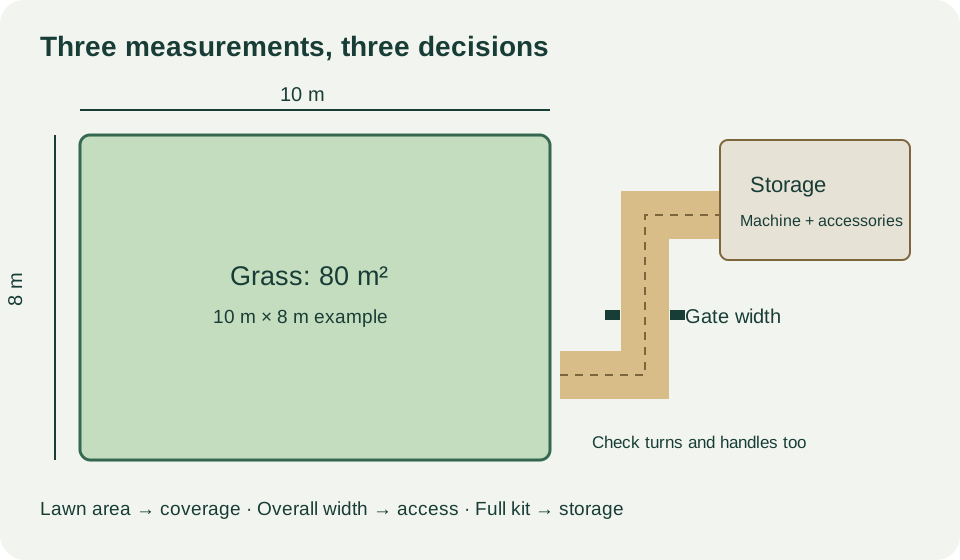
Locate the suitable electrical supply and draw the route to the furthest part of the lawn. Include the path around a shed, through a gate or beside a flower bed. The direct distance across a plan may be much shorter than the route a cable can safely follow.
Think through successive passes, not merely whether the lead reaches the far corner once. Where will the cable sit after turning? Does it cross the area you are about to mow, a shared entrance or a route used by children or pets?
A workable arrangement must remain manageable throughout the session.
Electrical Safety First's garden safety guidance recommends RCD protection and attention to cable condition and position when using electrical garden equipment.
Follow the mower and extension equipment instructions; do not treat an RCD as a substitute for preventing cable damage.
Do not improvise a chain of extensions or use equipment that is not suitable for the load and outdoor conditions. If you cannot establish a safe arrangement, seek qualified advice or choose a solution that does not rely on that route.
A cheap mower is not a saving if using it depends on an unsuitable connection.
Work out the battery arrangement you would actually own
For a cordless candidate, identify the exact battery platform, permitted pack models and number of packs required during operation.
The word “cordless” does not tell you whether a single supplied battery is enough to start the machine or whether the listed product is supplied without batteries altogether.
Check the package code rather than only the main model name. Two listings can show similar photographs while including different packs or no charger. Put every necessary component in the comparison basket.
If you already own compatible equipment, confirm the mower supports those exact batteries instead of inferring compatibility from colour or brand.
Now consider scheduling. A battery shared with a trimmer may not be available for both tasks consecutively without recharging.
A household with only a brief mowing window might value a second approved pack, while someone happy to split the job across sessions may not. Neither preference can be inferred from lawn area alone.
Charging and storage conditions are model-specific. Follow the manufacturer's temperature, location and handling requirements. A damp shed or a very hot enclosed space should not become the default charging location simply because it is near the mower.
Worked example: a simple 48-square-metre lawn
Imagine a rectangular lawn measuring 6 by 8 metres, beside a suitable supply and with no separate front lawn. The owner can establish a safe cable route and has a dry, accessible place to store the machine.
The area is an illustrative input, not a claim that every corded mower is suitable for it.
For this household, the cordless benefit may be convenience rather than access. The owner should compare the time and effort of managing the lead with charging and storing batteries.
If the existing corded setup is straightforward, replacing it solely because a cordless model is newer may not solve an important problem.
Suppose fictional complete purchase baskets are £130 for a corded setup and £230 for a battery setup. The £100 difference is not a running-cost conclusion: it is the initial extra spend in this example.
The owner can ask whether avoiding the lead is worth that amount without pretending the purchase will automatically pay for itself.
If they choose corded, handling and cutting-height adjustment still deserve inspection. If they choose battery, they should verify the actual kit and coverage. The simple garden removes some obstacles; it does not remove the need to compare product details.
Worked example: two lawns separated by the house
A second fictional property has a 35-square-metre front lawn and a 90-square-metre rear lawn. The usable power supply is at the back, and the route to the front passes through an awkward shared entrance.
Adding the areas gives 125 square metres, but area is not the most important distinction here.
A battery mower may simplify movement between the two spaces because there is no mains lead to route around the building during use.
That advantage must be weighed against the machine's transport instructions, weight, gate clearance and ability to cover the planned work with its approved battery configuration.
The owner should not replace one problem with another. A heavy cordless model that is difficult to move over the threshold may be a worse everyday choice than a more manageable machine.
Compare weight with the batteries installed if that is how the mower will be moved, and follow the manufacturer's transport procedure.
The decision sheet might therefore prioritise access, handling and complete-session coverage before purchase price. This is a stronger explanation for choosing cordless than the assumption that battery equipment is always better for a particular area band.
Worked example: existing batteries, but a different kit requirement
A third household already owns tools from the same manufacturer as a shortlisted mower. It is tempting to compare the bare-mower price with a complete corded package and assume the batteries are effectively free.
First establish whether the existing platform and exact packs are approved for that mower.
Even when compatible, the available capacity and number of packs may not support the household's intended session. The packs may also be needed in other equipment on the same day.
Write down the sequence: mow the rear lawn, mow the front, trim edges, then store and charge. This reveals whether the existing inventory really covers the work.
If another battery or charger is required, add it to the basket before deciding. If none is required, the existing platform is a genuine practical advantage, but it should not overrule a failed width, handling or coverage check.
Compatibility is therefore a constraint and an opportunity, not a blanket reason to buy every garden tool from one range. The mower still needs to suit the garden and the person operating it.
Runtime: compare evidence rather than amp-hours alone
Battery capacity in amp-hours is not a promise of mowing minutes. Voltage, usable energy, machine behaviour and conditions all affect the relationship.
Comparing two packs by amp-hours alone can be especially misleading when their voltages or operating configurations differ.
Bosch's AdvancedRotak operating instructions identify grass density, moisture, length and cutting height as factors affecting cutting capacity.
This illustrates why one published runtime should not be transferred uncritically to another garden or machine.
Look for the coverage figure associated with the actual supplied battery set, and record the conditions the manufacturer provides. If important conditions are absent, keep that uncertainty visible.
Do not create a guaranteed area by multiplying an advertised maximum runtime by an invented mowing speed.
If a battery session might require a break, decide whether that is acceptable before purchase.
The separate battery lawn-mower runtime guide explains how to organise energy, coverage and charging information without confusing an illustrative calculation with a product test.
Purchase cost and running cost belong in different calculations
Create one column for initial equipment and another for ongoing use. The initial battery basket can include the machine, required approved packs and charger. The corded basket can include the machine and any necessary suitable connection equipment.
Do not automatically add every optional accessory to either side.
For an illustrative electricity calculation, a device drawing an average 1.0kW for half an hour uses 0.5kWh. At a made-up tariff of 30p per kWh, that costs 15p. This is arithmetic, not a measured mower's consumption or a claim about today's electricity tariff.
A battery mower's charging energy should be measured at the socket if you want a useful ownership record; battery label energy alone does not include every charging loss.
A corded mower's rated input is also not necessarily its average draw through the entire session. Apply the same evidence standard to both sides.
Include replacement and servicing uncertainties without inventing a fixed battery lifespan. Warranty terms, use, storage and the manufacturer's guidance matter.
A five-year total presented as precise would be misleading if the replacement assumptions are merely guesses.
Maintenance does not disappear with either choice
Both types still need the inspection, cleaning and blade care described in their manuals. Removing a mains lead does not make moving cutting parts harmless.
Isolate the equipment exactly as instructed before cleaning, adjustment or inspection, and never defeat a safety interlock.
For a corded model, inspect the cable and plug as directed and stop using damaged equipment. Do not make improvised repairs to continue a session.
For a battery model, follow battery inspection and handling guidance and stop using damaged packs rather than attempting to repair them at home.
Check replacement-blade and servicing support for the exact model. A mower that fits your lawn but lacks accessible service information may become frustrating to own.
Compare the availability of instructions and approved parts alongside the attractive features in the sales listing.
Storage is another shared requirement. Verify the permitted orientation, folded dimensions and cleaning procedure. A picture of a vertically stored mower applies to that product, not to every other machine in the same category.
A final decision worksheet
List the reasons a cable would be difficult in your garden, then list the reasons battery ownership would be difficult. Be specific: “the front lawn has no suitable route from the supply” is useful; “cordless is easier” is not yet enough to choose a model.
- Measure each grass area and the route between them.
- Record a suitable supply and the full corded working route, if feasible.
- Confirm the cordless platform, exact packs, charger and published coverage conditions.
- Compare machine dimensions and handling with the actual storage route.
- Price the complete required basket, with optional extras separated.
- Read operating, isolation and storage instructions before deciding.
Use the main mower sizing guide if width and access are unresolved, or the lawn-mower finder once your constraints are clear.
Those measurements prevent either power-source preference from leading to a machine that does not physically fit.
Questions before you choose
Is cordless always lighter? No category-wide assumption is reliable. Compare the stated working weight and included components for the exact products, then consider the required handling route.
Can I use a longer cable to reach any garden? Not automatically. The mower and connection equipment must support the arrangement, and the route must remain suitable throughout use. If that cannot be established, do not improvise.
Does a spare battery remove all waiting? Only if the packs and charging arrangement support your session. Account for actual coverage, charging conditions and other tools sharing the batteries rather than assuming continuous use.
Which is better value for a small lawn? Either can be. A straightforward corded route may keep the initial basket simple; awkward access may make cordless convenience more valuable.
Choose from the measured route, complete kit and routine you can sustain, not a universal lawn-size cutoff.
Continue researching