Buying guide
Battery vs petrol lawn mower: session capacity, care and ownership
Choose between a battery and petrol lawn mower by how you complete and maintain a full mowing session. Battery equipment needs a workable charging and spare-pack plan. Petrol equipment needs appropriate fuel, engine care and storage.
Both must fit the lawn, access route, operator and desired finish. Neither power source solves an unsuitable deck width or an awkward gate.
For regularly maintained domestic grass, begin by comparing complete machines that meet the same physical requirements.
A light push mower and a wide self-propelled roller mower are not a fair power-source comparison. The lawn-mower finder and main mower guide help establish the basic specification before you choose how to power it.
The current finder covers the maintained corded and battery catalogue; it does not rank petrol models. Use its lawn and handling requirements as a starting point, then compare any petrol candidate directly against its manufacturer's specification and manual.
Define the session you need to finish
Record the grass area, normal interval between cuts and any sections that are left longer. Then record the whole routine: moving the mower out, travelling between lawns, cutting, emptying clippings, cleaning and returning everything to storage.
The available time for that routine is more useful than a vague preference for “long runtime”.
Suppose you usually have 50 minutes before another commitment. A battery setup that reliably needs a long recharge halfway through is inconvenient, even if its total energy cost is low.
A petrol mower that is difficult to start or too cumbersome to retrieve can be equally frustrating. The decision is about a repeatable session, not which fuel sounds more powerful.
Do not extrapolate from one unusually easy cut. The first cut after a holiday, heavier growth and changes in collection requirements can alter the workload.
Build a plan with room for the conditions you genuinely expect, while staying within the machine's intended use. Repeatedly neglected grass may require a different maintenance approach rather than simply a larger power source.
Compare like-for-like machines
Create a shortlist with similar cutting width, collection options, propulsion and finish requirements. Then compare weight with the necessary battery fitted or the manufacturer-defined petrol configuration.
A bare-machine weight and a ready-to-use weight are different measurements.
| Question | Battery setup | Petrol setup |
|---|---|---|
| How is the next session prepared? | Charge compatible packs in the permitted conditions | Check fuel and engine requirements |
| What extends the session? | A compatible charged spare or a charging break | A refuelling break following the manual |
| What recurring care is specific to power? | Pack, charger, contacts and storage instructions | Oil, filter, spark plug and fuel-system schedule |
| What care is shared? | Blade, deck, controls, collection and drive components | Blade, deck, controls, collection and drive components |
| What decides physical fit? | Complete model dimensions and handling | Complete model dimensions and handling |
Use this table to collect evidence, not to award automatic points. A household with accessible dry charging space and limited fuel storage may favour battery.
Someone maintaining separated lawns with an established petrol servicing routine may value a different arrangement. The practical constraints determine how much each difference matters.
Battery runtime is conditional
A battery's amp-hour figure alone cannot tell you how long a mower will cut. Voltage, usable energy, the mower design and the task all matter.
A manufacturer area claim also needs its conditions: the battery supplied, grass state, cut height and operating mode may be important qualifications.
For example, Bosch's AdvancedRotak manual explicitly connects cutting capacity with grass conditions and height of cut.
Read the conditions rather than treating the maximum square-metre claim as a guaranteed result. Our separate battery runtime guide explains the energy arithmetic and provides a charging example.
Ask whether the advertised pack is included, whether the mower uses one or more packs together, and whether a spare can be charged while mowing continues.
A two-pack mower does not necessarily give two sequential sessions; both batteries may be required simultaneously. Confirm the exact arrangement before pricing a spare set.
Refuelling is a workflow too
Petrol can support an extended session without waiting for a battery recharge, but replenishing it is not simply pouring more fuel into a running machine. Follow the exact manual's shutdown, cooling and refuelling instructions.
Include the time and suitable location in your plan.
Honda's HRZ536C manual, for example, requires refuelling in a ventilated area with the engine stopped and cooled after operation.
Use the instructions for your own mower and engine; this example is evidence that refuelling constraints belong in the comparison.
Also identify the specified fuel.
Do not assume advice for a car, another engine or an older mower applies. Honda's E10 guidance explains compatibility for its equipment, while individual instructions govern storage and use.
If you mow infrequently, fuel ageing and seasonal preparation deserve particular attention.
Maintenance: less engine work does not mean no work
A battery mower avoids petrol-engine oil, spark-plug and fuel-system tasks. It still has a cutting system, guards, controls, collection equipment and, where fitted, a drive mechanism. Those components need inspection and maintenance according to the manual.
A blunt or damaged blade is not corrected by installing a larger battery.
For a petrol example, Hayter's mower-maintenance guidance discusses fuel, cleaning and engine care, and states its annual servicing requirement for warranty purposes.
That requirement belongs to the relevant Hayter ownership terms; it should not be presented as every manufacturer's universal warranty rule.
Before buying either type, look up the blade part number, service support and instructions for routine cleaning. Decide which tasks you are comfortable performing and which require a dealer.
For a busy owner, access to reliable servicing may be worth more than a small difference in a headline specification.
Storage changes the ownership experience
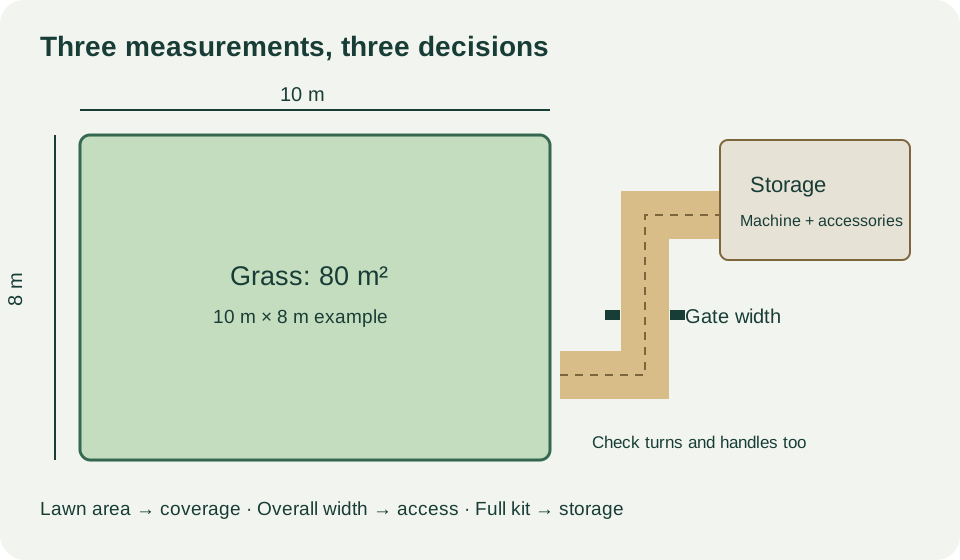
Measure the mower's stored footprint using the permitted handle position. Check whether vertical storage is explicitly supported; never infer it from a photograph of another model.
Consider the path to the storage position, including a raised threshold or the need to lift the machine. A mower that technically fits but is difficult to retrieve may discourage timely cutting.
Battery storage and charging have separate instructions from storing the mower chassis. Hayter's battery-care guidance addresses charging, temperature and seasonal care.
Use the specified charger and the exact pack's requirements. A damp shed with no appropriate charging place is a real constraint to solve before purchase.
Petrol storage adds fuel and engine preparation. Honda's maintenance guidance warns about fuel deterioration and explains its storage approach.
This is another reason to read the correct manual: copying a general winter-storage tip can conflict with the manufacturer's procedure.
Noise: compare declared measurements carefully
Avoid the claim that a battery mower is silent. The blade, airflow and drive still produce sound, and operating conditions matter. Compare manufacturer-declared sound data for the exact models, ensuring the figures describe the same measurement.
Sound pressure and sound power are not interchangeable labels.
You may value how a mower sounds near the house, but a specification alone cannot reproduce your garden's acoustic conditions. Walls, fences and distance influence the experience.
Where practical, ask for a demonstration or listen to the actual model without treating an online recording's volume as a calibrated measurement.
Follow the manual's hearing-protection instructions whichever power source you choose. It is also sensible to plan mowing at considerate times for the household and neighbours.
Power source is one input to that conversation; it does not create permission to ignore the machine's operating requirements.
Worked case: a maintained family lawn
Consider an illustrative 220-square-metre lawn with a level access route and weekly cutting during active growth. The owner wants a manageable push mower and has an appropriate indoor charging location.
Their existing cut, including collection stops, usually fits into a 40-minute session. Those are scenario assumptions, not test results.
The owner shortlists battery and petrol machines with comparable width and collection arrangements.
For the battery candidate, they ask for the battery configuration behind the area claim and price a compatible spare if the claim leaves little room for harder cuts.
For petrol, they include fuel preparation, scheduled servicing and the ready-to-use handling weight.
If the battery arrangement fits the session with reasonable reserve and the complete cost is acceptable, its charging routine may suit this owner well. That conclusion follows from the available charging space and regular mowing pattern.
It does not establish that every lawn of 220 square metres should use battery power.
Worked case: separated lawns and irregular growth
A second fictional owner cuts a front lawn and a larger rear lawn, moving between them along a narrow path. Cutting intervals vary, and collection stops make the session longer.
They already have suitable petrol storage and a nearby dealer but no established battery platform.
Their first task is to choose a mower that fits the path and can be manoeuvred safely. They then compare a battery setup with enough complete pack sets against a suitable petrol machine.
If a battery proposal requires an unplanned charging pause every session, the apparent convenience is reduced. If the petrol candidate is too heavy at the access pinch point, easy refuelling does not rescue it.
The owner may choose petrol, more battery capacity, or a narrower machine with a revised mowing routine. The useful comparison exposes the trade-off rather than declaring a winner solely from lawn area.
For width and access calculations, return to the main chooser.
Calculate ownership cost with explicit assumptions
Use your actual purchase quotes and planned ownership period. Include batteries, charger, required spare capacity, routine servicing, consumables and any delivery or setup charges.
Keep uncertain replacement costs as scenarios rather than claiming a battery will fail after a fixed number of years.
For an illustrative five-year comparison, imagine a £120 difference between two complete initial packages. Spread over five years, that difference is £24 per year before electricity, petrol, servicing or replacement parts.
This arithmetic helps assess scale; the £120 is an invented difference, not a current market quote or prediction of total savings.
You can add measured seasonal electricity or fuel use once you own the machine. Until then, record ranges and assumptions transparently.
A cost table with honest unknowns is more useful than an exact-looking total built from an invented runtime, fuel consumption and battery lifespan.
A useful dealer demonstration
Bring the gate width, storage dimensions and a description of the lawn. Handle the machine with the intended battery fitted or the manufacturer's equivalent ready-to-use configuration.
Try the controls while the machine is safely demonstrated, and confirm that drive speed can suit your walking pace where self-propulsion is included.
Ask how the grass box comes off, how the handle folds and where the mower may be lifted. Have the dealer identify routine maintenance points and the exact manual. A demonstration should answer ownership questions, not merely show that the blade spins.
If a key task feels awkward before purchase, imagine repeating it through the mowing season.
Battery and petrol questions
Does a large garden automatically need petrol?
No. Appropriate battery equipment can be configured with additional compatible energy capacity, while petrol remains a practical option for some workloads. Compare the full session and exact mower capability.
Area alone omits grass conditions, access, collection and available charging.
Can I keep my existing petrol mower until it wears out?
If it remains suitable and serviceable, assess repair and maintenance against your actual needs. A power-source change is not automatically necessary because a newer technology exists.
If it has safety defects or no longer suits the job, obtain appropriate repair or replacement advice.
Is a spare battery always better than a faster charger?
It depends on session length and permitted charge times. A spare provides ready energy; a faster compatible charger can reduce later waiting but may not finish before the spare is depleted.
Model the timeline using the specific packs and charger rather than assuming uninterrupted work.
Can either mower be washed with a pressure washer?
Only use cleaning methods explicitly allowed by its manual. Power source does not establish water resistance.
Check the procedure for isolating the machine and cleaning the deck, and do not direct water at components on the assumption that outdoor equipment is waterproof.
What should settle a close decision?
Choose the complete setup you can maintain and use consistently: suitable handling, sufficient session capacity, practical storage and accessible support.
Once both candidates meet the lawn's needs, those everyday details are more valuable than an abstract argument about battery versus petrol.
Continue researching