Buying guide
What lawn mower do I need? Size, cutting width and garden fit
Choose a lawn mower by measuring the grass you actually cut, the narrowest access route and the place you will store it. Then decide whether a cable, batteries or petrol suits that route.
Cutting width matters, but a wider deck is only useful when you can move, turn and store the complete machine comfortably.
This guide brings mower size and cutting-width decisions into one process. The garden dimensions and pass counts below are illustrative calculations, not performance tests or recommendations for a particular product.
Check the manual for the exact mower, including slope limits, operating conditions and handling instructions, before ordering.
Measure the lawn, not the whole garden
A property described as having a large garden may have a relatively small lawn interrupted by beds, paths and a shed. Draw the grass as separate rectangles and triangles, calculate their areas and add them together.
Subtract permanent features that will not be mown. Keep front and rear lawns separate on the sketch even if you add their areas for coverage planning.
For example, a rear rectangle measuring 10 by 8 metres contains 80 square metres. A front rectangle measuring 6 by 4 metres adds 24 square metres. The total is 104 square metres before any deductions.
That is the area to compare with a manufacturer's published coverage guidance, rather than the entire plot size.
Do not stop at the area figure. Mark trees, curved borders, steep sections, steps and places where the mower must reverse direction. Two lawns with the same area can create very different handling and charging demands.
A straightforward rectangle permits longer uninterrupted runs; a fragmented lawn requires more turning and repositioning.
If the lawn includes a slope, measure or otherwise establish its gradient using a suitable method and compare it with the manufacturer's operating limits. Do not infer slope suitability from weight, wheel size or a product photograph.
Where the terrain exceeds the permitted conditions, choose another method or seek professional advice.
Record three different widths
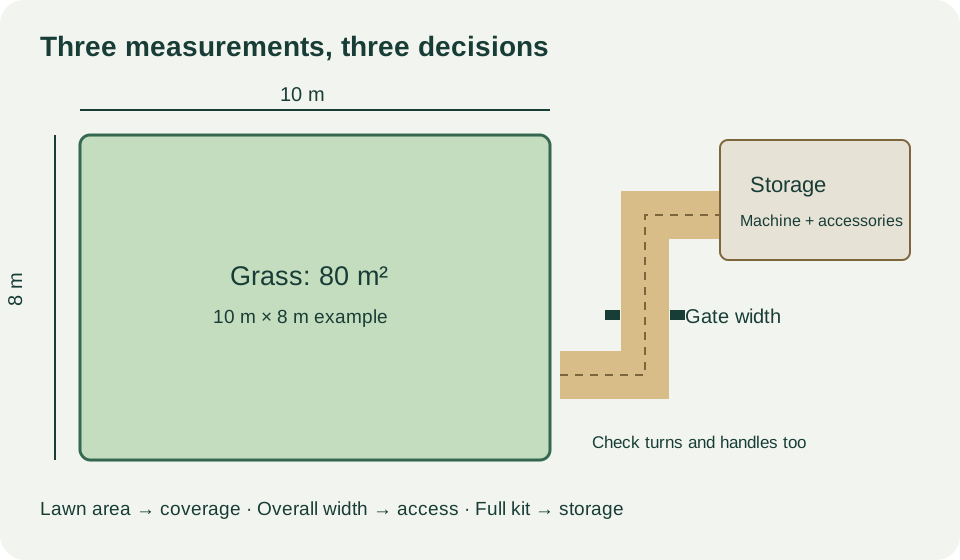
Cutting width is the span of grass cut in a pass. Overall machine width includes the housing and wheels. Access width is the usable gap through your gate or beside stored objects. These are not interchangeable measurements.
Measure the narrowest real route from storage to lawn, including gate hardware and any turn immediately before or after the opening. A mower can pass through a straight gap but still be awkward to turn into it.
Check the handle arrangement as well as the deck when assessing the route.
| Measurement | What it helps decide | Common mistake |
|---|---|---|
| Grass area | Published coverage and likely session scale | Using the whole property plot |
| Cutting width | Approximate number of passes | Treating it as overall machine width |
| Overall width | Gate and path access | Forgetting wheels and housing |
| Operating length | Turning and parking space | Measuring only the folded mower |
| Storage dimensions | Whether the complete kit fits | Leaving out the grass box and charger |
Leave practical handling clearance instead of planning a millimetre-perfect fit. The person moving the mower needs room for hands and feet. Do not assume the handle may be folded while moving or operating the machine; follow the instructions for that model.
What cutting width changes in practice
For a simple illustration, imagine mowing across an 8-metre-wide rectangular lawn with parallel straight passes. Suppose a 32cm cutting width is used with 4cm of overlap.
The effective new strip per pass is 28cm, so 8 ÷ 0.28 is approximately 28.6: about 29 passes. A 40cm width with the same illustrative overlap gives 36cm per pass, or about 23 passes.
Those figures explain the geometry; they are not mowing-time predictions. They exclude perimeter work, turns, missed patches, grass-box stops and any obstacles. Actual overlap depends on the machine and the operator.
A nominally wider mower can still take longer overall if it is awkward to manoeuvre or needs repeated repositioning.
Use this comparison to ask whether width solves a real problem. On an open lawn, fewer passes may be welcome. In a garden divided by planting beds, access and turning may matter more.
If your current difficulty is carrying a machine out of a shed, increasing deck width could worsen the task you dislike most.
Flymo's lawn-mower buying guide also highlights the relationship between cutting width and narrow passages.
Its advice describes its own range and should not be treated as a universal model specification.
Choose the power source around the route
A corded mower needs a suitable electricity supply and a safe cable arrangement reaching the whole working area. A battery mower removes that working cable but introduces charging, battery compatibility and coverage checks.
A petrol mower requires the fuel, servicing and storage arrangements specified by its manufacturer.
Start with the obstacles rather than a preference for one technology. If front and rear lawns are separated by a building, sketch both access and power routes.
If the only socket requires a cable across a shared walkway, that is a constraint to resolve, not an inconvenience to ignore. Outdoor electrical equipment and extension arrangements must be suitable for their intended use.
For a battery model, inspect what the quoted package includes. A bare machine may omit both batteries and charger. Some products require more than one battery to operate.
An existing battery bearing the same brand name does not establish compatibility; check the exact platform and approved pack list.
For petrol, count maintenance and handling as part of ownership. Consider whether you have a suitable place to keep the mower and fuel according to their instructions. Do not run a petrol engine indoors or in enclosed storage areas.
If these arrangements do not suit the property, a nominally capable machine is still the wrong purchase.
The dedicated battery versus corded comparison and battery versus petrol comparison address those ownership choices in more detail.
Worked garden A: a small lawn with awkward access
Consider a fictional 45-square-metre rear lawn reached through a passage and a right-angle turn. Storage is a small ground-level cupboard.
The main constraint is not mowing coverage: it is whether the complete mower can negotiate the turn and fit beside the grass box.
Make a cardboard footprint matching each shortlisted machine's published overall dimensions. Use it to investigate access while remembering that a flat template cannot represent handle height, weight or turning behaviour.
Then check those remaining details separately. This simple rehearsal can eliminate an unsuitable shape before comparing cutting specifications.
A smaller cutting width may be entirely reasonable here. If it adds a few passes but makes every setup and storage movement easier, that is a meaningful benefit.
A cordless option might simplify the working route; a corded option could remain viable if supply and cable routing are suitable. The garden description alone does not settle the choice.
The purchase worksheet should therefore put overall dimensions, handle storage, carrying instructions and complete-kit cost ahead of maximum advertised coverage. Ask the seller for missing dimensions rather than estimating them from a perspective photograph.
Worked garden B: open grass and a narrow gate
Now consider a fictional lawn measuring 12 by 15 metres, or 180 square metres, with largely straight runs. The gate is the bottleneck.
A wider cutting deck looks attractive because it reduces the number of passes, but the shortlisted machine must still pass through the gate with its housing and wheels.
Compare two candidates using actual overall widths. Add the collection box, handle and storage measurements to the same sheet.
If one model only fits when an accessory is removed, establish whether removal is intended to be a routine operation and whether you are willing to do it every session.
For battery candidates, compare published coverage for the supplied pack configuration and note the stated conditions. Do not convert the lawn's area into a guaranteed runtime. Longer grass, repeated turns and other operating conditions can change the result.
Plan what happens if the session exceeds one charge without assuming a spare battery is included.
This garden may justify a wider model, but only after the gate and ownership checks pass. Choosing by area first and checking access last is an expensive way to discover that a good mower is a poor match for your property.
Worked garden C: separate front and back lawns
A third fictional property has 30 square metres at the front and 95 at the back. There is a step between the storage area and the rear lawn, while the route to the front passes through a shared entrance.
Although the combined area is 125 square metres, the transfer route deserves as much attention as cutting capacity.
Check machine weight with the components you will actually move, not an ambiguous shipping or bare-unit figure. Find the manufacturer's carrying and transport instructions. Do not assume one person can safely lift a mower because it has a handle.
If the route needs lifting that the user cannot manage, change the equipment or storage plan.
Think through the order of the session: collect the machine, reach the first lawn, deal with clippings, transfer to the second lawn, clean as instructed and put everything away.
A machine that completes both lawns but makes those transfers unpleasant may be used less often than intended.
A written route rehearsal also exposes small omissions such as nowhere to leave the grass box or a charger positioned where it obstructs normal access. Resolve these before buying accessories to compensate for them.
Collection, mulching and the finish you want
Decide how you will handle clippings and confirm the model supports that method. Do not assume every mower can collect and mulch interchangeably. A mulching accessory may be optional, unavailable or subject to particular operating instructions.
For collection, assess removal and emptying as well as box capacity. A larger container can reduce stops but may be less convenient to handle when filled. Check the route to your composting or disposal area and follow local arrangements for garden waste.
Capacity is a useful specification, not a complete description of the task.
If a striped appearance matters, inspect a mower's actual roller arrangement and the manufacturer's explanation of its finish. A roller does not remove the need to consider access, power and handling.
The separate rear-roller guide helps decide whether that feature deserves a place on the shortlist.
Also compare the available height adjustments with your lawn-care plan. More settings are not automatically better if the adjustment is difficult to use.
Look for clear instructions and accessible controls rather than choosing solely from the number of positions printed in a comparison table.
Compare the complete purchase, not the headline price
Write a complete basket for each finalist: mower, required batteries, charger, any genuinely necessary approved accessory, delivery and foreseeable maintenance items. Keep optional purchases separate.
A lower machine-only price can be misleading when the equipment needed to operate it is missing.
Then record where each component will live. Battery charging requires the conditions specified by the charger and battery manufacturer. Fuel storage has its own requirements.
A folded handle can save space, but verify the permitted storage orientation; do not stand a machine upright just because a different model is advertised that way.
Check the seller's return conditions before outdoor use and understand the manufacturer's warranty and servicing arrangements. This is particularly relevant if access dimensions remain uncertain.
Keep the model number and written specifications with your shortlist so that you do not accidentally order a different package with similar photographs.
Questions to settle before ordering
Is a wider mower always faster? It covers a wider strip in a straightforward pass, but total session time also includes turning, emptying, setup and storage. Use the pass example to understand width, not to promise minutes saved.
Can one battery cover my lawn? Only the exact mower, approved battery configuration and actual conditions can answer that. Manufacturer coverage guidance is a starting point.
See battery mower runtime for a structured comparison.
Should I size the mower for the biggest occasional job? Include realistic difficult conditions, but do not buy a cumbersome machine for a task you rarely perform without considering hiring or another arrangement.
Balance frequent use against occasional demands.
What if the dimensions are missing? Request the overall operating and storage dimensions, not just cutting width. An unanswered access question should pause that purchase rather than become an optimistic assumption.
Use the lawn-mower finder to organise the shortlist once the measurements are ready.
Your final selection should satisfy the whole sequence: reach the lawn, operate within its instructions, complete the work, manage clippings and return to storage without a recurring workaround.
Continue researching