Buying guide
Do you need a rear-roller lawn mower? Stripes, handling and garden fit
A rear roller is worth considering when a striped finish is an important part of your lawn routine and the complete mower suits your garden. It is not a guarantee of a level lawn, a better cut or easy handling.
Compare roller design, drive, turning behaviour, cutting height and the machine's full weight before deciding.
The roller question is separate from battery versus petrol and from basic mower sizing. Both the finish and the physical garden need to work.
Use the mower finder to establish a suitable class, then use this guide to decide how much value the roller adds to that shortlist.
What the rear roller contributes
A rear roller passes over the grass behind the cutting area and lays it in the direction of travel. Alternating the direction of adjacent passes produces the familiar striped appearance.
The visible effect is not created by intentionally cutting one stripe lower than the next. It depends on the way the grass lies and how it is viewed.
The RHS mowing guide identifies a rear roller as the equipment used for striping and recommends varying cutting direction to avoid repeatedly following the same routes.
That matters because a good-looking pattern should remain part of sensible lawn care, not become a reason to keep tracking exactly the same lines indefinitely.
A roller also changes the mower's contact with the ground and its handling. The practical effect depends on the whole design. Do not assume a small trailing striping roller on a light mower behaves like a substantial driven rear roller on another machine.
The shared word “roller” conceals important differences.
Identify the roller arrangement
Look at the actual machine, not just a side-on product photograph. Establish whether the rear roller is integral or an optional attachment, whether it provides drive, and whether it is a single piece or split into sections.
Check the manual for adjustment, cleaning and maintenance requirements.
For a documented example, Hayter's roller range includes push and self-propelled machines. Its description also distinguishes two-piece rollers on particular models.
This demonstrates that owning a roller does not itself tell you whether the machine will propel itself or how its turning arrangement works.
If an accessory roller is proposed, confirm compatibility with the exact mower. A generic attachment may interfere with guards, collection, movement or storage. Do not modify safety equipment or add improvised ballast to intensify stripes.
The approved design and its operating limits take priority over appearance.
Roller and non-roller comparison
Compare complete machines intended for similar lawns. The table gives questions to investigate rather than universal claims that every model behaves the same way.
| Decision | Rear-roller candidate | Non-roller candidate |
|---|---|---|
| Desired appearance | Investigate its striping arrangement | Decide whether the cut finish is enough without deliberate stripes |
| Tight turns | Try the exact roller and drive behaviour | Try the wheelbase and steering effort |
| Moving to storage | Check full dimensions and lifting points | Check full dimensions and lifting points |
| Edge work | Verify manufacturer technique and support | Verify wheel position and suitable edge technique |
| Maintenance | Include roller and any drive components | Include wheels and any drive components |
| Main purchase reason | A suitable cut plus valued presentation | A suitable cut with other priorities taking precedence |
This comparison avoids two common shortcuts. A roller model is not necessarily petrol-powered, and a non-roller machine is not necessarily lighter or cheaper in every matched pair.
Get the relevant specification and complete package price before making those claims.
Be realistic about the finish
Striping is a presentation effect layered onto the lawn you already have. Bare patches, uneven density and irregular boundaries do not disappear when a roller passes over them.
If the lawn is struggling, buying a heavier roller mower is not a substitute for identifying the underlying cause.
The appearance also changes with viewpoint and lighting. A pattern that is obvious from an upstairs window may appear less distinct from the patio. Before paying substantially more for stripes, decide where you actually want to see them.
This is particularly useful in small gardens where the main viewing direction is fixed by the house.
Do not promise yourself a particular photographed finish from an equipment badge. Marketing photographs combine a specific lawn, preparation, weather, viewpoint and mowing pattern.
Your decision should be whether you value making a deliberate pattern, not whether the machine can reproduce someone else's photograph under all conditions.
Keep cutting height separate from stripe contrast
Use the cutting height appropriate to the lawn and conditions, within the mower's instructions. Do not lower the blade simply because the stripes seem faint.
The finish you want should be achievable within appropriate mowing practice, rather than by repeatedly scalping the lawn.
The RHS seasonal lawn advice recommends raising cutting height or pausing mowing during hot, dry conditions. That is a useful reminder that presentation preferences may need to change with conditions.
The mower's lowest setting is an available mechanical position, not a year-round target.
For a comparison in a showroom, check how height adjustment works and whether the full range suits your intended lawn care. A roller may attract your attention, but an awkward adjustment mechanism will affect every change of season.
Confirm whether height changes require separate adjustments and how the instructions describe them.
Work out the pattern before choosing the machine
Sketch the lawn outline, obstacles and viewing direction. Straight uninterrupted runs are easier to plan than short strips interrupted by trees or beds. Mark where turns can be made without entering borders or creating an awkward reverse manoeuvre.
Use the mower's permitted operating method when planning those turns.
For an illustrative 8-by-12-metre rectangular lawn, imagine a mower that provides an effective 40-centimetre strip after allowing for overlap. Across the 8-metre dimension, approximately 20 passes cover the width.
At 12 metres per pass, that is about 240 metres of straight travel before turns and perimeter work. These figures describe layout only, not mowing time or energy consumption.
Turn the pattern through 90 degrees and the same approximate straight travel remains, but there are roughly 30 shorter passes and more turns.
That difference helps explain why the pattern direction can change handling demands even when the grass area is identical. The best-looking orientation may not be the quickest or easiest one.
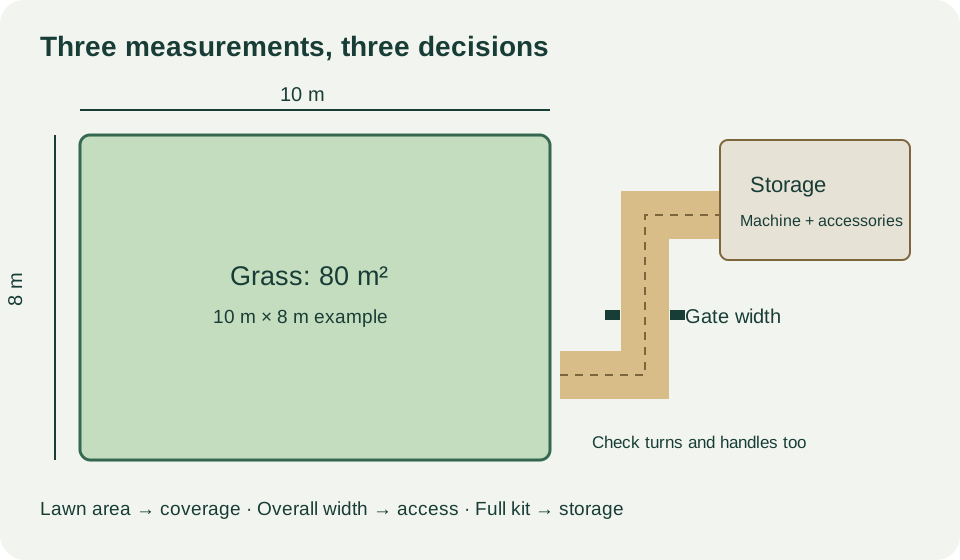
Worked case: a formal rectangle
Consider a fictional gardener whose main lawn is a simple rectangle viewed from a rear window. They cut regularly, value stripes and have level access to a storage space.
A roller mower has a clear purpose here, provided the whole machine is comfortable to use.
They shortlist two roller designs with similar width and compare push versus self-propelled handling. During a dealer demonstration they ask about turning at the end of a pass, disengaging drive and removing the collection box.
They also measure the packed footprint because a long handle can make a mower difficult to store even when its deck width fits the door.
The decision is not automatically the heavier machine. If the lighter option produces the kind of finish they want and is easier to manage, it may be preferable.
A heavier model would need a demonstrated practical benefit for this gardener, not an assumption that weight alone guarantees better stripes.
Worked case: an irregular family garden
A second fictional lawn curves around a play area and two beds. The owner mostly wants tidy grass and a machine that is easy to retrieve. Long uninterrupted stripes would occupy only a small part of the lawn, while many passes end at obstacles.
This owner compares a roller model against a suitable non-roller mower, focusing on manoeuvring, storage and collection. If the roller makes the repeated turns awkward and striping is a minor preference, the non-roller machine may be the better fit.
That is an honest trade-off rather than a failure to buy the “better” finish.
If they still prefer stripes, they can plan a simple pattern in the open central area without requiring every corner to follow it.
The buying question becomes whether the extra presentation value is worth the handling and cost difference in their actual garden. The main sizing guide covers those physical constraints in more detail.
Edges require a stable operating method
A wide rear contact area can influence how a mower feels near an edge, but do not treat a roller as permission to overhang unsupported ground. Check the exact manual and inspect the border.
Crumbling edges, abrupt drops and changes of level require an appropriate approach regardless of roller design.
Where the mower cannot safely reach, use an appropriate separate edging method. A narrow strip left for another tool is preferable to making the mower unstable to eliminate every final blade of grass.
The purchase should be judged on the full maintenance routine, including realistic edge work.
If edge cutting is a major concern, ask the dealer to explain the documented technique for that model. Compare the distance from the cutting area to the side of the machine and the practical access around raised beds.
Marketing language about close cutting is not a measured guarantee that it will fit every border.
Slopes and uneven ground are separate suitability checks
Neither a roller nor self-propulsion establishes that a mower is suitable for a slope. Follow the manufacturer's gradient limits and instructions for direction of travel and traction. The operator's footing and the ground condition are part of that assessment.
Similarly, a roller is not a garden-levelling machine. If there are hollows, humps or abrupt transitions, assess the mower's ability to pass them at the intended cutting height without damage.
Correcting a lawn's surface is a separate job requiring appropriate advice; repeatedly pressing a mower over a problem is not a reliable repair method.
During selection, describe the difficult parts of the garden honestly. A demonstration on a flat showroom floor can establish control layout and size but cannot reproduce every outdoor condition.
If a candidate's suitability remains uncertain, obtain model-specific advice rather than assuming the roller will stabilise it.
Maintenance and cleaning around the roller
Read how the manufacturer wants grass and debris removed around the roller, bearings and drive components. Stop and isolate the machine exactly as instructed before cleaning or inspection.
Do not reach around moving parts or improvise a cleaning method because the roller appears separate from the blade.
Check whether spare parts and servicing support are available for the exact model. A rear roller can be a durable part of a mower, but its bearings, drive or surrounding components are still part of the maintenance system.
For petrol models, Hayter's maintenance advice provides an example of the wider ownership tasks beyond the roller itself.
Keep the manual and model identifier with your records. If handling changes, unusual noise develops or the machine stops tracking normally, investigate through the manual or service support.
Do not add weight or alter drive adjustments as a guess at improving stripe appearance.
Budget for the finish you actually value
Compare current quotes for equally suitable complete machines. Separate any premium for the roller from differences in propulsion, deck construction, width, battery capacity or starting system.
Otherwise you may attribute a large price gap to striping when several other features account for it.
As an illustrative decision, suppose two matched packages differ by £150 and you expect five years of use. That is £30 per year before maintenance or resale differences.
This invented calculation does not tell you whether the premium is worthwhile; it gives you a clear amount to weigh against the enjoyment and effort of maintaining the finish.
If the budget is tight, fund a mower that fits the lawn and can be maintained first. A roller becomes a sensible extra when appearance is an established priority.
Do not sacrifice essential access, handling or required battery capacity for a feature you only occasionally intend to use.
Rear-roller questions
Does a roller cut the stripes into the lawn?
The blade cuts the grass; the roller influences how the grass lies. Adjacent passes in different directions create the appearance. Deliberately alternating blade heights is not the normal way to produce stripes.
Do I need petrol power for stripes?
No. Power source and roller arrangement are separate characteristics. Find a suitable complete model, then assess its battery or petrol ownership requirements using the power-source comparison.
Can I add a universal roller to any mower?
Only use an attachment approved for the exact machine and follow its fitting instructions. Physical fit is not enough if it affects guards, stability, movement or collection. Check before ordering or modifying anything.
Will a rear roller flatten bumps?
Do not buy it as a substitute for assessing and correcting uneven ground. Its role in a mowing system does not establish that it can safely reshape the lawn. Ground preparation and mower selection are different tasks.
Why are my stripes less visible from another angle?
The effect depends on the direction the grass lies relative to the light and viewer. Plan around the main viewpoint, while varying mowing direction as appropriate. Faint stripes from one position do not alone prove a fault with the mower.
Is self-propulsion essential with a roller?
No universal rule applies. Consider the complete machine's weight, terrain, pace and the operator's handling needs. A practical demonstration is more informative than choosing solely from the words push or self-propelled.
Continue researching