Buying guide
Cordless-tool battery compatibility: check your exact system
Find out which battery system your cordless tool uses, why matching voltage is not enough, and how to check the tool and charger before buying.
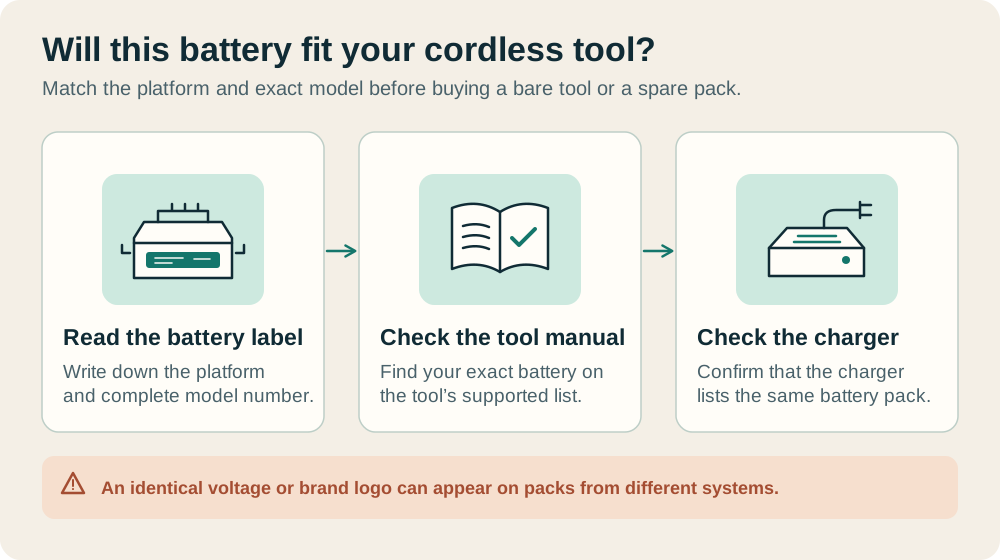
Match a cordless battery to the exact tool platform, then check the model's instructions. The same brand name or voltage on two products does not establish compatibility.
A battery must belong to the supported system, and the charger needs its own compatibility check.
This matters most when buying a bare tool, adding garden equipment to a drill kit or replacing an older pack. “I already own an 18V battery” is a useful starting point, but the next question is which 18V battery.
The platform name and model number are the details that turn a guess into a sensible purchase.
Use the battery compatibility checker to compare the systems, then confirm the exact combination in the manufacturer's documentation.
This guide explains the common traps and how to build a practical kit without buying unnecessary batteries or chargers.
Read three labels, not one
Find the tool model, battery model and charger model. Photograph their labels if the print is small or the items live in different places. Keep the full model code, including suffixes where shown, rather than copying only the large brand name from the casing.
Next, identify the platform name. Examples include POWER FOR ALL, AMPShare, ONE+, LXT, XGT and CXT. These names describe systems within or across brands. They are more useful for compatibility than a broad description such as “cordless garden range”.
| Item | Information to record | Question it answers |
|---|---|---|
| Tool | Exact model, platform, required battery arrangement | What can power this tool? |
| Battery | Model, platform, voltage, capacity | Which pack do I actually own? |
| Charger | Model, supported packs, input supply | Can this charger charge that battery here? |
| Proposed purchase | Bare tool or kit, included model numbers | What will arrive in the box? |
If the battery label is unreadable, do not identify it by colour alone. Look for original paperwork or ask the manufacturer using clear photographs and any remaining markings.
A confident answer based on the wrong model is less useful than pausing a purchase until the identity is clear.
Why matching voltage is not enough
Voltage is one number to check. You still need the supported battery platform and exact pack listed for the tool.
It does not tell you the shape of the battery rails, the contact arrangement, the supported electronics or the manufacturer's intended combination. Two packs marked 18V can belong to entirely separate systems.
Two tools can look alike in a shop listing and still belong to different generations or markets. Read the model number on the tool itself and use it to find the right manual.
The drill voltage guide explains how voltage fits into choosing a drill.
For battery sharing, however, the order is simpler: establish the platform first, then check the supported pack and any model-specific requirements. More voltage is not an upgrade you can apply by choosing a different battery at random.
Bosch green and Bosch Professional are different systems
Bosch's POWER FOR ALL system and its Professional 18V system are a common source of confusion because both carry the Bosch name and use 18V packs. They should not be treated as interchangeable.
Bosch explicitly says that AMPShare-compatible tools do not work with POWER FOR ALL 18V batteries.
Its AMPShare information also explains that Bosch Professional 18V batteries and chargers are part of that professional system, including supported older products without the newer alliance label. Bosch AMPShare compatibility information.
POWER FOR ALL is a separate alliance spanning participating home and garden products. Check that the particular product is identified as part of the system; a partner brand can also sell products outside it.
The alliance's own technology page describes its compatibility scope and notes the need for products to have been converted to the platform. POWER FOR ALL battery technology.
In practical terms, somebody who owns a Bosch DIY drill should record the battery's platform before ordering a Bosch Professional bare tool. Somebody buying a garden tool from another alliance member should look for the platform marking on that exact model.
The logo on the shop sign is not the relevant boundary.
One brand can contain several battery families
RYOBI separates its 18V ONE+, 36V MAX POWER and 4V USB Lithium systems. Its UK battery guide explains that the different voltage ranges and their chargers are not interchangeable.
Owning a ONE+ drill therefore does not mean every RYOBI garden tool can use its pack. RYOBI batteries and chargers guide.
Makita similarly distinguishes CXT, LXT and XGT.
Its manufacturer FAQ describes CXT 12V max, LXT 18V and XGT 40V max as separate cordless systems, with some higher-voltage tools using two packs from their own system. Makita cordless system FAQ.
| Familiar name on the product | Detail that still needs checking | Buying implication |
|---|---|---|
| Bosch | POWER FOR ALL or Professional/AMPShare | Do not cross the two systems |
| RYOBI | ONE+, MAX POWER or USB Lithium | Match the named range and charger |
| Makita | CXT, LXT or XGT | Keep tool and pack within the supported system |
| An alliance member brand | Exact model's alliance participation | Brand membership alone is insufficient |
This table is a starting map, not a complete list of every current or discontinued tool. Keep the model manual as the final check, particularly for older equipment and specialist products.
A charging adapter is not a tool adapter
The word “adapter” needs careful reading because it can describe different jobs. An accessory that lets a charger accept another supported battery does not necessarily let that battery power a tool from the charger's usual platform.
For example, Makita's UK specification for the DC40RC XGT charger lists the optional ADP10 adapter for charging LXT batteries. That is a documented charging arrangement.
It does not state that an LXT battery can run an XGT tool. Makita DC40RC charger specification.
Keep two questions separate on your shopping list: “Will this pack run the tool?” and “Will this charger charge the pack?” A product page might answer one clearly and say nothing about the other.
Do not treat an unapproved third-party adapter as proof that two systems are compatible. Physical connection alone cannot establish that the intended protections and operating requirements are preserved.
If the combination is not supported by the relevant manufacturers, choose a supported battery and tool arrangement rather than modifying rails, contacts or latches.
What changes when a tool uses two batteries?
Two battery slots can mean different things. A tool may need both packs together to operate, switch between packs, or provide a storage position for a spare. Read the model's instructions rather than inferring the arrangement from a photograph.
Some Makita LXT tools use two 18V packs for an 18V X2 system. That does not turn every 18V tool into a two-pack tool, nor make a single pack from another voltage family a substitute. The designed arrangement belongs to the tool.
Check the instructions for permitted pack combinations, capacity requirements and charge condition. If a matched pair is required or recommended, include that in the purchase plan.
Remember that two working packs may also require a suitable charging routine before the next session.
For a mower, count the batteries needed for one complete operating set before calculating the value of a kit. A box containing two batteries is not necessarily “one battery plus a spare”.
The battery mower runtime guide explains how pack arrangement and charging affect finishing the lawn.
Capacity changes the working plan, not the platform
Amp-hours describe battery capacity. Within a supported platform, a larger-capacity pack may be useful for longer tasks, but it can also change the tool's weight, balance and physical clearance.
Compatibility and convenience are related questions, rather than identical ones.
For a simple energy comparison, an 18V 2Ah pack represents a nominal 36Wh, while an 18V 4Ah pack represents 72Wh. That is double the nominal stored energy. It does not promise exactly double the runtime in every tool or working condition.
Consider a drill used for short tasks around the house and a garden tool used continuously for longer stretches. The smaller supported pack may make the drill easier to handle, while a larger supported pack may be more useful outdoors.
You can share a platform without insisting on using the same pack for every job.
Check any manufacturer guidance about recommended batteries for demanding tools. A pack that is supported may not deliver the performance or working duration you expect from the tool's headline demonstration.
Look at the battery used in the specification or test conditions before comparing claims.
A worked purchase check for a bare tool
Imagine Alex owns a drill, two batteries and a charger. A bare hedge trimmer appears attractive because the brand matches.
Before comparing the price with a kit, Alex photographs the labels and discovers that the drill and trimmer belong to different battery families.
The bare-tool price now needs a compatible battery and charger added. Alex compares that complete cost with a trimmer in the existing supported platform and with the manufacturer's kit.
This changes the comparison from three incomplete prices to three usable setups.
Now imagine the trimmer does belong to the same platform. Alex still checks the recommended pack, the battery's physical clearance and whether the current packs provide a sensible working session.
The existing charger may be compatible but inconvenient if both batteries take turns on it after a long garden job.
The useful outcome is a small list of what is already covered and what is missing. It may be sensible to buy the bare tool, or a kit may fill a real gap. Neither answer follows from the phrase “one battery system” alone.
Check kit contents before comparing value
Retailers may offer the same tool as a body only, a single-battery kit or a bundle with several packs and a charger. Read the model numbers and capacities of the included items.
Product photographs sometimes show accessories that are optional or belong to a different bundle.
Build your comparison around the equipment needed to do the job. Include the required number of packs, the appropriate charger and any essential accessories.
Do not count a duplicate charger as a saving unless a second charging location or faster turnaround would actually help you.
Also consider the next likely tool, rather than every tool you might someday own. A platform with a suitable drill and the garden tool you already need may be more useful than a huge catalogue containing little you expect to buy.
The guide to choosing a drill helps keep the first purchase tied to real tasks.
For occasional use, keeping two separate systems can be reasonable if each solves a particular job well. Sharing batteries is a convenience to weigh alongside tool suitability, handling and complete cost.
It does not need to become the main objective of every purchase.
Keep a small compatibility record
Make a note with a row for each tool and the supported battery and charger models. Add a link to the manual or official compatibility page.
This is particularly helpful when family members share tools or when similar-looking batteries live in the same cupboard.
Label storage locations by platform, keeping the product labels visible. When buying second-hand equipment, ask for photographs of the actual model labels and included parts.
A seller's description such as “fits all our tools” does not identify the range they own.
If a manual is missing, use the manufacturer's support service rather than trying combinations until something clicks into place. Explain the exact tool, battery and charger models in one message.
That gives support enough information to answer the question you actually need resolved.
Will any 18V battery work in an 18V tool?
No. The voltage needs to be appropriate, but the supported platform and model combination also need to match. Look for explicit manufacturer compatibility rather than a similar casing or a connector that appears close enough.
Can I use a higher-capacity battery in my drill?
Often there are several supported capacities within a platform, but check the drill and pack documentation. Also consider weight and clearance. A large pack that is excellent for a long garden task may be cumbersome for a short job inside a cupboard.
Can I charge a battery with another brand's charger?
Only where the exact charger and battery are supported together, such as a documented shared platform arrangement. Different brands can share an approved system, while products carrying the same brand can belong to incompatible systems.
Check charging compatibility explicitly.
What is the quickest reliable check before ordering?
Put the tool model, battery model and charger model side by side. Confirm their named platform and the manufacturer's supported combination, then check the kit contents.
Once those details line up, you can compare capacity, handling and price without discovering afterwards that the battery you already own belongs to a different family.
Keep exploring
Related drill guides
 What voltage drill do I need? Platforms, batteries and practical capabilityInterpret nominal and maximum voltage, verify battery platforms and compare complete drill setups using energy examples and three buying scenarios.What drill do I need? A task-first guide to your first complete kitMatch household jobs to drill drivers, combis and specialist tools, then check bits, access, batteries and complete-kit costs using three worked project cases.
 Battery lawn-mower runtime: energy, area claims and charging plansRead battery energy and conditional lawn-area claims, calculate illustrative runtime and model spare-pack charging without inventing tested mowing results.