Buying guide
What drill do I need? A task-first guide to your first complete kit
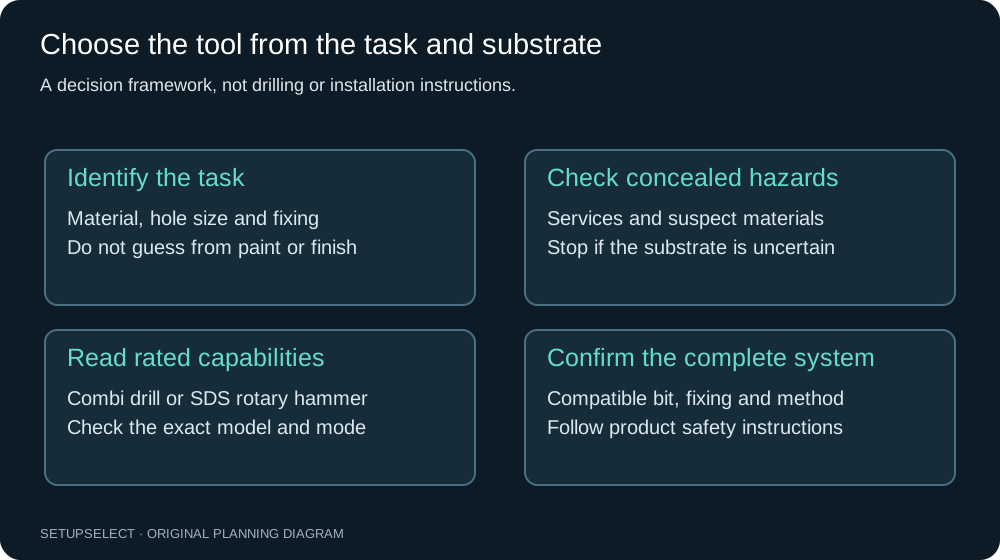
Choose a drill from the jobs you can describe, not from the largest voltage or torque number. For screws and suitable wood or metal holes, start with a drill driver. Add a combi drill to the shortlist when appropriate masonry drilling is a real requirement.
Investigate an SDS rotary hammer for concrete or other work that calls for that specialist mechanism. An impact driver is primarily a fastening tool and is a different purchase decision.
The most useful first purchase is a complete working setup: the right tool class, compatible battery and charger where needed, appropriate bits and a way to support the work. The drill finder can organise those requirements.
This guide explains how to define them without buying a collection of overlapping tools before you know the tasks.
Write a job list with materials and sizes
“DIY around the house” is too broad to identify a drill. Replace it with specific work: assemble a wardrobe, drill pilot holes in timber, make holes in sheet metal, fit a curtain rail to a known substrate, or drive repeated screws into a garden project.
Record the hole or screw size and the expected quantity where you know them.
Separate confirmed jobs from possibilities. A dozen furniture screws this month and a speculative future extension are not equally strong reasons to choose today's tool.
You can hire, borrow or buy specialist equipment when a real project establishes its requirements. That is particularly useful when one rare task would otherwise make the everyday tool unnecessarily large.
For walls, establish the substrate and the fixing requirements before choosing equipment. A painted finish does not tell you whether the material behind it is plasterboard, brick or concrete.
Tool selection does not determine whether a wall can support a proposed load. The fixing system and the building need their own assessment.
Match the tool class to the work
| Main requirement | Tool class to investigate | What still needs checking |
|---|---|---|
| Furniture screws and suitable ordinary holes | Drill driver | Control, access, bit fit and rated capacities |
| Mixed ordinary drilling plus suitable occasional masonry | Combi drill | Hammer mode, masonry rating and substrate |
| Repeated demanding concrete holes | SDS rotary hammer | SDS system, rated range and appropriate dust controls |
| Repeated compatible fastener driving | Impact driver | Fastener approval, impact-rated accessories and control |
| A single specialist operation | Hire or specialist help | Correct equipment, instructions and competence |
These are starting categories, not permission to perform every task associated with a material. The exact model and accessory must support the intended operation.
A compact drill driver and a large drill driver can have very different capacities despite sharing a category name.
The combi versus drill-driver guide develops the first two choices. For harder masonry, use combi versus SDS.
That specialist guide covers a separate mechanism and should be read before treating a combi's hammer symbol as evidence that it can replace every rotary hammer.
Distinguish drilling from driving
Drilling removes material to create a hole. Driving turns a fastener into or out of a material or threaded connection. A drill driver combines these tasks, but their control needs differ.
For fastening, excessive force can damage the screw head, thread, fitting or surrounding material. For drilling, the bit, material, diameter and speed requirements matter.
A numbered clutch ring is useful for controlled fastening when used according to the manual. It is not a calibrated torque wrench. A gear selector changes the operating range, and a trigger commonly provides variable speed within that range.
Learn how the particular model separates mode, gear and clutch controls before assuming every ring does the same thing.
The Bosch UniversalDrill operating instructions show a concrete example with separate drilling and screwdriving settings.
The important purchase question is whether the controls support your tasks and are understandable in use. For the rating terminology, see drill torque explained.
Read rated capacity instead of inventing a power score
Look for manufacturer capacities in the actual materials you plan to drill. Keep diameter, material and any gear or bit conditions together.
A maximum drilling diameter is not a promise that every bit shape, depth and material variation at that diameter will be equally easy.
For a documented compact example, Bosch's GSR 12V-15 information identifies separate wood and steel capacities. This illustrates why a voltage badge alone cannot describe the work.
Read the exact specification rather than assuming all tools in that voltage class share one capability.
Also avoid multiplying voltage, torque and speed into an invented overall ranking. These fields describe different aspects of the system and may be measured under different conditions.
A purchase decision is clearer when it says “supports the specified hole in this material” than when it claims a tool is a certain percentage more powerful without a comparable test.
Bits are part of the purchase
List the bit types and sizes needed for the first projects. Check both the working end and the shank that fits the tool.
A chuck's capacity does not describe the diameter of every hole the drill can safely make; a large cutter may have a smaller shank while still demanding more from the tool than its rating permits.
For screwdriving, identify the exact screw recess rather than choosing a vaguely similar bit. For drilling, choose a bit intended for the material and permitted operating mode.
An accessory pack with many pieces is not necessarily useful if it omits the few correct bits you need.
Ask whether a bit holder is needed and how it affects reach. A long holder may help in one recess but make another space inaccessible. Keep the initial kit focused, with appropriate replacement bits for frequently used sizes.
Expanding from real projects is more economical than judging a set by its piece count.
Access and handling can decide between suitable drills
Measure the working space, including the bit and holder. Tool body length alone can be misleading inside a cabinet.
Consider whether the battery protrudes into an adjacent panel and whether your hand can reach the trigger and direction switch while keeping the tool aligned.
Handle candidates with the intended battery fitted. A body-only weight does not describe the complete tool in your hand. Check grip comfort, balance and the visibility of the working point.
A large battery may extend available energy but also change access and handling; the biggest included pack is not automatically the best fit for every project.
Do not choose an awkward full-size drill solely for a possible future heavy task if almost all current work is in tight spaces. Conversely, do not choose a tiny tool that lacks the rated capability for confirmed jobs.
The useful compromise is the smallest convenient setup that actually supports the work, with specialist needs handled separately.
Worked case: assembling and adapting furniture
A fictional first-time buyer has two flat-pack units to assemble and wants to drill a few holes in a separate timber project. They do not have confirmed masonry work.
Their priorities are controlled screwdriving, suitable wood-drilling capability and access inside the furniture.
They compare compact drill drivers, checking the manufacturer's capacity, clutch functions and complete-tool dimensions. They also keep the furniture instructions in view: some fittings may specify hand assembly or careful final tightening.
Owning a drill does not mean every supplied fitting should be driven at full trigger speed.
Their initial basket contains the complete tool kit, the correct screwdriver bits, the specified wood bits and suitable workholding equipment. A large masonry-bit set and an impact driver are not automatically necessary.
If a later wall-mounting job appears, they identify the wall and fixing requirements before deciding whether another tool is needed.
Worked case: a mixed household project list
A second buyer plans furniture assembly, timber pilot holes and several fixtures in known masonry. After checking the fixing system and substrate, they find the proposed holes fall within a suitable combi drill's intended capability.
A combi now has a clear role beyond ordinary drilling.
They compare it with a drill driver plus occasional access to another tool. The decision depends on how often the masonry work will recur, the complete cost and handling.
If the combi is equally convenient for ordinary tasks and the hammer function is genuinely needed, one versatile tool may be sensible.
If investigation instead reveals a concrete task better suited to an SDS rotary hammer, they revise the plan.
Buying a higher-voltage combi without addressing the mechanism would not answer the new requirement. The SDS comparison explains that branch of the decision without making the entire first-tool purchase revolve around it.
Worked case: repetitive fastening
A third buyer already owns a drill driver and plans a project with many compatible screws. They find that switching repeatedly between drilling and driving is inconvenient.
An impact driver may be worth investigating as a second tool, especially if the fastener instructions permit that method.
The first step is still to identify the screws, pilot-hole requirements and material. The impact driver's larger advertised torque is not a reason to abandon those instructions.
They compare low-speed control, accessory fit and the ability to keep the drill set up for holes while the driver handles fastening.
The useful benefit here is a workflow with two prepared tools, not the idea that an impact driver replaces ordinary drilling. Impact driver versus combi drill explores that specific division and its limitations.
Decide whether a battery platform helps
If you already own batteries, record the exact platform and model identifiers before shopping. Brand and voltage alone do not prove interchangeability.
Some manufacturers have separate consumer and professional systems, and chargers can have their own compatibility restrictions.
When starting from nothing, compare complete kits with appropriate batteries and chargers. A low body-only price is not comparable to a ready-to-use kit.
Consider only future tools you are likely to need, rather than treating the longest possible product catalogue as a reason to spend more now.
The drill-voltage guide covers platform labels, nominal versus maximum voltage and energy calculations.
For the first purchase, the practical question is simpler: does the complete system support the confirmed jobs and fit how you will store and charge it?
Include preparation equipment in the budget
A drill purchase does not eliminate the need to measure, mark and support work accurately. Set aside money for the task-specific bits, suitable workholding and required protective measures.
For fixtures, include the correct fixing system; do not assume miscellaneous plugs in a bargain kit suit the substrate and load.
As an illustrative allocation, divide a hypothetical £150 allowance into £105 for a complete tool kit, £20 for the specific bits and £25 for project-specific support or accessories. These are budgeting buckets, not current price claims.
If real quotes exceed one bucket, revise the plan before sacrificing a necessary item to keep the drill badge you first liked.
The right balance depends on what you already own. Someone with clamps, measuring tools and batteries starts in a different position from a complete beginner. Inventory existing equipment first, then spend on the missing parts of the actual job.
Safety checks belong before the first hole
Read the tool and accessory instructions and understand the material being worked. Check for concealed services and hazardous materials before drilling into walls or other blind areas.
If the substrate or consequences are uncertain, obtain qualified help; a detector reading alone is not a complete structural or material assessment.
Bosch's drill safety instructions illustrate the importance of correct gripping and appropriate handling of long bits.
Use the instructions for your exact model, including work support, protective equipment and any auxiliary handle. This buying guide is not a substitute for a safe task-specific method.
After purchase, learn the controls on suitable practice material for the planned operation, within the instructions. Confirm how to stop, isolate the tool for bit changes and recognise warning indicators.
Familiarity is useful; experimentation in an unknown wall is not an appropriate substitute.
First-drill questions
Can a combi drill drive screws?
Many are intended to, using their screwdriving mode and appropriate settings. Confirm the manual and turn off masonry percussion for fastening. The presence of hammer mode does not require using it for every job.
Do I need an impact driver with my first drill?
Not automatically. It becomes useful when compatible repetitive fastening or a two-tool workflow is a real need. For a small mixed household list, first establish whether one suitable drill driver or combi covers the jobs.
Is a brushless motor essential for occasional DIY?
It is one design feature, not a substitute for correct tool type and complete-kit value.
Compare capability, control, handling and support. Brushless versus brushed drills explains when the motor distinction can justify a premium.
Should I buy the highest torque I can afford?
Only when a documented requirement makes that capability relevant. Small fasteners and confined work often prioritise control and access. Maximum torque also needs its measurement definition before comparing models.
What should be on my final shopping note?
Write the exact tool, battery and charger identifiers; the required bits; the confirmed tasks and materials; complete price; and any unresolved compatibility question.
A short evidence-based list is easier to buy from than an aspiration to own the most powerful drill.
Continue researching