Buying guide
Combi drill vs drill driver: when is hammer mode worth having?
A drill driver is intended for screwdriving and ordinary rotary drilling. A combi drill adds a percussion or hammer-drilling mode for suitable masonry tasks.
If your work is furniture, timber and metal within the tool's ratings, the extra mode may not be necessary. If suitable masonry holes are a regular part of your work, a combi can combine those jobs in one tool.
The key word is suitable. A combi's hammer function does not make it equivalent to an SDS rotary hammer, and a product name does not establish capacity.
Use the drill finder to shortlist from actual tasks, then compare the exact models and operating instructions.
The practical difference is an additional mode
Both tool classes can offer a chuck, variable speed, gears and a fastening clutch. Their individual specifications may differ, but those features are not exclusive to combis. The extra masonry percussion function is the defining distinction in this comparison.
When using a combi for wood, metal or screwdriving, select the appropriate non-percussion mode described by its manual. Buying an additional function does not mean using it all the time.
Clear mode markings matter because accidentally leaving the tool in the wrong setting can spoil work or conflict with accessory instructions.
The Bosch UniversalDrill and UniversalImpact operating instructions show the distinction in one related pair: the UniversalDrill provides drilling and screwdriving selections, while the UniversalImpact adds impact drilling.
This is a model example, not a promise that all brands arrange their controls identically.
Compare a documented pair carefully
Bosch's technical data for the same pair lists 13 mm chucks, 35 mm maximum wood drilling and 13 mm steel drilling for both.
The UniversalImpact additionally has a 13 mm masonry figure, while the UniversalDrill's masonry field is blank. These are the manufacturer's rated figures for those models.
| Specification in the documented example | UniversalDrill 18V-60 | UniversalImpact 18V-60 |
|---|---|---|
| Chuck capacity | 13 mm | 13 mm |
| Maximum wood drilling diameter | 35 mm | 35 mm |
| Maximum steel drilling diameter | 13 mm | 13 mm |
| Maximum masonry drilling diameter | Not listed | 13 mm |
The comparison is useful because it separates the added mode from assumptions about every other task. It does not prove equal drilling speed, identical handling or equal performance with every bit.
Those would require further specifications or controlled testing. It also does not mean that a hole below the maximum diameter is automatically appropriate in any material that looks like masonry.
Match the extra function to a real job
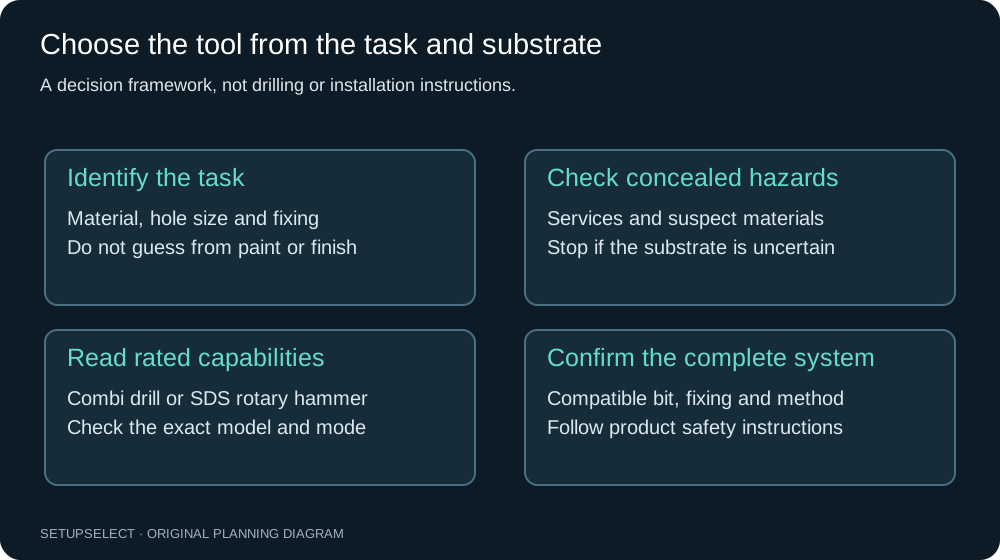
List the jobs for which you would actually select hammer mode. Include the substrate, hole diameter, depth, quantity and fixing requirements. If you cannot name any, the combi's extra function is a possibility rather than a current requirement.
That may still be worth having, but its value should be judged honestly.
If the list includes walls of uncertain construction, investigate them first. Surface plaster and paint can hide very different materials. A combi purchase does not resolve uncertainty about services, hazardous materials or load-bearing suitability.
The choice of fixing and installation method remains a separate decision.
For confirmed concrete work or a larger repeated masonry workload, read combi versus SDS. This guide deliberately concentrates on the smaller decision between ordinary drilling and adding conventional percussion.
Escalating voltage or torque within the wrong class does not necessarily solve a mechanism mismatch.
Ordinary drilling still needs the correct bit and mode
For timber and metal, compare the tool's rated capacity with the accessory and task. Choose a bit intended for the material and follow its speed and operating instructions.
A combi in ordinary drill mode can be relevant here, but the hammer function provides no general reason to expect a better hole.
Chuck capacity refers to the shank it can hold. It is not a blanket approval for every cutter with a shank that fits. A large hole saw may fit the chuck while exceeding the tool's intended capacity or requiring a different operating setup.
Check the complete combination rather than using physical fit as the only test.
Also consider smaller bits. A larger maximum chuck capacity is not the only useful number; find the minimum clamping range if fine work is important.
A set containing bits too small for secure retention is not made suitable by tightening harder or improvising packing around the shank.
Screwdriving depends on control
When fastening is most of the workload, compare clutch behaviour, trigger response, access and balance. A hammer mechanism is not a fastening benefit by itself.
Some buyers will prefer the feel of one drill driver; others may find a particular combi equally convenient. Try the exact candidates rather than relying on category stereotypes.
The numbered clutch settings are relative settings for the tool. They should not be treated as Newton-metre values or transferred directly between models.
For consequential fasteners with a specified tightening torque, use the prescribed method and appropriate equipment. Drill torque explained covers this distinction.
Furniture instructions also matter. A powered driver is not automatically appropriate for every cam, insert or small screw in a kit. Follow the assembly method and use controlled final tightening where required.
Damaging a fitting with a high setting is not evidence that you needed a weaker voltage platform; it may be a control or method issue.
Worked case: furniture and a timber storage box
Imagine a buyer assembling bedroom furniture and building a small timber storage box from a supplied plan. The project specifies screw and pilot-hole sizes, and no masonry drilling is involved.
Both a suitably rated drill driver and combi can be candidates for the ordinary drilling and fastening.
The buyer compares the complete tool length with the required bit fitted, the weight with the chosen battery and the accessibility of the clutch control.
If a drill driver is more convenient or better value in a matched package, there is no missing masonry requirement to justify rejecting it. If the combi fits equally well at a comparable complete price, the extra mode may be a reasonable option.
The important result is that the confirmed project decides the minimum capability. The buyer does not pay for more torque merely because the furniture includes many screws, and does not buy masonry bits that have no use in the project.
The savings can fund the correct bits and workholding equipment.
Worked case: occasional fixtures in known masonry
A second buyer expects ordinary household drilling and several small fixtures in a known masonry substrate. The fixing instructions specify the hole, and the chosen bit and combi are explicitly suitable for that operation.
Here the percussion mode has a clear use.
They compare a complete combi kit against a drill driver plus access to a suitable separate masonry tool. The combi may be convenient if the jobs recur and its handling is comfortable.
If the masonry work is a one-off and the drill driver serves ongoing tasks better, borrowing or hiring the appropriate second tool may still be sensible.
This example does not set a universal number of holes at which a combi becomes worthwhile. Costs, access to tools and the particular substrate vary.
The useful question is whether the extra mode removes a real recurring inconvenience without compromising the tasks performed most often.
Worked case: a wall that changes the decision
A third buyer initially assumes they need a combi for shelves. Investigation shows that the wall and specified installation require a different drilling method, or that the substrate remains uncertain.
They stop treating the combi-versus-driver choice as the whole project.
If an SDS rotary hammer is appropriate, it becomes a separate equipment decision. If the load or building condition needs professional assessment, buying any drill first is premature.
The shelf's intended use and fixing requirements cannot be reduced to a hole-making problem.
Once that specialist part is resolved, the buyer can still choose an ordinary drill driver for furniture and timber.
Owning a specialist tool for one job does not automatically make it the most convenient tool for all the others. The broad drill chooser shows how to separate those roles.
Weight, length and balance need matched measurements
Do not assume every combi is heavier than every drill driver. Product generations, motor design, gearbox and battery size can change the comparison.
Obtain the complete weight for the configuration you will use and check whether published figures exclude the battery.
Length matters most with the bit installed. In an illustrative 300 mm opening, a 180 mm tool plus a 100 mm projecting bit leaves only 20 mm before allowing for positioning and your working method.
Those invented dimensions show why a compact body may still be awkward with a long accessory. Measure the real combination, and do not rely on the bare-tool photograph.
For work above a bench or inside furniture, balance and grip can matter more than a small specification advantage. A demonstration with the intended pack is worthwhile.
It should help you understand control and access, not be interpreted as a full performance test of the machine.
Complete kits can reverse the apparent price comparison
Compare the tool, batteries, charger, case if useful and the bits needed for the actual tasks. A body-only drill driver may appear cheaper than a combi kit until you add the missing battery and charger.
A two-battery package may be valuable for repeated work but unnecessary for a short occasional session.
As an illustrative comparison, suppose a complete driver package costs £20 less than a complete combi package with equivalent batteries and charger. Over several years that may be a modest premium if the hammer function is useful.
If the combi requires an additional £60 of equipment you do not need for the driver, the decision changes. These are invented differences for budgeting, not market prices.
Do not assume that accessories shown beside a product are included. Match retailer contents to the exact bundle code and keep a copy of the description. A buying decision based on an imagined accessory pack can undermine an otherwise sensible tool comparison.
Battery platform is another independent choice
The combi-versus-driver distinction does not establish battery compatibility. Tools with the same voltage badge may use different platforms, including separate ranges from one manufacturer.
Read the approved battery and charger list rather than assuming physical similarity proves fit.
If you already own suitable packs, compare complete working configurations with those packs fitted. An existing large battery might technically fit while making a compact tool less convenient.
If starting afresh, consider the immediate jobs and a few plausible future tools, not a speculative collection you may never buy.
What voltage drill do I need? explains those platform questions.
Motor design is another separate layer: brushless versus brushed should be considered after you know whether the tool needs masonry percussion at all.
Learn the controls before changing materials
Keep the manual available and identify the symbols for screwdriving, ordinary drilling and percussion. Understand how gear and clutch selections interact on that model.
Change settings only as permitted by the instructions, and isolate the tool appropriately before changing accessories.
For a project that moves between materials, plan the mode change explicitly. A small note beside the bit case can be useful: material, bit, permitted mode and required hole size.
This reduces the chance of treating the last-used setting as the correct one for the next operation.
Follow the exact tool's safety guidance, including concealed-service checks and suitable work support. Bosch's drill safety instructions provide an example of why accessories, grip and long-bit handling require attention.
Additional modes do not reduce those responsibilities.
Questions about combis and drill drivers
Is a combi always the better first drill?
Only if its extra function is useful and the complete machine suits the main tasks. A drill driver can be a better fit for someone whose work is ordinary drilling and controlled fastening, especially when handling or package value favours it.
Can a drill driver make masonry holes with a masonry bit?
Do not infer permission from the bit name alone. Check the tool, bit and substrate instructions for the specific operation. A model without a masonry rating should not be advertised as equivalent to a rated combi on that basis.
Does the hammer setting increase screwdriving torque?
It is a percussion mode for an intended drilling application, not a general fastening boost. Use the screwdriving configuration specified by the manual. An impact driver's fastening mechanism is a different subject.
Can I leave a combi in drill mode for everything?
No. That may bypass the fastening clutch and omit percussion where the approved masonry method requires it. Select the mode for each task rather than treating one setting as universal.
What should decide between two otherwise similar kits?
The real masonry requirement, comfortable handling, complete price, compatible batteries and support should decide. An unused hammer symbol is neither a major advantage nor a reason to reject an otherwise suitable model; judge its actual value in your work.
Continue researching