Buying guide
Brushless vs brushed drill: motor design, runtime claims and value
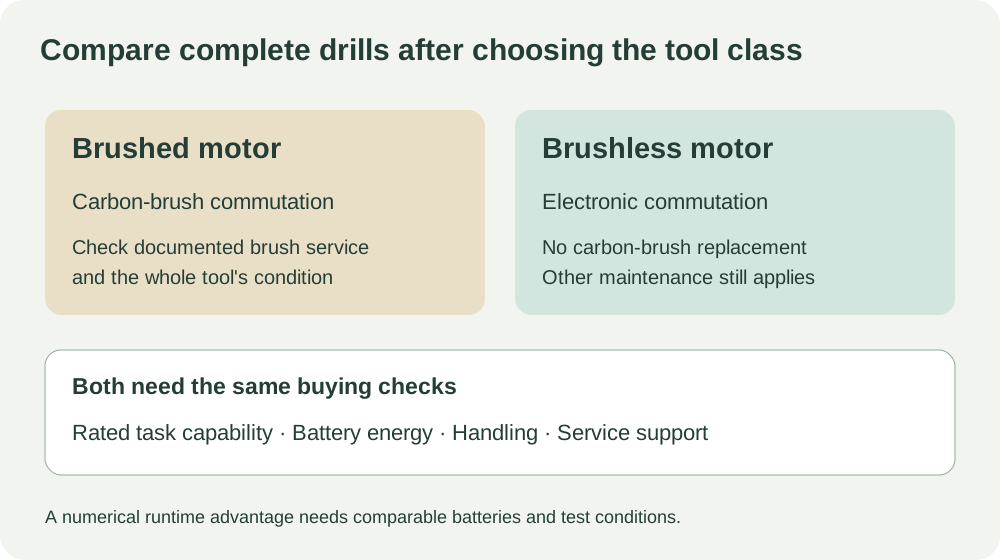
A brushless drill uses electronic motor control instead of carbon brushes for commutation. That can support an efficient, compact design and removes brush wear as a maintenance item.
It does not automatically make every brushless drill stronger, longer-running or better value than every brushed drill. Compare the complete tools, batteries and tasks before paying for the motor label.
For frequent work, a well-suited brushless model can be worth considering for its documented performance and handling.
For occasional jobs, a suitable serviceable brushed drill may remain entirely practical. The drill finder establishes the tool class and task requirements first; the motor design is a second-stage comparison.
What changes inside the motor
A brushed motor uses carbon brushes contacting a commutator to switch current as the motor turns. A brushless design performs the switching electronically.
Removing that sliding electrical contact removes a source of friction and a wearing component, but the drill still contains mechanical and electronic parts that can wear or fail.
Makita's brushless-motor explanation describes the absence of brushes and the resulting efficiency benefits in its designs.
Its electronic control guidance explains matching motor operation to changing demand.
These are manufacturer descriptions of the technology, not an independent guarantee of a particular runtime improvement for every competing drill.
For a buyer, the useful consequence is not a need to understand the circuit in detail.
It is knowing which claims follow from the design and which still require model-specific evidence. “No carbon brushes to replace” is a design distinction. “Twice as many holes in my timber” needs a relevant comparison test.
Brushless does not mean maintenance-free
The motor may avoid brush replacement, but the chuck, gearbox, bearings, controls, battery and ventilation still need appropriate care. The tool still requires inspection and cleaning according to its instructions.
A damaged accessory or contaminated chuck does not become harmless because the motor is brushless.
Brushed tools vary in serviceability. Some provide a documented brush-replacement procedure or service route; others use assemblies that should be assessed by service support.
The Bosch GSR 18V-21 manual includes model-specific carbon-brush information.
That demonstrates a real maintenance distinction without implying every owner should dismantle every brushed tool.
Before buying either type, check spare-part identification and service support. A well-supported older tool can remain useful, while a newer design with unclear repair arrangements can be difficult to assess.
Motor type is one factor in repairability, not a complete repairability score.
Keep efficiency claims tied to their comparison
A percentage runtime claim needs a baseline. Ask which brushed model was compared, whether the same battery was used, what material and bit were involved, and how the test was performed.
Without those conditions, the percentage cannot be transferred reliably to your own job.
For instance, a statement that a particular model lasts longer than its predecessor does not establish that all brushless drills beat all brushed drills by the same amount. The predecessor may also have a different gearbox, speed control, size or battery.
Several changes can contribute to the observed result.
Treat broad manufacturer explanations as evidence of design intent. Use task-relevant test data for numerical performance claims.
Where comparable data is unavailable, say the expected advantage is uncertain rather than inventing a universal uplift such as 30% more runtime for every purchase.
Battery energy can overwhelm a casual comparison
Suppose an invented brushed-drill kit includes an 18 V, 4 Ah pack, while a brushless kit includes an 18 V, 2 Ah pack. Their nominal energy figures are 72 Wh and 36 Wh respectively.
That difference means an unqualified claim that the second kit must run longer because it is brushless is not justified.
The reverse comparison is equally misleading. A brushless kit with a larger battery cannot demonstrate the motor's efficiency advantage merely by lasting longer.
To isolate motor-related performance, the comparison needs suitable controls, including battery and task.
A purchase comparison may legitimately include different batteries, but then it should describe complete-kit usefulness rather than motor efficiency alone.
| Comparison question | Evidence needed | What the motor label cannot supply |
|---|---|---|
| Which kit finishes my session? | Suitable battery capacity and relevant workload evidence | Guaranteed runtime from brushless wording |
| Which tool is easier to handle? | Complete dimensions, weight and a practical demonstration | A universal size or balance advantage |
| Which needs less motor maintenance? | Exact design and service instructions | Zero maintenance for the whole drill |
| Which drills a particular hole faster? | Comparable test conditions or clear task evidence | A ranking from motor type alone |
For battery definitions and compatibility, see what voltage drill do I need?. Keeping energy and efficiency separate makes the motor comparison much clearer.
Compare equivalent tool classes
A brushless drill driver does not gain masonry percussion simply through its motor design. A brushed combi may include that mode, while a brushless drill driver does not.
If the intended task requires a function missing from one candidate, motor technology cannot fill the gap.
Similarly, an impact driver and a drill are not comparable just because both are brushless and use the same battery. Their mechanisms and accessory interfaces serve different purposes.
Start with combi versus drill driver or impact driver versus combi when the role is uncertain.
After choosing the class, compare rated capacities, gear ranges, chuck and control features. A motor badge should not distract from a missing capability or an accessory that will not fit.
The best technology choice is only useful inside a tool that actually supports the project.
A documented model is more useful than a generic claim
Bosch's GSR 18V-45 product information identifies a brushless drill driver and provides its technical specification.
That lets a buyer investigate the complete product rather than assigning imagined capabilities to all brushless tools. It is an example of specification reading, not a claim that we have tested or ranked it.
For a brushed candidate, identify its own exact manual and product code with the same care. Do not compare a current detailed specification against an old retailer summary missing the battery and capacity conditions.
If the documentation is incomplete, record the uncertainty rather than filling it from another model in the range.
Model generation matters too. A redesigned drill may combine a motor change with a shorter body, new controls or a different battery package. If you prefer it, say which of those benefits matters.
Attributing the entire improvement to brushless construction alone would oversimplify the evidence.
Worked case: occasional furniture and repairs
Consider a fictional owner who uses a drill for a handful of household projects each year. Their existing brushed drill remains serviceable, its batteries are suitable and it meets the confirmed drilling and fastening requirements.
They are considering replacement because brushless models are widely advertised.
They list the actual limitations of the existing tool. If there are none beyond its age and motor label, a replacement has no demonstrated task benefit. Money may be better spent on correct bits, replacing worn accessories or completing a necessary repair.
That is a practical ownership decision, not a claim that motor efficiency never matters.
If the old tool has a failing battery or poor access for new work, they compare repair and replacement using complete costs. A brushless model may then offer a useful combination of size, control and support.
The reason to replace is the resolved limitation, with motor design contributing to the overall assessment.
Worked case: frequent workshop sessions
A second fictional owner regularly drills and drives compatible fasteners for extended sessions. Charging interruptions and tool balance are noticeable parts of the routine.
Here a brushless candidate's documented efficiency and compact design may have more practical value than for occasional use.
The owner compares a suitable brushed and brushless model on the same platform, with equivalent permitted batteries. They seek comparable task evidence or a demonstration and check the complete weight.
They do not assume a percentage improvement; they identify whether the newer tool would reduce an interruption or improve handling in the actual work.
If both finish the planned session comfortably, runtime may no longer be the deciding factor. Control, access, service support and price can take over.
An efficiency advantage is valuable when it changes the experience, not merely because it appears on a feature list.
Worked case: a discounted brushed kit
A third buyer finds a brushed kit at a lower complete price than a brushless alternative. Both have appropriate rated capacity, but the discounted kit includes two batteries while the other includes one.
The correct comparison is the equipment needed to perform the intended projects, including whether a spare is actually useful.
The buyer verifies that the discounted platform remains supported and that the batteries and charger are the correct regional versions. They check the exact tool's dimensions and service information.
If it meets the tasks and the saving funds necessary project equipment, it may be good value.
If the discount is offset by an unsuitable battery size, missing accessories or difficult service support, the apparent bargain weakens. Neither a low price nor a brushless label ends the investigation.
The complete package and realistic ownership period determine the value.
Put a premium into a useful scale
Suppose, purely illustratively, a brushless package costs £60 more than a comparable brushed package. If you expect five years of ownership, the initial premium averages £12 per year.
That arithmetic does not include repair, battery replacement or resale, and it is not a current market-price claim.
Now relate the premium to use. Someone making six short sessions each year is considering about 30 sessions over five years, or £2 per planned session. Someone making 50 sessions each year is considering about 250 sessions, or 24 pence per session.
These invented examples explain why frequency changes the perceived value without pretending to calculate a universal payback period.
Avoid claiming the premium will necessarily be recovered through electricity savings. Drilling sessions, charger losses and electricity tariffs vary, and household energy savings may not be the practical reason for the purchase.
Handling, reduced interruptions and required capability are often easier to assess directly.
Repair versus replacement deserves an honest comparison
If an existing brushed drill develops a problem, obtain an appropriate diagnosis and quote rather than assuming the brushes are responsible. A battery, switch, chuck or gearbox fault is a different repair.
Replacing brushes speculatively is not the same as confirming a serviceable tool.
Likewise, a brushless tool's fault does not automatically make it unrepairable. Service arrangements depend on the model and available assemblies. Ask for the exact repair route, parts and cost.
Blanket claims that brushed is always repairable or brushless is always disposable are not useful purchase evidence.
Compare the repair's expected practical result with a complete replacement setup. Existing compatible batteries and accessories may retain value, but only if they remain suitable and serviceable.
Do not discard a working system merely to standardise motor labels across a collection.
Handling and controls still deserve a demonstration
Try the exact tool with the intended battery fitted. Check trigger response at the beginning of travel, clutch selection, direction switching and visibility of the bit.
A shorter body can be useful, but the complete accessory length and battery shape still determine access.
For a project with many small screws, predictable control may matter more than a higher maximum torque.
For larger rated holes, appropriate gearing and accessory support matter. Drill torque explained helps interpret the numerical ratings without treating them as a summary of the entire tool.
A shop demonstration is evidence about fit and controls in that setting. It is not a controlled durability or runtime test. Keep those claims separate when deciding what you have actually learned from trying the tool.
A final model-to-model check
Record exact model codes, tool class, material capacities, complete weight, batteries, charger, price and service support. Then add the specific brushless benefits documented for the candidate.
This order makes it harder for a single label to overshadow a missing practical requirement.
If a claimed advantage has no clear source or test conditions, leave it unquantified. You can still prefer the overall tool for its size or controls.
An honest sentence such as “this model fits the cabinet space better” is more useful than an unsupported promise of a fixed runtime gain.
The main drill guide helps if the shortlist has become dominated by features rather than jobs. Return to the first project and check whether each item in the basket earns its place.
Motor-design questions
Is brushless always worth the extra money?
No universal answer applies. It can be valuable for frequent use or a particularly suitable compact design. For occasional work, a capable brushed kit or a serviceable existing tool may offer better practical value.
Does brushless mean no sparks anywhere in the tool?
Do not turn a motor-design distinction into an environmental safety approval. Use the tool only in the environments permitted by its instructions. A brushless label does not certify equipment for explosive or otherwise hazardous atmospheres.
Will a brushless drill last twice as long?
There is no general basis for that promise. Removing brush wear changes one maintenance factor, while overall life depends on design, workload, conditions, care and other components. Use model-specific evidence and support information.
Can the same batteries work with brushed and brushless tools?
They may, within an explicitly compatible platform. Motor type does not by itself establish compatibility. Check the exact tool, battery and charger approvals.
Should I replace a working brushed drill now?
Identify a real limitation first: unsuitable capability, poor access, unreliable operation or an uneconomic repair. If the existing drill remains suitable and serviceable, a newer motor design alone does not make replacement necessary.
What is the fairest runtime comparison?
Use appropriate comparable batteries, the same task and clearly defined test conditions. If those controls are absent, compare complete-kit usefulness and describe the uncertainty instead of attributing all differences to the motor.
Continue researching