Buying guide
Impact driver vs combi drill: fastening, drilling and two-tool workflows
An impact driver is primarily a fastening tool; a combi drill is a drilling and screwdriving tool with an additional masonry-percussion mode. They can complement each other, but the word “impact” does not mean they use the same action.
Choose by the fasteners, holes and materials in the project, not by comparing their largest torque numbers.
If you need one tool for ordinary holes and household screws, a suitable drill driver or combi is often the first class to investigate.
If repeated compatible fastening or keeping two tools set up would help, an impact driver may earn its place. The drill finder starts with those tasks; this guide explains the division of work.
The two impact actions have different purposes
An impact driver applies rotational blows to help turn a fastener when resistance rises. A combi's masonry mode adds percussion along the drilling direction. The first action concerns fastening rotation; the second assists an intended drilling operation.
Similar terminology can hide this important mechanical difference.
That is why an impact driver is not automatically a substitute for a hammer drill in a wall. Equally, a combi's hammer mode is not a shortcut for driving difficult screws. Use the mode and accessory arrangement the exact tool and fastener instructions permit.
Bosch's impact-driver and wrench information distinguishes fastening tools and their holders and calls for impact-resistant accessories.
For conventional masonry drilling versus a rotary hammer, use combi versus SDS; that is a separate comparison from the fastening decision here.
A chuck and a hex holder are different interfaces
A typical combi has an adjustable chuck that grips compatible bit shanks within its clamping range. Many impact drivers use a quarter-inch hexagonal holder.
Check the exact model: impact wrenches and combination holders can use other interfaces, and a similar-looking tool may have a different intended role.
The Bosch GDR 18V-160 product information, for example, lists a quarter-inch hex holder and a 160 Nm maximum torque.
That identifies this model's interface and rating; it does not prove that every hex-shank accessory is approved for every impact operation.
Both shape and rating matter. A hex-shank drill bit may physically enter the holder while lacking the required impact compatibility or intended use. An adapter introduces additional restrictions and dimensions.
Read the tool and accessory instructions rather than treating a successful connection as a complete compatibility check.
Compare the tasks, not just the tools
| Project operation | Combi drill role | Impact driver role |
|---|---|---|
| Ordinary wood or metal hole | Candidate within rated capacity and suitable mode | Only if tool and accessory explicitly support the operation |
| Pilot holes followed by screws | Can perform both with bit changes | Can keep a compatible driving bit ready as a second tool |
| Small delicate furniture fittings | Controlled fastening mode may help | Requires particular care and explicit suitability |
| Repeated compatible construction screws | May be suitable within instructions | A main reason to investigate an impact driver |
| Suitable masonry holes | Percussion mode may apply | Rotational impact is not equivalent masonry percussion |
| Fastener with specified final torque | Follow the prescribed tightening method | Maximum impact rating is not a torque setting |
The table intentionally leaves some cells conditional. A tool category cannot establish whether a particular screw, substrate or accessory combination is appropriate.
For structural or consequential fixings, the fastening system's instructions are decisive, including pilot holes and final tightening requirements.
Maximum torque does not measure control
An impact driver may display a substantially larger torque number than a combi. That does not mean it is better for every screw.
The measurement conditions and mechanism differ, and the maximum says little about how gently the tool starts or how predictably it stops near the desired seating point.
For ordinary fastening, investigate speed selections, trigger control and any documented fastening modes. Some models provide settings intended to help particular applications, but their names and behaviour vary.
Read the actual function rather than assuming a setting labelled precision acts like a calibrated torque limit.
Where a connection has a specified tightening torque, use the required procedure and suitable calibrated equipment.
An impact driver's maximum rating and a combi's clutch number are not substitutes. Drill torque explained separates those terms and shows why converting a clutch number into Nm is usually unjustified.
Fastener design can rule out a tempting tool
Identify the screw diameter, length, head recess, material and installation instructions. Also identify the material being joined and whether a pilot hole is specified.
Repeated fastening is not one uniform workload: a small cabinet screw and a large structural timber screw can have very different requirements.
Do not assume that because an impact driver can turn a fastener, it should be used for it. Some fittings can be damaged by overdriving or require a controlled final stage.
A tool's ability to continue turning is not evidence that the joint is correctly assembled.
Before buying for a large project, obtain the fastener manufacturer's instructions and compare them with the candidate tool's intended use. If the required method is unclear, resolve it before choosing equipment.
This prevents a common mistake: buying the most forceful driver first, then trying to adapt the entire project around it.
Bits and holders deserve their own budget
Use appropriately rated accessories in the correct size and profile. A close-looking bit can fit poorly in a screw head. Good engagement, condition and alignment matter alongside impact compatibility.
Replace damaged accessories according to their instructions instead of increasing force to compensate for worn contact surfaces.
Check how the holder retains the bit and whether the chosen accessory has the required shank form. A short insert bit may need a compatible holder rather than fitting directly.
Adding a holder changes the total working length, which can matter in a cabinet or near a wall.
The GDR 18V-160 operating manual identifies its intended fastening use and accessory arrangements.
Use the corresponding instructions for your own model; photographs of another driver's holder are not enough to establish the correct method.
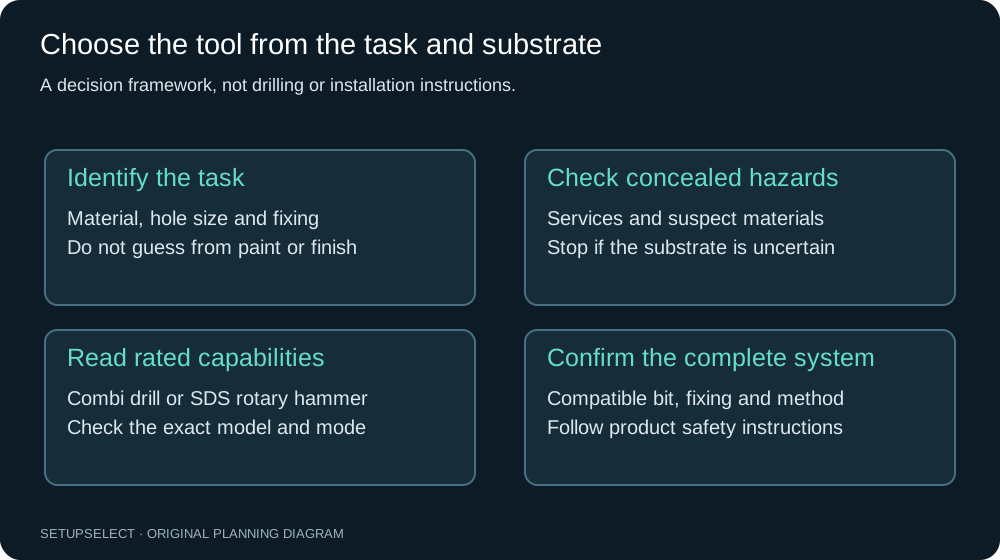
Worked case: a timber project with repeated pilot holes
Imagine a fictional project with 60 identical joints, each requiring a pilot hole and a compatible screw according to its plan. A single combi or drill driver can be set up for drilling, then changed for driving.
Another approach keeps a drilling bit in one tool and a suitable driving bit in a second.
For planning only, suppose a bit change takes 12 seconds including putting the removed accessory somewhere secure. If an inefficient one-joint-at-a-time sequence causes 119 changes, the total is nearly 24 minutes.
Batching all suitable holes before fastening, where the project permits it, could reduce that substantially without buying another tool.
This invented arithmetic does not claim real project timings. It shows that the benefit of a second tool depends on workflow. If staging is practical, reorganising work may solve the inconvenience.
If each joint must be drilled and fixed immediately, two prepared tools may have clearer value.
The buyer then checks whether an impact driver is the appropriate second fastening tool for those screws.
If the fasteners require a different controlled method, the efficient solution may be another drill driver or a suitable hand tool instead. “Two tools” and “impact driver” are not automatically the same decision.
Worked case: a first tool for a rented home
A second buyer expects occasional furniture assembly and a small number of permitted household projects. They do not have a confirmed repetitive fastening task.
An impact driver bundle looks attractive because its torque number is high, but their main work requires ordinary drilling and careful small-screw control.
They first identify a suitable drill driver or combi from the real task list. The impact driver remains an optional future purchase.
If wall drilling is needed, they check the building, fixing and permission requirements separately; the impact driver's name does not make it the appropriate masonry tool.
This decision protects the budget for correct bits and project-specific equipment. It is not a claim that beginners cannot use impact drivers.
It simply gives the first purchase the broad role the buyer actually needs rather than a specialised role suggested by an impressive specification.
Worked case: an existing drill that is still suitable
A third owner already has a serviceable drill and compatible battery system. They are considering an impact driver because a project involves repeated permitted fasteners.
Their existing drill can remain set up for pilot holes and countersinking where specified, while a driver handles the repetitive fastening.
They check whether the new tool is approved for their existing batteries and whether those packs are convenient in its smaller body. A large pack that works well on a saw may make the driver cumbersome in the intended space.
Compatibility and comfortable handling are separate checks.
They also inspect the actual bundle. A body-only purchase may be sensible with suitable existing batteries, but a different platform would require another charger and packs.
The complete additional cost determines whether this workflow improvement is worthwhile. No current-price claim is necessary to perform that comparison honestly.
Access changes when the accessory is fitted
Impact drivers often attract buyers for confined fastening, but compare the complete working length rather than assuming every one is shorter than every combi. Tool body, bit holder, bit projection and screw position all contribute.
An extension that solves one reach problem can create another clearance problem.
For an illustrative recess 250 mm deep, a 150 mm body and 75 mm projecting accessory leave only 25 mm before considering positioning and your hand. These invented dimensions are a prompt to measure the real setup, not a recommended clearance.
The work must allow correct alignment and safe operation, not merely a diagonal squeeze into the space.
Handle the tools with the intended battery installed. Check whether you can see the screw head and operate the trigger without twisting your wrist awkwardly. A product photograph taken without a battery or accessory does not answer those questions.
Sound, vibration and repeated work
The impacting action creates a different sound and vibration experience from ordinary drilling or gentle clutch-controlled driving. Consult the exact manual's declared values and protection requirements.
Do not infer exposure from a short online recording or assume a compact tool must be quiet.
For sustained work, the task's duration, grip, material and operating pattern matter. Follow the manufacturer and workplace guidance applicable to your situation.
A domestic buying guide cannot turn a laboratory vibration declaration into a personal safe-use duration without the relevant assessment.
If you are comparing tools for frequent professional use, ask for a suitable demonstration and review the declared data with your actual application in mind.
For occasional household use, understanding the noise and control before purchase still helps avoid an unexpected mismatch with the work environment.
A twin kit needs two useful tools
Drill-and-impact-driver bundles can be convenient, but count the included battery capacity, charger and exact tool models. Similar kit names may contain different generations.
Do not value a second tool highly if it has no planned role or duplicates work already covered comfortably.
Create two columns headed first tool and second tool. Under each, write the operations it will perform. If the second column remains vague, compare the bundle against a better-fitting single-tool kit plus the accessories you actually need.
If both columns are substantial, the bundle may support a sensible working arrangement.
For a purely illustrative budget, a £70 premium for a twin kit is £70 that cannot also buy missing bits, workholding or the correct fixing system. There is no universal right allocation.
The point is to make the trade-off explicit instead of treating an extra motor in the case as free value.
Check the first project before committing
Write down the first fastener type, quantity and required method, then the holes that accompany it. Verify the tool, bit and battery compatibility for each operation.
This short exercise distinguishes an actual impact-driver use case from a general desire for more power.
If the tool will be used for removing fasteners, check that operation too. Removal can introduce its own damage and access issues.
A stuck or damaged fastener does not justify unlimited impacting, and a consequence-sensitive connection may require a specific service procedure.
Use the main drill guide if the tool roles remain unclear. The best next purchase is the one that resolves a real limitation in the current workflow while meeting the project instructions.
Impact-driver questions
Can an impact driver drill holes?
Some tools and specifically suitable accessories support certain drilling operations. Verify both instructions and the intended material. It is not a reason to assume a hex holder replaces a conventional drill for all bit types and tasks.
Is an impact driver the same as an impact wrench?
No. Holders, torque ranges and intended applications can differ. Identify the exact tool and accessory interface. A square-drive wrench and a quarter-inch hex driver should not be treated as interchangeable because both use impact action.
Can I use ordinary screwdriver bits?
Use accessories rated and approved for the tool and application. Physical fit alone is insufficient. Check the required holder and shank form as well as the tip profile.
Will the driver stop when a screw is correctly tight?
Do not assume that. Read the documented control modes, and follow the fastener's installation method. A high maximum torque rating is not an automatic final-tightness control.
Which tool should I buy first?
Choose from the actual task list. A suitable drill driver or combi usually deserves consideration first for mixed holes and screws. An impact driver becomes more compelling when compatible fastening is a substantial, clearly identified part of the work.
Continue researching