Buying guide
Drill torque explained: hard, soft, maximum and clutch settings
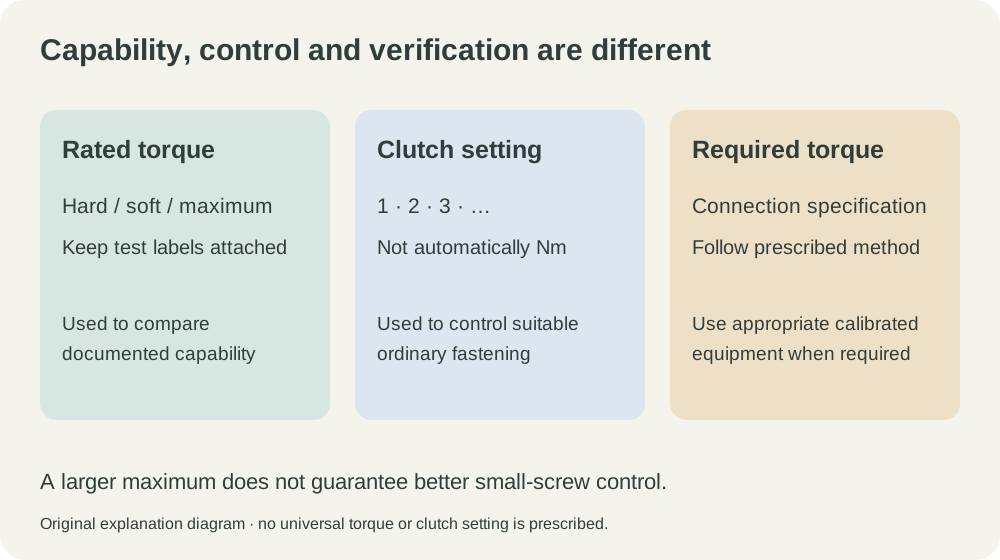
Drill torque is turning effort, usually stated in newton-metres, or Nm. The headline maximum is a capability figure under defined conditions, not a setting you should apply to every screw.
A drill's numbered clutch positions are usually relative control settings rather than calibrated Nm values. Read the rating label, understand the joint and choose the control method the task requires.
This distinction matters when comparing drills and when using one.
More maximum torque can help with suitable demanding tasks, but it does not automatically improve small-fastener control or hole quality. The drill finder starts with the task; this guide explains how to interpret torque without letting one number dominate the purchase.
What a newton-metre represents
Torque is force acting through a perpendicular lever arm. As a simple static illustration, 10 newtons applied at a right angle to a 0.1-metre lever produces 1 Nm. Applying the same force at 0.2 metres produces 2 Nm.
This is a units explanation, not a method for calibrating a drill or improvising a tightening tool.
The unit describes turning effort, not rotational speed. Speed is commonly shown in revolutions per minute.
Power relates to torque and rotational speed together, but a product's maximum torque and no-load speed should not be multiplied as though they necessarily occur at the same operating point.
For buying purposes, this means a high torque figure does not tell you how quickly a drill makes a particular hole. It also does not tell you how gently the trigger starts or how well the clutch controls a small screw.
Those are different questions requiring different evidence.
Hard, soft and maximum torque can be separate figures
A screw joint can become resistant to further turning rapidly or progressively. The test conditions affect the measured torque, so manufacturers may publish hard-joint and soft-joint values.
Do not interpret “hard” simply as hardwood and “soft” as softwood; the joint's tightening behaviour is the relevant concept.
Bosch's cordless-drill guidance distinguishes soft and hard screwdriving torque.
Its UniversalDrill technical data gives a concrete example: 47/24 Nm for hard/soft screwdriving according to ISO 5393, alongside a separate 60 Nm maximum for the UniversalDrill 18V-60.
| Published field in that example | Value | How to use it |
|---|---|---|
| Hard screwdriving torque | 47 Nm | Compare with the same defined field on another model |
| Soft screwdriving torque | 24 Nm | Retain the soft-joint label and conditions |
| Separately stated maximum torque | 60 Nm | Do not silently relabel it as either figure above |
The lesson is not that one figure is dishonest. Different fields answer different measurement questions. A retailer that drops the labels can make an accurate specification misleading.
Keep the definitions when building a comparison, and ask the manufacturer if a competitor publishes only an unexplained maximum.
Torque is not a universal screw-size selector
A screw's diameter alone does not establish the required turning effort. Length, thread, pilot hole, material, joint arrangement and installation instructions all matter. Two screws with the same diameter can be very different tasks.
A long screw in one assembly should not be treated as equivalent to a short screw in another simply because the heads use the same bit.
Start with the fastener or project instructions. Identify whether pilot drilling is required and whether a specific final tightening method is prescribed. Then confirm that the drill and accessories are intended for the work.
A larger maximum torque is not permission to ignore those steps.
For structural, safety-related or otherwise consequential joints, use the specified method and appropriate equipment. A consumer drill clutch should not be assumed to certify the connection.
Tool capability and verified installation quality are separate matters.
What the clutch numbers mean
A numbered clutch ring gives a sequence of settings intended to limit fastening effort in the manner described by the tool's manual. Unless the manufacturer explicitly provides calibrated values, setting 5 does not mean 5 Nm.
Nor does setting 5 on one drill necessarily correspond to setting 5 on another.
The Bosch UniversalDrill operating instructions describe 20 torque preselection stages and explain that the clutch is deactivated in drilling mode.
That is useful operational information, but it does not publish a conversion table turning those 20 positions into calibrated tightening torques.
Treat the clutch as a control aid for suitable fastening tasks. Find an appropriate setting in representative practice material following the instructions, and reassess if the material or fastener changes.
Do not copy a number from an unrelated online project and assume the resulting joint will match.
Gear, trigger and clutch are separate controls
The gear selector changes the mechanical operating range. The trigger controls speed within the tool's supported behaviour. The clutch selection limits fastening effort in its intended mode.
A drill-mode position may bypass that clutch, while a combi's percussion setting serves another purpose again.
Learn those controls separately. If a screw stops short, the answer is not automatically to select drill mode and apply full trigger.
The bit may be wrong, the pilot hole may be unsuitable, the screw may have reached an obstruction or the task may exceed the intended method. Identify the cause before increasing effort.
Likewise, slow speed does not necessarily mean low maximum torque. A suitable low-speed range can still deliver substantial turning effort. Your control of the trigger does not replace an appropriate clutch setting or the required final tightening procedure.
A worked practice sequence for ordinary fastening
Consider an illustrative, non-structural timber assembly whose instructions allow powered screwdriving and specify the fastener and pilot hole. Prepare representative offcut material and support it appropriately.
Use the correct bit and start with a conservative permitted clutch setting, following the drill's manual.
Observe the result rather than merely listening for the clutch. Did the screw stop short? Did the head reach the required position? Was the surrounding material damaged? Keep a small record so that changes are deliberate.
If something unexpected occurs, check the bit, screw and preparation rather than treating every problem as insufficient torque.
| Illustrative observation | What to check next | What not to assume |
|---|---|---|
| Screw stops short without visible damage | Preparation, alignment and a permitted setting adjustment | That maximum drill mode is required |
| Head sinks farther than intended | Required seating, control and a lower suitable setting | That stronger material will hide the error |
| Bit slips in the head | Correct profile, condition and alignment | That more trigger speed will restore engagement |
| Resistance changes unexpectedly | Stop and inspect the task | That every obstruction should be overcome |
This is an observation framework, not a universal fastening recipe. A different screw, joint or specified final torque may require a different procedure.
The value is making the adjustment process explicit instead of using trial and error on the finished piece.
Why the same setting can produce different results
Even with the same drill, changing material or fastener changes the resistance encountered. Moving from a prepared hole to an unprepared one, or from one type of fitting to another, can change when the clutch acts and how the finished assembly looks.
A previous successful setting is a starting observation, not a permanent calibration.
Tool condition and the battery configuration can also matter to the system's behaviour. Follow the approved combination and inspect accessories.
If results become inconsistent under apparently similar conditions, check the setup and manual before assuming the clutch number has a fixed physical meaning that the material must obey.
For repeated production or a connection requiring documented tightening accuracy, use equipment and procedures intended for that purpose.
The ordinary household drill's convenience should not be confused with a controlled assembly process that measures and verifies every joint.
Drilling requires more than torque
A drill bit removes material, so the required speed, geometry, material and diameter matter. Torque may be relevant to the load, but it does not choose the bit or tell you whether hammer mode is appropriate.
A high-torque drill can still be unsuitable for a particular concrete task or large cutter.
Read the manufacturer-rated drilling capacities and accessory guidance. For wood and metal, compare the actual bit and hole requirements.
For masonry, identify the substrate and tool mechanism. Combi versus SDS explains why increasing a combi's torque number is not equivalent to selecting a suitable rotary hammer.
Also distinguish a chuck's maximum shank capacity from the maximum hole diameter the drill can make. A reduced-shank cutter may fit physically while placing demands outside the tool's rating. Torque marketing should not override those model-specific limits.
Comparing an impact driver adds another complication
Impact drivers apply rotational blows and often advertise much larger torque figures than ordinary drills. They are not simply the same drill with a higher clutch ceiling.
Their fastening mechanism, measurement conditions and control behaviour need separate consideration.
Bosch's impact-driver comparison chart distinguishes maximum tightening torque, adjustment ranges and, for some models, breakaway torque.
Those terms should remain separate. A release or breakaway figure is not automatically a final-tightening specification.
For an ordinary buying decision, do not compare a drill's soft-joint figure with an impact tool's largest advertised number and declare the latter universally better. Impact driver versus combi shows the task split.
A delicate fastener may value predictable control far more than an unused maximum.
A torque-comparison worksheet
For each exact model, record the published hard torque, soft torque, any separate maximum, the stated test method, battery used where specified, rated screw capacity and available control functions. Leave unavailable fields blank.
Never estimate a missing soft rating by dividing the maximum by a guessed ratio.
Add the actual project beside the specifications: fastener identity, substrate, preparation, quantity and final-tightening requirements. This makes the comparison concrete.
A drill with a larger maximum but poor access for the planned joint may offer no practical advantage.
Where two models both meet the task, compare handling, complete weight, chuck quality as documented or demonstrated, battery compatibility and support. Torque can narrow the field, but it rarely answers every remaining ownership question.
The drill finder helps retain that broader context.
Worked buying case: modest screws versus demanding holes
Imagine two fictional projects. The first involves small fittings in furniture, where the instructions call for controlled assembly. The second involves larger rated holes in timber using an appropriate bit and supported workpiece.
A buyer sees one drill advertised at 60 Nm and another at 45 Nm.
For the furniture, the maximum comparison may have little value once both tools are suitable. The buyer prioritises clutch behaviour, access and the manufacturer's instructions.
For the timber holes, they compare the rated diameter, permitted bit and gear requirements; torque is supporting evidence rather than the sole rule.
Now suppose the 45 Nm figure is a hard-joint value and the 60 Nm figure is an unexplained maximum. The initial numerical ranking is not a like-for-like comparison at all.
Resolving that definition is more useful than arguing that the difference is exactly one-third more capability.
When to stop increasing the setting
Stop when the fastener behaves unexpectedly, the material is damaged, the accessory slips repeatedly or the tool indicates overload. Consult the task and tool instructions and identify the cause.
A clutch that operates is not automatically a fault; it may be doing the limiting job you selected.
Do not use the drill as a substitute for an installation check. A screw sitting flush may look tidy while the wrong fixing or substrate makes the connection unsuitable. Conversely, some assemblies intentionally require a different final position.
The specified outcome comes from the project instructions, not a universal visual rule.
If a required torque is stated in Nm, use the prescribed tightening and verification method. Guessing from a clutch ring, trigger position or motor sound does not establish that value.
This is the practical boundary between a convenient driving control and a measured tightening process.
Torque questions
Does clutch setting 10 mean 10 Nm?
Only if the manufacturer explicitly defines it that way. Ordinary numbered drill settings should be treated as relative settings. Do not assign Nm values without a supported calibration specification.
Why can one drill list three torque figures?
They may represent hard-joint, soft-joint and a separately defined maximum measurement. Keep their labels and test conditions. The numbers are not interchangeable just because they use the same unit.
Does more torque make a drill safer or easier?
Not automatically. The task needs suitable capability and control. Extra available turning effort can be irrelevant to small screws, and the tool still requires correct handling, accessories and work support.
Can I use the clutch to tighten a specified automotive bolt?
Do not assume a consumer drill clutch supplies the required calibrated torque. Follow the vehicle or component service procedure and use appropriate tightening equipment. A setting remembered from a previous job is not verification.
Why does a screw stop before its head reaches the surface?
Possible causes include the selected clutch setting, preparation, alignment, fastener suitability or an obstruction. Stop and assess the actual task. More torque is only one possible adjustment and may be the wrong response.
What is the most useful torque number when buying?
The one with a clear definition that relates to a documented requirement and can be compared fairly. If the task is already supported by two candidates, handling, control and complete-kit suitability may decide more than another increment in maximum torque.
Continue researching