Buying guide
What voltage drill do I need? Platforms, batteries and practical capability
Choose drill voltage as part of a compatible tool system, after establishing the tasks and handling requirements. Voltage alone does not tell you drilling capacity, fastening control or whether a tool has masonry percussion.
A compact lower-voltage drill may be suitable for the work you actually do, while a larger platform may make sense for more demanding tasks or compatible tools you already own.
The useful comparison is between complete setups with the intended batteries fitted. Start with the drill finder if the tool class is uncertain.
This guide concentrates on voltage labels, battery compatibility, energy and the practical trade-off between a compact setup and a broader system.
Voltage is an electrical characteristic, not a job description
A voltage badge identifies an aspect of the electrical system. It does not specify the motor, gearing, chuck, operating modes or rated material capacities.
Two drills with the same voltage can be designed for different workloads, and a higher-voltage tool can still be the wrong class for a particular job.
For example, adding voltage to a drill driver does not add masonry percussion. An impact driver and a combi can use the same battery platform while serving different roles.
The first decision therefore remains the operation: ordinary drilling, controlled fastening, suitable masonry drilling or a specialist task.
Use the main drill buying guide for that decision. Once the class is known, compare the exact model's capacities and handling.
The phrase “18 V drill” is an incomplete specification in the same way that an engine size alone does not describe an entire vehicle.
Maximum and nominal voltage can produce different labels
Read the manufacturer's definition before assuming two printed numbers represent different capability classes. A battery's maximum initial voltage and nominal voltage are different ways of describing the system.
Regional branding can make this particularly confusing when browsing imported products or international reviews.
DEWALT's 20V MAX system page explicitly states that the nominal voltage is 18 V. That does not make every product labelled 20 V physically interchangeable with every 18 V product.
It shows why the label must be interpreted before comparing numbers.
Do not infer compatibility from electrical equivalence. Connector design, protection, communication, charger specification and platform approval still matter.
A tool can belong to a similar nominal voltage class while remaining entirely incompatible with another manufacturer's batteries.
Read a model's capability beside its voltage
The Bosch GSR 12V-15 specification lists a 19 mm wood-drilling capacity, 10 mm steel-drilling capacity and a 7 mm maximum screw diameter.
These documented limits are more informative for a project than the 12 V label alone. They apply to that model, not every compact drill.
For a larger-platform example, Bosch's GSR 18V-45 information identifies a different drill driver with its own rated capacities and brushless design.
Compare the exact specification and instructions, not a blanket claim that every 18 V tool outperforms every 12 V tool in every useful way.
Neither example is a tested recommendation from us. They illustrate a reading method: identify the model, material, diameter and measurement conditions.
If the proposed task is outside the rating, a comfortable grip or familiar battery does not make it appropriate.
Platform names matter more than shared branding
Write down the full battery-platform name, the battery model and the charger model. Some brands operate distinct consumer and professional platforms at the same nominal voltage. Legacy ranges can add another layer.
The same logo on the casing is not enough evidence of interchangeability.
Bosch's UniversalDrill and UniversalImpact technical data identifies approved PBA batteries and charger restrictions.
This is a practical example of why exact compatibility information belongs in a buying decision. Do not replace that list with the assumption that any Bosch 18 V item must work.
If an adapter is proposed, treat it as a separate engineering and approval question. Physical connection does not establish that all protections or functions are retained.
Prefer the manufacturer's supported system and do not assign a bargain adapter the same status as explicit compatibility approval.
Build a compatibility worksheet
| Item | What to record | Common mistake to avoid |
|---|---|---|
| Tool | Full model and platform | Using only a shortened retailer title |
| Battery | Exact model, voltage definition and capacity | Assuming equal voltage proves fit |
| Charger | Exact model and approved pack list | Assuming every charger from the brand works |
| Existing tools | Confirmed compatible models | Counting hypothetical future purchases as savings |
| Complete weight | Tool plus intended battery | Comparing body-only with ready-to-use weight |
| Task evidence | Material and rated diameter | Treating voltage as a capacity specification |
Fill this in before choosing a body-only offer. If you cannot identify an existing battery confidently, look at its label and the manufacturer's compatibility resources. A low purchase price is not useful if it leaves you with an unusable combination.
Keep compatibility and condition separate. An approved battery that is damaged or otherwise unserviceable should not be counted as ready capacity.
Follow the manufacturer's inspection and service guidance, and do not attempt to restore compatibility by altering the connector or casing.
Amp-hours and watt-hours answer another question
Battery capacity is usually shown in Ah, while energy may also be labelled in Wh. Nominal voltage multiplied by Ah gives a nominal energy figure. At an assumed nominal 18 V, a 2 Ah pack represents 36 Wh and a 4 Ah pack represents 72 Wh.
That is an energy comparison, not a claim about the number of holes a drill will make.
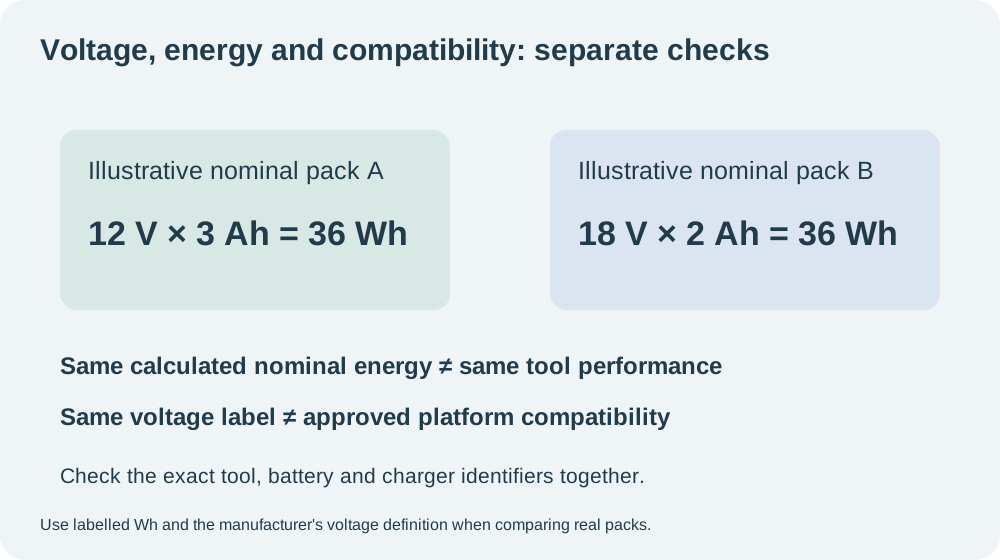
Comparing Ah across different voltages can mislead. A hypothetical nominal 12 V, 3 Ah pack and an 18 V, 2 Ah pack both represent 36 Wh mathematically. Their physical compatibility, usable energy, power delivery and effect on tool performance still differ.
Use the labelled Wh where supplied rather than multiplying a marketing maximum voltage without checking its definition.
| Illustrative nominal values | Nominal energy calculation | What it does not establish |
|---|---|---|
| 12 V × 3 Ah | 36 Wh | Equal drilling performance to another 36 Wh pack |
| 18 V × 2 Ah | 36 Wh | Compatibility with the 12 V system |
| 18 V × 4 Ah | 72 Wh | Exactly twice as many holes under all conditions |
The table helps compare energy scale. It does not model real runtime because the task's demand and usable energy are not specified. A larger compatible pack can be worth investigating for sustained work, but it is not automatically the best handling choice.
Weight and access change with the battery
A tool advertised as compact may become awkward with a large pack attached. The battery can affect balance, total height and access near adjacent surfaces.
Compare the combination you will actually use, not the shortest body photograph and lightest available weight from separate listings.
For an illustrative cabinet task, suppose the tool body and bit fit comfortably but the battery collides with the shelf below. A shorter head alone does not solve that problem.
You may need a different approved pack, a suitable alternative tool design or a different assembly sequence. Measure the full working envelope before assuming the voltage class decides fit.
Try the grip and controls with your normal working hand and the intended pack fitted. Check whether you can keep the tool aligned and see the working point.
Comfort is individual, so a demonstration can be more useful than treating a small numerical weight difference as a guaranteed improvement.
Worked case: compact furniture and light drilling
Consider a fictional owner who mainly assembles furniture and drills specified small holes in timber and metal. The work takes place in a flat, and the kit must fit a small cupboard. They have no existing battery platform and no confirmed masonry requirement.
They compare suitable compact drill drivers by documented capacity, clutch control, total size and complete-kit price. A lower-voltage candidate may meet the tasks and fit comfortably.
A larger-platform candidate may also work, but it needs a practical benefit to justify extra size or cost.
The owner does not reject the compact tool merely because another product has a higher voltage number. Nor do they assume compact means suitable without reading capacities.
The result is a task-supported purchase with enough room in the budget for the correct bits and work support.
Worked case: an existing 18 V system
A second owner already has serviceable, explicitly compatible 18 V batteries and a charger. They need a drill for tasks within a shortlisted model's rating.
A body-only tool on that platform can be worth comparing because the supporting equipment is already present.
They still handle it with the batteries they own. If those packs are large and make the drill inconvenient for the main work, a smaller approved pack may be an additional cost.
The comparison should include that possibility instead of calling the battery free while ignoring its practical effect.
They also avoid replacing other tools simply to make the system look consistent. Compatibility provides value when it supports useful equipment.
It is not an obligation to remain on one platform when a different tool solves a specialised task substantially better.
Worked case: future tools without a shopping fantasy
A third buyer expects a drill now and a specific compatible garden or workshop tool next year. They compare the two real purchases as a system, including the battery sizes each needs.
If one tool requires a much larger pack, they check whether using it on the drill is comfortable or whether two capacities would be more practical.
The comparison might favour a broader platform, but only because the second purchase is credible and compatible. A catalogue containing hundreds of tools is not itself a saving.
Count the tools you are likely to use and the packs their instructions support, not every possible expansion.
As a simple illustrative budget, if platform A saves £40 on today's kit but platform B avoids a later £60 charger-and-battery purchase, the two-purchase difference could favour B by £20 before other costs.
Those invented numbers show the calculation; actual quotes and genuine compatibility determine the real result.
Charging belongs in the ownership plan
Check the charger input requirements, permitted battery list and charging conditions. Read whether quoted times refer to a particular capacity and charge level.
A fast-charge headline for one pack should not be applied automatically to every pack the charger accepts.
Choose a suitable location according to the instructions, with the required environment and ventilation. Keep batteries and charging equipment in the condition the manufacturer specifies.
A platform decision is incomplete if there is no practical place to charge and store it.
If you work in short sessions, a single appropriate pack may be sufficient. If you work for longer periods, consider the actual swap-and-charge sequence.
Two packs do not guarantee continuous operation if one empties faster than the other can recharge under permitted conditions.
Do not use voltage to diagnose every problem
Slow progress can result from an unsuitable or worn bit, the wrong mode, an inappropriate gear, unsupported material or a task beyond the tool's intended capability. A weak-feeling operation does not by itself prove that the voltage class is too small.
Start with the manual and the task setup. Check accessory condition and compatibility, then verify settings and capacity. Stop when an unexpected obstruction or warning appears.
Increasing tool power before understanding the cause can make a poor method more consequential.
If the work consistently requires capability beyond the model, choose an appropriate tool class and rating. For masonry, that may mean examining combi versus SDS.
For repeated fastening, impact driver versus combi may be more relevant than simply moving to a higher voltage.
Voltage and battery questions
Is 20 V always stronger than 18 V?
No. Some labels use maximum initial voltage while others use nominal voltage. Read the manufacturer's definition and compare actual tool capabilities. Similar electrical labels still do not establish battery interchangeability.
Can batteries from the same brand be incompatible?
Yes. Distinct platforms and charger restrictions can exist within one brand. Verify the exact tool, battery and charger identifiers in the manufacturer's compatibility information.
Does a larger Ah battery increase voltage?
Not when comparing capacities within the same nominal-voltage platform. It represents a different charge capacity, although pack construction and permitted performance can also differ. Do not treat Ah as another voltage rating.
Should I buy the biggest included battery?
Choose enough suitable energy for the work while considering balance, access and charging. A large pack can be useful for sustained tasks, but a smaller approved pack may be more convenient for light or confined work.
Is 12 V only for screwdriving?
No. Some 12 V-class drills have documented drilling capacities. Read the exact model's material and diameter ratings instead of imposing a category-wide assumption.
What should decide a close choice?
Use confirmed task capability, complete handling, approved compatibility and total useful-system cost. Voltage is a useful label within that evidence, but it should not replace the evidence.
Continue researching