Choose FLYBIRD Adjustable Weight Bench for
Buyers whose exact FLYBIRD listing provides a verifiable model number, suitable pad and adjustment dimensions, a working footprint that fits the room and a combined load limit above the planned use.
Curated comparison
FLYBIRD and YOLEO both sell several adjustable benches, so the brand names alone are not a usable comparison. This page links to two specific Amazon catalogue targets and explains the figures that must match the exact variant delivered. SetupSelect has researched the listings but has not physically tested either bench.
Requirements first
Compare known specifications and compromises. Personalised Fit Scores appear only when you have supplied requirements.
Bottom line
There is no evidence here for a universal winner. Choose only after the live listing and manufacturer material agree on the model, pad dimensions, adjustment positions, working and stored footprint, combined user-and-weights limit, assembly and warranty. If those details are missing or conflict, use a seller with clear returns or choose a better-documented bench.
Buyers whose exact FLYBIRD listing provides a verifiable model number, suitable pad and adjustment dimensions, a working footprint that fits the room and a combined load limit above the planned use.
Buyers whose exact YOLEO listing provides a verifiable model number, suitable pad and adjustment dimensions, a working footprint that fits the room and a combined load limit above the planned use.
Lowest planning cost: YOLEO Adjustable Weight Bench at £55. This is a catalogue estimate, not a current offer or a claim of best value. No performance or overall winner is awarded without comparable evidence.
| Specification | FLYBIRD Adjustable Weight Bench | YOLEO Adjustable Weight Bench |
|---|---|---|
| Price band | budget | budget |
| Planning estimateDifferent | £95 (not live) | £55 (not live) |
| Major features | Popular folding adjustable-bench format; Multiple back positions for upper-body work | Folding format reduces storage demand; Adjustable back support broadens exercise choice |
| Compromises | Cheaper versions may have fewer adjustments, a lower capacity or a simpler finish; Check the exact model, maximum user or load limits, assembly requirements and warranty before ordering | Cheaper versions may have fewer adjustments, a lower capacity or a simpler finish; Check the exact model, maximum user or load limits, assembly requirements and warranty before ordering |
Only comparable, documented differences are highlighted. Unknown does not mean absent. Confirm the exact model, included parts and current specification.
Decision checks
Record the model number or SKU from the live listing, manual and delivered label. Do not merge specifications from a different bench sold under the same brand or a similar title.
Compare the bench length, base width and pad height while open, then record the folded dimensions. Add room to adjust the back and seat, approach the bench and handle weights without hitting walls or furniture.
Confirm whether the published figure covers the user, dumbbells or bar and any accessories together. Stay within the exact manual's instructions and do not infer structural suitability from a marketing headline.
Check back-pad and seat length, width and height from the floor, plus the actual flat, incline and decline positions. More positions are useful only when the chosen angles, gaps and support suit the planned exercises.
Follow the supplied assembly and locking instructions, inspect the bench on a level floor and stop if it rocks, flexes unexpectedly or a pin does not seat. Confirm seller, warranty and return costs before opening or discarding packaging.
Product details

Check the exact model, seller, availability and delivery terms on Amazon before buying.
Key features
Trade-off: Cheaper versions may have fewer adjustments, a lower capacity or a simpler finish
Paid link. As an Amazon Associate I earn from qualifying purchases. Details
Check the exact model, seller, availability and delivery terms on Amazon before buying.
Key features
Trade-off: Cheaper versions may have fewer adjustments, a lower capacity or a simpler finish
Paid link. As an Amazon Associate I earn from qualifying purchases. Details
SetupSelect compares structured product data, intended use, price band, space, portability and practical limitations. These products are researched rather than hands-on tested. Specifications and retailer listings can change, so confirm the exact model, included parts, limits, warranty, seller and returns before buying.
Common questions
Neither brand is universally better, and each sells more than one bench. Compare the exact model numbers, usable pad, adjustment positions, open and folded dimensions, combined load limit, assembly, warranty and seller returns.
Check that the listing, manual and delivered label identify the same model. Then compare pad dimensions, height, adjustment angles, open and folded footprint, the meaning of the load limit, locking method, assembly, warranty and return terms. SetupSelect does not display live prices.
Not necessarily. A headline may use different test or loading assumptions. Use the exact manual's definition and include the user, lifted weight and accessories wherever the manufacturer requires them to be combined.
The one whose verified open footprint, adjustment clearance and folded size fit the measured room while still supporting the planned exercises. A small folded size does not reduce the space needed during use.
Research and worked examples · Reviewed 29 September 2026
By Benjamin Dickman. Illustrative scenarios, not hands-on product testing.
Do not choose between a FLYBIRD and YOLEO adjustable bench from the brand names alone. Both names appear on more than one bench, and a retailer listing can change while an older product identifier remains in a catalogue.
The first comparison is therefore model identity: establish exactly which two products, manuals and specifications you are comparing.
SetupSelect has not personally tested these benches. The existing marketplace targets have not been conclusively matched to unchanged current manufacturer models, so this page remains excluded from search indexing while that identity gap is unresolved.
The guide explains what can be checked and what remains unknown instead of inventing a winner or transferring specifications from a similar-looking product.
FLYBIRD publishes a product page explicitly naming the Compact Foldable Weight Bench FB139.
YOLEO publishes an adjustable folding bench product page.
Those are useful manufacturer references, but their existence does not prove that every marketplace listing using the brand name refers to the same revision or supplied configuration.
Check the live retailer title, model identifier, seller, included parts and manual against the manufacturer's information. If those disagree, ask for clarification before ordering.
A photograph, capacity headline or similar adjustment pattern is not sufficient evidence of identity on its own.
Keep a copy of the relevant specification and order details for your own purchase decision. Product pages can change, so record the date and exact model. Do not use a previous review of another revision as if it were a measurement of the current item.
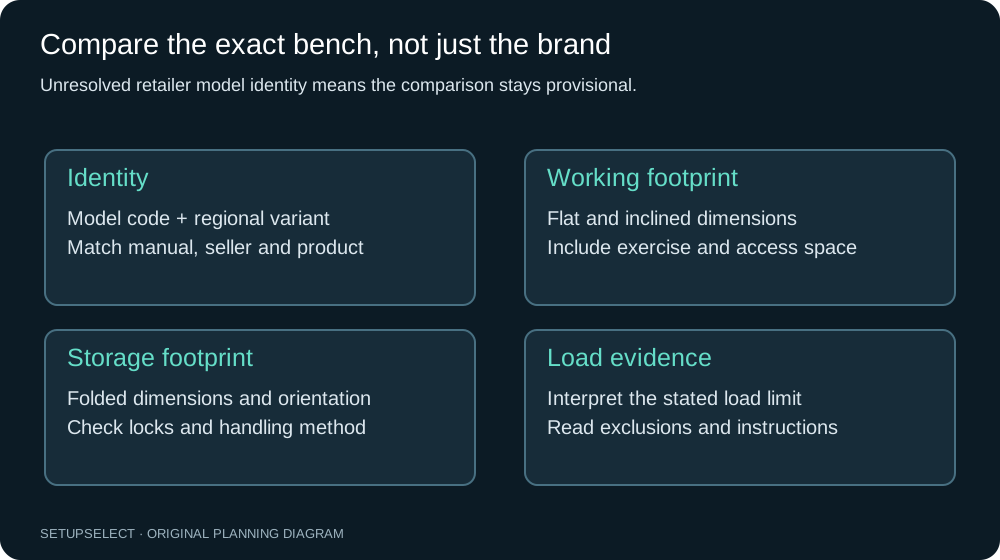
The useful shortlist begins with fields that are verified for each exact model. Mark missing or conflicting data as unknown.
A table with several unknowns may be less visually satisfying than a numerical ranking, but it prevents a false sense of certainty around equipment that must support a person and load.
| Decision field | FLYBIRD candidate | YOLEO candidate | What resolves it |
|---|---|---|---|
| Exact marketplace-to-model match | Not conclusively established here | Not conclusively established here | Matching model label, manual and listing |
| Flat and adjusted dimensions | Verify exact revision | Verify exact revision | Manufacturer drawing or supplied manual |
| Folded storage dimensions | Verify approved orientation | Verify approved orientation | Model-specific folding instructions |
| Load limit and definition | Verify what the stated total includes | Verify what the stated total includes | Manual and manufacturer clarification |
| Permitted exercises | Model-specific | Model-specific | Instructions, not brand assumptions |
| Warranty and returns | Check seller and market | Check seller and market | Current written terms for the order |
This table is deliberately not a product performance ranking. It identifies the evidence required before one can be made responsibly. Neither a larger advertised number nor a more familiar brand removes those checks.
Find out exactly what the stated capacity includes. A headline might describe a combined user-and-weight limit, a different test condition or a particular configuration. Do not assume it means an additional lifting load on top of the user's body weight.
If the definition is unclear, obtain manufacturer clarification.
Check whether the limit changes with adjustment or exercise. The permitted use of a flat configuration may differ from an inclined or declined position, and accessories can introduce separate restrictions.
A rating on a marketing image does not replace the instructions supplied for the exact model.
This guide does not calculate a safe lifting load or approve a programme. Follow the equipment limits and appropriate exercise guidance, and seek qualified advice where needed.
Do not test a bench's capacity by exceeding instructions or applying improvised loads.
Record the bench's overall length and width in the flat position, including stabilisers, feet and adjustment hardware. Then record the dimensions in the positions you intend to use.
The backrest can change height and the support frame can move, so one overall rectangle may not describe every state.
Compare the pad dimensions with your intended use through an appropriate trial or verified guidance. A long overall frame does not necessarily mean a long usable back pad.
Gaps, hinge positions and seat dimensions can affect how the bench works, and these details are difficult to judge accurately from an angled photograph.
For the room, add the user's movement, access and controlled equipment handling. A narrow bench footprint does not mean a narrow exercise zone is adequate.
The home-gym space guide explains why stored, operating and access footprints must be kept separate.
Compare the actual adjustment positions and how they are secured, rather than simply counting them. More positions are not automatically useful if they do not match the intended activity or are awkward to change.
Read the instructions for the locking mechanism and verify that all required components are present.
Check whether the seat and backrest adjust independently and whether the combination you intend to use is supported. A product image showing a position does not establish every permitted exercise in that position.
Follow the model-specific instructions and do not remove or bypass a locking component for convenience.
During an appropriate inspection, check that adjustments engage as described and that the equipment is assembled correctly. Stop if a mechanism behaves unexpectedly, parts are missing or the supplied instructions do not match the product.
Do not compensate for an uncertain mechanism with a guessed fastener or improvised restraint.
Measure the full folded shape, including protruding handles, feet and pads. Check the manufacturer's approved storage orientation and whether the bench is intended to stand independently.
The fact that an object can be balanced vertically does not mean it should be stored that way.
Suppose a storage opening is 125cm long, 50cm wide and 35cm high. Those are hypothetical room dimensions, not the folded dimensions of either bench.
A candidate must fit with enough practical access to insert and remove it in the approved orientation, without damaging the equipment or surrounding furniture.
Also measure the route from storage to use. A bench that fits beneath a bed may need space to turn or unfold that is unavailable in the room.
Keep the folding process separate from the final folded footprint, and follow handling instructions rather than lifting by an unapproved part.
A heavier bench may be less convenient to move, but weight alone does not establish stability or quality. A lighter model may be easier to store, but that does not prove it suits the intended loads or exercises.
Compare handling with the verified design and instructions rather than treating mass as a universal score.
If the bench will be moved every session, identify the approved grip points and any transport features. Consider the user's ability to move it safely and the room's thresholds, floor finish and corners.
Avoid dragging equipment unless the instructions explicitly support the method.
For an upstairs flat, include the noise and vibration created during setup and reset. Repeatedly moving a bench and weights across the room can become a significant part of the disturbance.
The quiet home-gym guide offers a planning approach without promising soundproofing.
Use the bench on the surface and under the conditions specified by its manufacturer. Check levelling, support contact and assembly sequence. A very soft or uneven surface can change how equipment behaves, so do not assume any gym mat is suitable beneath it.
Inspect all supplied fittings against the manual and follow the tightening and reinspection instructions. If the product arrives damaged or incomplete, resolve that before use.
Do not treat wobble as an inevitable feature to be fixed with random packing material or altered parts.
The building's floor capacity is a separate issue, particularly where equipment and weights create concentrated loads. This comparison does not assess structural suitability.
Seek appropriate advice rather than assuming that a compact footprint or a rubber mat resolves the question.
For a shared room, the most important verified difference may be storage and handling. If one exact model can be stored in an approved orientation through the available route and the other cannot, that is a meaningful practical distinction.
It still does not override load or use limitations.
For a permanent training area, the relevant differences may be pad geometry, adjustment positions and the supported activities. Storage convenience becomes less important if the bench stays in place.
Compare the instructions and trial conditions for the routine rather than automatically choosing the model that folds smallest.
For a user planning future equipment changes, clear documentation and support may be valuable. However, do not buy capacity for an undefined future programme while ignoring current fit.
A bench should meet the actual intended use now, with future changes reassessed when they become concrete.
Check who is selling the item and which written warranty applies in your market. A brand's general support page does not necessarily establish the terms of every marketplace seller.
Record the order's model and seller details, the return period and any collection or packaging requirements.
For bulky equipment, return logistics can materially affect the purchase. Ask whether disassembly is required and whether original packaging should be retained. Do not assume a free return merely because a smaller accessory from the same retailer had one.
Keep the decision grounded in current terms rather than historical prices or claims from an old review. This page does not provide a live price comparison, and affiliate links do not guarantee a particular seller, model revision or availability.
A defensible recommendation would identify both exact models and revisions, cite consistent manufacturer dimensions and limits, and explain which measured user requirements favour one.
It would distinguish researched specifications from observations made during actual testing, and record any unresolved fields.
If hands-on testing is later performed, useful evidence would include assembly observations, measurements in stated positions, adjustment operation and the permitted test conditions. That work should be documented rather than implied by first-person language.
No such testing is claimed here.
Until model identity is resolved for the existing catalogue links, the responsible verdict is conditional: shortlist the exact bench whose verified instructions, dimensions and support meet your requirements.
Do not infer an overall brand winner from incomplete data.
Use the equipment fit checker and equipment database to organise published evidence, not as approval for an uncertain installation.
Related space planning and adjustable-dumbbell guidance help assess the rest of the setup.
Ask the retailer to confirm the exact model code, provide the matching instruction manual and identify whether the stated load limit includes the user and equipment together.
Request unfolded and folded dimensions for that same model, rather than a generic brand specification.
If the reply links a different product photograph or manual, keep the question open. Similar upholstery, frame colour or adjustment positions are not enough to establish that two listings describe the same bench.
Regional and revised versions can also require separate documentation.
Before making a final comparison, put both confirmed records side by side and mark any missing field as unresolved. This may leave no defensible winner.
That is a useful result: it prevents a brand-level comparison from disguising a model-level information gap, and tells you exactly what evidence is needed before purchase.
Which brand is better? The available identity evidence does not support a blanket winner.
Compare exact models against the activity, user and room. Can I use the largest capacity figure as the deciding factor? Only after its definition and applicable configuration are verified; it is not a standalone quality score.
Why does this comparison remain noindex? The existing marketplace-to-model mapping is unresolved, and publishing a confident search-targeted verdict would overstate the evidence.
The page remains useful as an explanation of the decision process, while the reverse-order URL is consolidated to this one.
Are the illustrated dimensions measurements of these products? No. Any room or storage figures are explicitly hypothetical. Manufacturer references were reviewed for this editorial update, but SetupSelect has not measured or load-tested the benches.
Verify the delivered model and supplied instructions before use.
Reviewed 29 September 2026. Exact marketplace model identity remains unverified. The linked Amazon targets use specific product identifiers, while both brands publish several visually similar adjustable benches. Current brand pages confirm that model dimensions, adjustments and stated limits differ across their ranges; they do not prove that an older marketplace identifier still maps to an unchanged specification. Verify the exact model on the live retailer page, supplied manual and delivered label before relying on any number.
Keep comparing