Buying guide
Quiet home gym in an upstairs flat: equipment, flooring and limits
A quieter home gym in an upstairs flat starts by reducing impact at the activity itself, then choosing equipment and a layout that suit the building.
A mat can protect a surface or change some vibration behaviour, but it cannot make every workout silent or establish that the floor can support the proposed loads. Treat noise, structural suitability and exercise suitability as separate questions.
This guide offers a planning and testing method, not a promise of soundproofing or a prescribed exercise programme. The examples are hypothetical.
Follow the equipment instructions and obtain appropriate professional advice if the building, tenancy conditions, health requirements or safe use of equipment is uncertain.
Distinguish the sound sources
Airborne sound includes voices, music, fans and mechanical noise travelling through the air. Impact and structure-borne vibration can arise from footsteps, jumping, equipment movement or weights contacting the floor.
These paths behave differently, so a solution aimed at one may do little for another.
A machine described as quiet may refer to a measurement near its motor rather than what a neighbour hears below. A soft mat can alter contact with the floor without eliminating vibration through the building.
Avoid assuming that a low advertised noise figure predicts the complete experience in your room.
Record the likely sources before shopping. Include setup and storage noises, not just exercise. Dragging a folded bench across the floor or repeatedly placing weights down can be more noticeable than the activity you originally planned to quieten.
Check the building and permissions first
Understand any relevant tenancy, building or household restrictions before creating a permanent installation. Do not drill mounts, fix storage or modify a floor without the appropriate permission and evidence.
A product being sold for home use does not establish that every flat is a suitable location.
Floor loading and concentrated storage are not matters a generic workout guide can certify. A heavy machine or a collection of weights may require assessment by a suitably qualified person.
Placing rubber or foam underneath does not change the need to establish structural suitability.
If the floor visibly moves, equipment feels unstable or the setup creates concern, stop and seek advice. Do not try to solve an unknown structural problem by adding more layers of flooring or moving the same load to a guessed stronger corner.
Plan a lower-impact routine with appropriate guidance
Start with the activities you can perform safely and consistently, using appropriate exercise guidance. Where suitable, controlled movements without jumping or dropping equipment may reduce impact at source.
That is a planning principle, not a claim that a particular exercise is appropriate for every person.
The NHS strength-exercise guidance provides general information for home activity. If you have an injury, health condition or uncertainty about technique, seek individual advice.
Do not replace a prescribed programme solely because a different movement appears quieter.
Write down the setup, exercise and reset sequence. Identify moments when equipment contacts the floor or moves between locations.
Reducing those transitions can be more useful than buying an accessory marketed as noise-reducing while leaving the same repeated impacts unchanged.
Choose equipment for control and handling
For any resistance equipment, check the adjustment method, intended use, permitted loads and handling instructions. A compact item is not automatically easy to move or place down quietly.
Consider the grip points, storage base and whether an adjustment requires moving components across the room.
Resistance bands may reduce some equipment-storage demands, but they introduce their own inspection, anchoring and use requirements. Do not attach them to an unverified door, railing or piece of furniture.
Follow the exact instructions and discard or replace damaged equipment as directed.
For adjustable dumbbells, check how they must be returned to their base and whether dropping is prohibited. Do not infer that a robust appearance makes them suitable for impact.
Controlled handling and an appropriate storage arrangement belong in the purchase decision, not just the maximum advertised load.
Flooring choices and their limits
Select flooring for the intended activity, equipment and existing floor finish. Soft exercise mats, interlocking foam and dense rubber products serve different purposes.
A very soft surface can change stability under some equipment, while a hard surface may be unsuitable for a particular floor exercise.
Check compatibility with the underlying finish, moisture, cleaning products and any adhesives. A temporary covering can trap moisture or mark a surface if used contrary to instructions.
Lift and inspect it as recommended rather than assuming hidden areas remain in good condition.
Do not quote a universal noise reduction for an unspecified mat. Acoustic performance depends on the source, material, installation and building.
If sound isolation is a significant requirement, seek relevant evidence or professional advice rather than treating thickness alone as a reliable performance measure.
| Question | Useful evidence | What does not answer it |
|---|---|---|
| Will the surface suit the exercise? | Product instructions and appropriate exercise guidance | A generic gym label |
| Will equipment remain stable? | Manufacturer base and flooring requirements | Softness alone |
| Will it protect the existing finish? | Compatibility and care instructions | Colour or appearance |
| Will neighbours hear less? | Relevant measurements or a controlled trial in the building | Unqualified silent claims |
| Is the floor structurally suitable? | Appropriate building assessment | Adding a mat |
A mat-first room example
Imagine a clear 2 × 2m zone used for a suitable low-impact routine. Draw the user's movement beyond the mat and keep storage outside it. The area is an example, not a universal safe minimum.
Check ceiling height, nearby furniture and the route to stand and leave.
Place frequently used items where they can be reached without stepping over equipment. Avoid balancing objects on furniture that is not intended as gym storage.
If the room doubles as a bedroom or office, define where the mat and accessories go after the session so they do not become everyday obstructions.
Trial the routine without adding unnecessary equipment. Record the audible and transmitted effects with the agreement of relevant household members or neighbours where appropriate.
The aim is to identify the actual problem, not to prove that a preselected purchase must work.
A bench-and-dumbbell example
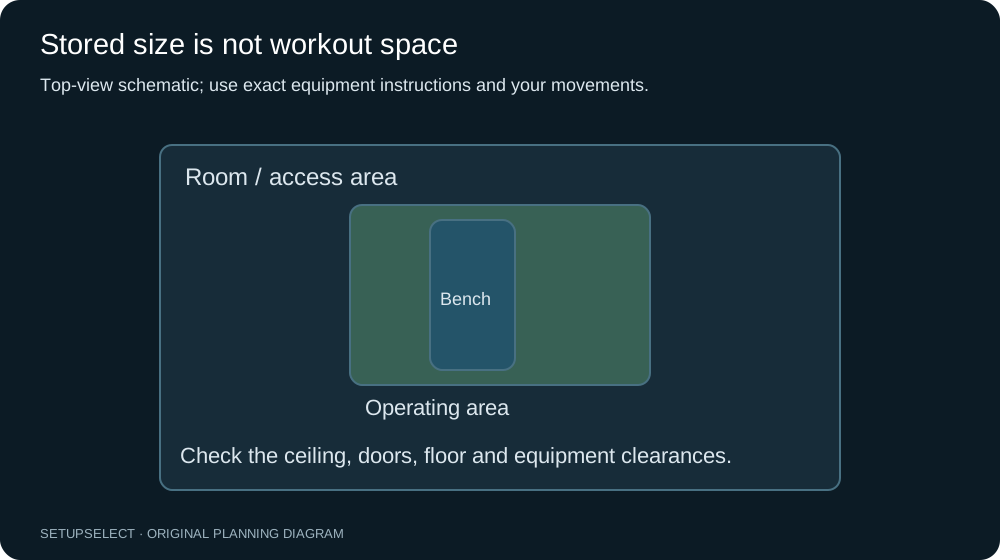
For a hypothetical folding bench, record its stored and operating dimensions, adjustment positions and the clearance required by its instructions. Add space for the person and controlled equipment handling.
A bench's narrow base footprint does not describe the complete activity zone.
Keep the dumbbell storage close enough for practical handling but outside the movement and exit route. Repeatedly carrying heavy items across a small room adds handling and noise opportunities.
Follow the equipment guidance for loads and use; this article does not approve particular exercises or combinations.
If setting up the bench requires dragging it across the floor, reconsider the storage route or equipment choice. Use approved handling methods rather than improvised wheels, straps or furniture modifications.
The home-gym space guide explains why the transition between stored and operating states matters.
A cardio-machine example
A compact cardio machine can generate motor, belt, fan or mechanical noise as well as vibration. Check the exact manufacturer's placement, levelling and maintenance instructions.
A device that is not correctly assembled or maintained may behave differently from its published specification.
Record mounting and dismounting space, ceiling clearance and the location of powered connections. Do not assume a machine suitable for a ground-floor room is automatically appropriate upstairs.
Its weight, dynamic use and building context require separate consideration.
If noise is the deciding constraint, seek relevant evidence for the model and test within the available return conditions where possible. A sound reading taken in another room or building cannot guarantee what will be heard below your floor.
Avoid describing any machine as neighbour-proof.
Run a controlled noise trial
Agree a suitable time and keep the activity within safe, familiar limits. Use the same room arrangement, equipment and routine for each comparison. Record what changes: movement, equipment location, flooring or maintenance.
Changing several things at once makes it difficult to identify which mattered.
Ask listeners to describe the character of the disturbance rather than only whether it is loud: repeated thumps, low vibration, mechanical rattle or music. Those observations help distinguish sources.
A phone sound-meter app can be a rough personal reference, but it is not a substitute for a professional acoustic assessment or a reliable comparison across different devices.
If the trial reveals a significant problem, stop and reassess. Do not continue an intrusive routine on the assumption that neighbours will adapt.
A different activity, location or schedule may be more practical than attempting to isolate an unsuitable source with accessories.
Timing and household routines
Choose times that respect the people sharing the building and any applicable conditions. A short, predictable session may be easier to accommodate than an irregular routine, but timing does not make an unsuitable load or installation safe.
Keep those questions separate.
Plan the setup and reset so they do not create additional disturbance outside the exercise period. Labels, a clear storage layout and fewer loose accessories can reduce repeated moving and searching.
A quieter routine is easier to maintain when the room is organised for it.
Consider children and pets, who may enter the area unexpectedly. Store equipment according to its instructions and keep the operating zone controlled.
A tidy photograph is not evidence that the equipment is secure when the room returns to ordinary household use.
Avoid false fixes
Do not stack arbitrary layers of foam beneath equipment without checking stability and the manufacturer's requirements. Do not use a decorative rug as evidence of impact protection.
Do not assume that placing a machine beside a wall or in a corner resolves floor loading or vibration transmission.
Likewise, noise-cancelling headphones only affect the listener wearing them; they do not reduce the disturbance sent into the building.
Soft furnishings may change the sound within a room but should not be presented as a complete solution for repeated floor impact.
The most useful changes often address the source: removing unnecessary impacts, correcting an approved setup, maintaining equipment and simplifying handling.
Where the source cannot be made appropriate for the room, choosing another location or activity is a valid outcome.
Maintenance and recurring checks
Follow the manufacturer's inspection and maintenance schedule. Check moving parts, fixings, pads and contact points as directed, without performing unsupported modifications.
A new rattle or unexpected movement deserves investigation rather than concealment with extra material.
Inspect the flooring and storage arrangement periodically, especially after moving equipment. Ensure access routes remain clear as other household items accumulate.
The original layout can become unsuitable even if no gym product has changed, simply because storage has expanded into the movement zone.
Repeat the planning check when buying a heavier item or changing the routine. A setup that worked for one activity is not automatically approved for another.
Keep the equipment sources and critical limits with the room plan so future decisions start from evidence.
Keep a simple disturbance log
If another occupant is willing to help, agree a short observation period at a considerate time. Record the exercise, the equipment placement and what was noticed in the other room.
Describe the observation plainly: a repeated thud, a vibration through the floor or audible music. Do not turn a phone recording into a claimed laboratory sound-reduction measurement.
Change one thing at a time so the result is interpretable. Moving a mat, changing an exercise and lowering the music simultaneously may improve the experience without showing which change helped.
If ordinary controlled movement still causes unacceptable disturbance, accept that limitation. The next step may be a different activity or location, not another layer of flooring.
A quiet home-gym plan is successful when it works for the building and its occupants, not when it contains the most products.
Checklist, sources and next step
- Confirm permissions and any structural questions before installing equipment.
- Identify airborne sound, impact and vibration separately.
- Choose appropriate activities and controlled handling methods.
- Verify flooring and equipment requirements rather than relying on generic claims.
- Test one change at a time in a respectful, safe trial.
- Keep storage, access and the reset routine part of the plan.
Use the gym-space planner and flooring calculator for layout and quantity estimates, not safety certification.
The distinction between source control and transmitted vibration is also discussed in HSE noise-control guidance; its workplace scope should not be mistaken for a tested domestic flooring specification.
No product or room in this article has been acoustically tested by SetupSelect, and no reduction in decibels is promised.
Continue researching