Buying guide
How much space does a home gym need? Worked room examples
A home gym needs enough space for the activity, not just enough floor area to store the equipment. Measure three footprints for every item: stored, operating and access.
Add the user's movement, overhead reach and the route needed to enter, leave and put equipment away. There is no reliable universal square-metre figure that makes every home gym suitable.
This guide uses hypothetical layouts to show the method. It does not assess a building's floor loading, prescribe exercises or certify an equipment installation.
Follow the exact equipment instructions, and obtain appropriate professional advice when structural suitability, health or safe exercise technique is uncertain.
Begin with the routine you intend to perform
Write down the activities the space needs to support before choosing products. A mat-based routine, adjustable dumbbells and a bench, or a cardio machine create very different movement and storage requirements.
Include the transitions between activities, not just the position used for one repetition.
Separate regular activities from speculative future purchases. A small space becomes difficult to use when it is designed around a rack or machine that is rarely used while the daily routine has nowhere to happen.
Start with the smallest set of equipment that supports the intended routine and can be stored sensibly.
If you are new to exercise or have a health concern, use appropriate guidance rather than designing a programme from furniture dimensions.
The NHS home strength-exercise guidance provides general starting information. Room planning and exercise suitability are related but separate decisions.
Measure the room in three dimensions
Record width, depth and ceiling height at the actual activity location. Include sloping ceilings, beams, light fittings, fans and low door frames.
Measure skirting boards, radiators and projecting handles rather than treating the room as a perfectly empty rectangle.
Draw doors and drawers open and mark routes that must remain clear. A room may have adequate total area but an awkward shape that prevents safe equipment access.
Separate fixed obstructions from furniture that can genuinely be moved each session, and account for where moved furniture will go.
For overhead activity, measure the full intended reach with appropriate guidance and equipment instructions. Do not calculate clearance solely from standing height. Footwear, platform height and the equipment itself can change the envelope.
A floor-plan calculator cannot determine whether a movement is safe beneath a particular ceiling.
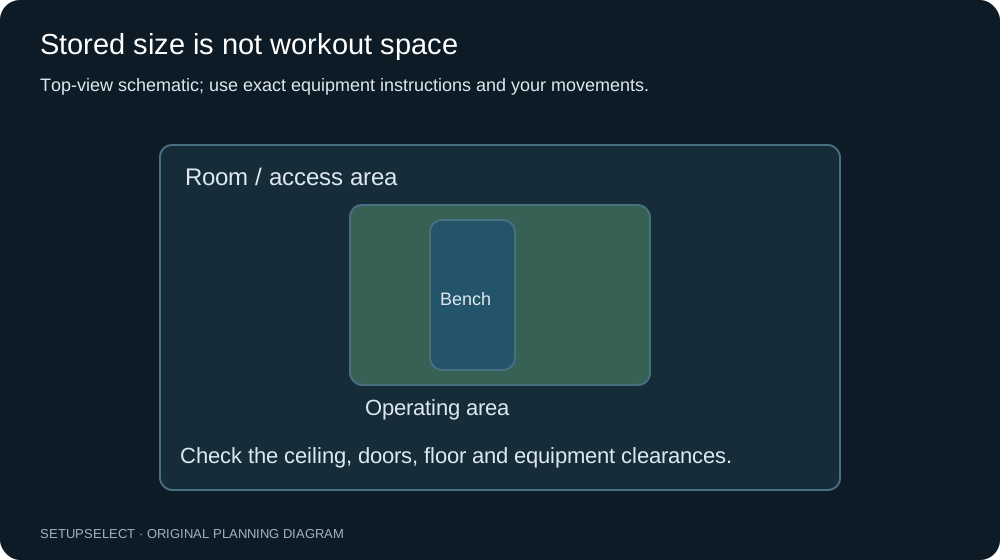
Stored footprint versus operating footprint
A folding bench might occupy a compact rectangle in storage but need a much larger area when unfolded and used. A cardio machine can require space for mounting, dismounting and maintenance in addition to its casing.
Product dimensions often describe only one of those states.
Record each state explicitly. Ask whether a stated dimension includes protruding handles, stabilisers, pedals or adjustment mechanisms. If a product folds, check the actual folded orientation and whether it is approved to stand upright or lean against a wall.
Do not invent a storage method from the fact that an item appears physically capable of it.
For shared rooms, include the route between storage and use. A bench that fits under a bed may still be impractical if retrieving it involves lifting it around a desk every session.
Weight, grip points and the manufacturer's handling instructions affect how realistic a daily reset will be.
Example one: a mat-first activity area
Imagine a 2 × 2m clear floor zone. A hypothetical 180 × 60cm mat occupies 1.08m², but that does not mean the rest of the zone is automatically sufficient for every movement.
Arms, legs and transitions can extend beyond the mat, while the user still needs a route to stand and leave.
Place a mat-sized template, then rehearse the intended movements without adding load or attempting unfamiliar exercises. Check lateral reach, head position and nearby furniture.
If the activity requires moving beyond the clear zone, change the routine or layout with appropriate guidance rather than assuming the mat boundary defines a safe area.
Storage may be simple in this scenario, but keep loose items away from the operating zone. A resistance band, water bottle or rolled mat can become an obstruction if left in the route. Plan where each item goes before, during and after use.
Example two: adjustable dumbbells and a bench
Consider a 2 × 3m room and a hypothetical bench 120cm long and 45cm wide when flat. Its bare footprint is only 0.54m², which makes it look easy to fit.
The real operating area also includes the person, feet, arm movement, loading or adjustment and a controlled place to set equipment down.
Draw the bench in every intended adjustment position, because the backrest and support frame may change the occupied shape. Add dumbbell storage where it can be reached without crossing over the bench or blocking the exit.
Follow the exact bench and dumbbell instructions for permitted exercises, loads and handling.
This example does not declare a 2 × 3m room adequate for all bench exercises. It shows why footprint arithmetic alone is insufficient.
Use the equipment fit checker to organise published dimensions and then verify the full movement and manufacturer clearance requirements.
Example three: a compact cardio machine
Suppose a machine's stated footprint is 150 × 70cm. A 2.2 × 2.5m room may appear to contain it comfortably, but access can become constrained once the specified operating clearances, door swing and storage are added.
The machine's exact instructions decide the required surrounding space.
Check mounting and dismounting, moving parts, user-height range and ceiling clearance at the highest operating position. A treadmill, elliptical and exercise bike do not share one universal clearance rule.
Do not transfer a requirement from one product type to another because their floor dimensions look similar.
If the machine folds, separate its stored dimensions from the clearance needed while folding it. Include its weight and handling route. A compact folded measurement is not useful if the daily transition cannot be completed safely in the available room.
| Planning state | What to draw | Common omission |
|---|---|---|
| Stored | Folded or parked equipment in an approved orientation | Handles, wheels or support feet |
| Operating | Equipment plus actual movement envelope | User reach and adjustment positions |
| Access | Entry, exit, mounting and loading route | Open doors and nearby furniture |
| Reset | Path between use and storage | Space needed to fold or turn the item |
Plan storage around handling
Keep frequently used items accessible without awkward lifting over other equipment. Heavy items need appropriate storage and handling, not merely an empty shelf.
Check the storage system's rated capacity and installation requirements, and avoid improvised wall attachments or unsupported furniture.
Label stored and ready-to-use positions on the plan. If dumbbells or other items move onto the floor during a session, include that temporary footprint.
A room can become obstructed even when everything has a tidy storage location, because the storage plan does not describe active use.
For a shared bedroom or office, time the reset with the real equipment or equivalent safe templates. If restoring the room requires several heavy moves, consider a smaller kit or a different permanent zone.
The useful gym is the one whose routine is practical enough to repeat.
Flooring is not a structural assessment
Flooring can affect grip, surface protection, cleaning and some aspects of noise, but it does not certify the building's load capacity. Do not use a mat as evidence that a heavy machine or concentrated weight storage is suitable for an upstairs floor.
Structural questions require appropriate assessment.
Match the surface to the activity and the equipment instructions. Very soft material may be unsuitable beneath equipment requiring a stable base, while a hard surface may not suit a particular floor exercise.
Check compatibility with the existing floor finish, moisture conditions and any adhesives or interlocking products.
The flooring guide and flooring calculator help with selection questions and quantities.
They do not guarantee sound isolation, impact protection for every use or structural suitability.
Upstairs rooms and neighbours
Consider impact and vibration before buying equipment. A device can be quiet near the user while transmitting vibration into the structure. Dropping weights, jumping and moving equipment can create different disturbances from a fan or motor.
Marketing descriptions such as quiet do not establish how a product will behave in your building.
Discuss suitable times and trial a low-impact routine where appropriate. If the arrangement causes disturbance or feels structurally unsuitable, stop and reassess rather than adding layers of soft material without evidence.
See the upstairs-flat gym guide for a source-first approach to noise.
Keep shared routes clear and consider other household members, children and pets. Equipment should not be left where it can move, fall or be used unsupervised contrary to its instructions.
Storage and access are part of the safety plan, not a final cosmetic step.
Ventilation, light and practical access
Check the room during the times it will be used. A small enclosed area can become warm or stuffy, while glare or poor lighting can make controls and obstacles harder to see.
Preserve access to ventilation and follow electrical requirements for powered equipment.
Do not route leads across the movement area. Position powered equipment so the connection can be made in accordance with its instructions without creating a trip hazard or relying on unsuitable extension arrangements.
Ask for qualified advice where the electrical setup is unclear.
Include cleaning and maintenance access. A machine pressed tightly between walls may be difficult to inspect or service even if it can operate there.
Follow the manufacturer's specified clearances rather than treating maintenance as something to solve after installation.
A room rehearsal before ordering
Use removable tape or paper templates to mark equipment, operating zones and storage. Keep the markings suitable for the floor finish. Walk through the session sequence, including setup, adjustment, access to water or controls and putting everything away.
Check every door and drawer with the equipment in use. Include another household member passing where that is part of normal use.
Do not perform unfamiliar or loaded movements simply to test a layout; use appropriate guidance and safe, low-risk rehearsal methods.
Record the conflicts rather than trying to make the drawing look successful. If two operating zones overlap, decide whether the activities genuinely happen at different times and whether equipment can be moved safely between them.
Shared space is useful only when the transition is practical.
Your equipment measurement sheet
| Item | Stored dimensions | Operating dimensions | Required clearances | Handling notes |
|---|---|---|---|---|
| Mat or floor zone | ______ | ______ | ______ | ______ |
| Bench | ______ | ______ | ______ | ______ |
| Resistance equipment | ______ | ______ | ______ | ______ |
| Cardio machine | ______ | ______ | ______ | ______ |
| Storage | ______ | ______ | ______ | ______ |
Add a source and check date for every manufacturer figure. If only a retailer estimate is available, keep that uncertainty visible. Do not fill unknown fields with dimensions from a visually similar model.
Product revisions and included accessories can change the result.
Plan equipment changes between exercises
A room can fit every item individually but still be awkward when changing exercises. Draw where the bench goes while you use the floor area, where weights wait before being lifted, and where equipment is stored after the session.
Do not use the doorway as the default overflow space.
For a shared room, write down the order of setup and clearing away. Heavy or awkward items that must be moved for every short session may reduce how often the space gets used.
A smaller routine with equipment that has a stable, accessible home can be more practical than a crowded collection.
Check the return journey too. After exercise, you still need enough room to handle and store each item in accordance with its instructions.
An arrangement that depends on lifting equipment over another obstacle should be redesigned rather than treated as an acceptable space-saving technique.
Questions and next step
How many square metres do I need? There is no reliable answer without the activity, user, exact equipment and clearance requirements. A small mat routine and a large machine are different planning problems.
Use area as a summary after checking the actual layout, not as the only input.
Does foldable mean suitable for a small room? It helps storage, but does not necessarily reduce operating clearance or make handling easy.
Check all states and the route between them. Can a mat make an upstairs gym safe? No; flooring is not a structural certificate or a guarantee against transmitted noise.
Start with the home-gym space planner, then draw the room in the visualiser. Use exact manuals and the sourced equipment database to replace illustrative dimensions.
The examples here are original planning exercises, and no room or product is presented as personally tested or professionally approved.
Continue researching