Buying guide
Home-gym flooring and mats: materials, stability and tile counts
Home-gym flooring has several possible jobs: providing a suitable surface for floor exercises, supporting equipment, protecting the existing finish and defining a training area. One material does not automatically perform all of them.
Begin with the activity, machine or weights, then check the floor beneath before choosing thickness, tile size or a large roll.
This guide focuses on material compatibility, stability, seams and quantities. For vibration and neighbour disturbance, use the upstairs-noise guide.
No mat or tile described here establishes structural floor capacity, makes dropping equipment acceptable or guarantees soundproofing.
Identify the existing floor
Record the visible finish and, where known, the construction beneath it. Vinyl, laminate, timber, carpet and concrete create different questions.
The floor manufacturer's care and installation guidance may restrict rubber backing, adhesives, moisture or concentrated loads. If you rent, include the property owner's requirements in the decision.
Inspect the area before covering it. Look for uneven sections, movement, dampness, damaged joints or an existing finish that is lifting. Flooring should not be used to hide a problem whose cause is unresolved.
A flat-looking mat cannot establish that the surface beneath is sound or suitable for a heavy machine.
Keep a photograph and the floor product information where available. If you need advice from the equipment or flooring supplier, being able to identify the actual finish is more useful than describing it as “wood effect”.
Similar appearances can conceal different materials and care requirements.
Separate an exercise mat from equipment flooring
An exercise mat is selected for the contact between your body and the surface during the intended activity. Its size, grip, cushioning, cleanability and tendency to move matter.
A thicker mat may feel comfortable for kneeling while being less stable for a movement that requires a firm base.
Equipment flooring must support the machine or weights in the way their instructions require. A soft foam layer can compress differently beneath small feet, allowing rocking or changes in level.
Do not assume that a product comfortable for lying down is appropriate beneath a treadmill or weight stand.
A dedicated equipment mat may protect against certain marks or perspiration while providing a suitable interface, but read its intended applications. The word gym on the packaging is not enough.
Check the machine and mat instructions together, including the permitted substrate and any ventilation or levelling requirements.
Compare materials by the job they must do
| Material or format | Potential use | Questions that decide suitability |
|---|---|---|
| Thin exercise mat | Floor contact and portable routines | Grip, cushioning, size and movement on the existing floor |
| Foam puzzle tiles | Selected light-duty activities | Compression, seam separation and equipment restrictions |
| Dense rubber tiles | Supported weight-area applications | Floor compatibility, density, edge treatment and approved loading |
| Rubber roll | Larger continuous areas | Weight, installation, seams, adhesive and removal requirements |
| Manufacturer-specified machine mat | A particular equipment footprint | Exact machine use, floor compatibility and cleaning |
Material names are broad categories. Two rubber products can differ in composition, density, surface texture and backing, while foam tiles can differ substantially in firmness.
Ask for the product's intended use and technical information rather than making the whole decision from its thickness.
Avoid treating a higher price as evidence of compatibility. An excellent product for a commercial installation may be awkward to remove from a rented room or unsuitable over the existing finish.
The best choice satisfies the specific floor, equipment and household constraints together.
Rubber and vinyl need particular care
Rubber is not automatically harmless to every floor beneath it. Gerflor's maintenance guidance warns that rubber can permanently stain vinyl floor coverings.
This is a concrete reason to check the actual flooring manufacturer's advice before placing a rubber-backed mat or rubber feet on a vinyl surface.
Do not assume a thin sheet of another material provides an approved barrier. The separator may have its own staining, slipping, moisture or warranty implications.
Obtain a supported combination from the relevant manufacturers, especially where an expensive existing floor or rental finish is involved.
A sample can help assess feel, odour and appearance, but a short trial does not prove long-term chemical compatibility. Written compatibility guidance is more useful for that question.
If the floor identity is unknown, choose an arrangement whose suitability can be established rather than accepting a broad “non-marking” claim without context.
Thickness is only one measurement
Thickness affects finished height and can influence cushioning, but density and construction determine how the material behaves under load. A thick soft tile may compress more under a machine foot than a thinner firm product designed for that application.
The correct choice follows equipment and flooring requirements, not a rule that more millimetres always means better protection.
Check door clearance, thresholds, furniture feet and any storage route. A surface that raises the exercise area can create a trip edge or prevent a door opening.
Include edging or transitions where the system requires them, and ensure they remain compatible with the activity and room circulation.
Do not use improvised layers to achieve a desired height. Several loose mats can slide relative to one another or create uneven support.
If a particular thickness or underlay is required, use a manufacturer-supported installation and account for the complete stack in the room measurements.
Calculate the area from the operating zone
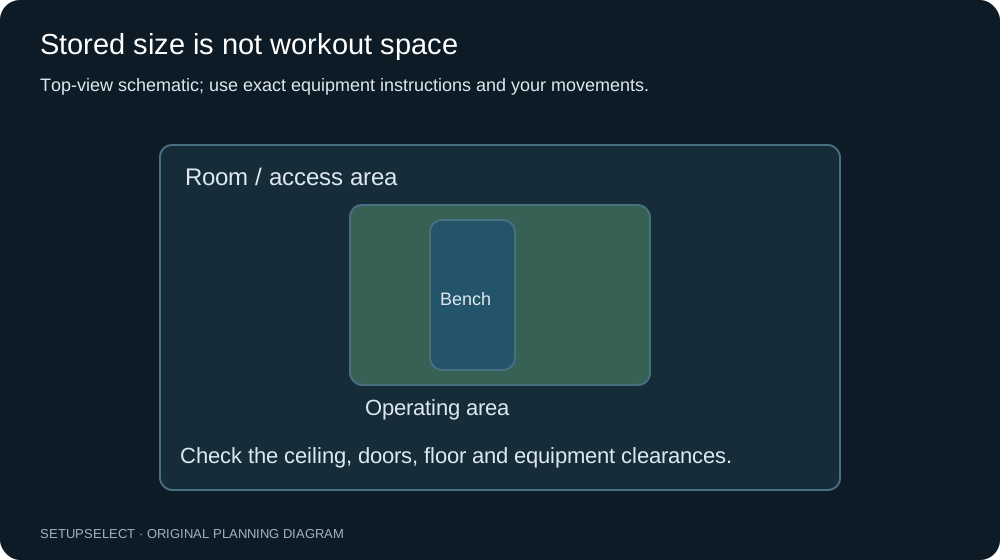
Measure the area the activity actually requires, including the equipment's specified clearance and your access.
Covering the whole room may be unnecessary, while covering only the static machine footprint may leave an awkward edge exactly where you step on or off. The gym space guide helps define those zones first.
For a rectangular area, length multiplied by width gives square metres. An illustrative 2.4 × 1.8m zone is 4.32 square metres. This is an area calculation, not a recommended minimum workout space.
The actual size must come from the movements and equipment involved.
Sketch doors, fixed furniture and obstacles before calculating packs. An alcove or radiator pipe can require cuts that change the useful yield from each tile.
If the product cannot be cut or installed in the required arrangement, a mathematically sufficient area is still not a workable plan.
Tile counts need rounding in both directions
Imagine tiles with a verified usable coverage of 60 × 60cm. To cover the 2.4 × 1.8m rectangle without cuts, you need four tiles along one side and three along the other: twelve tiles. At four tiles per pack, that is three packs.
Confirm that the stated tile dimensions refer to installed coverage rather than including interlocking tabs differently.
Now consider a 2.5 × 1.8m area. Dividing 4.5 square metres by 0.36 gives 12.5 tiles, but a simple rectangular layout needs five columns and three rows before trimming: fifteen tile positions.
Cut reuse may change the purchase count if the product and layout permit it. Area-only arithmetic can therefore understate the practical requirement.
Use the home-gym flooring calculator as a planning aid, then check the layout against the manufacturer's installed dimensions, edge pieces and cutting instructions.
Pack rounding, spare tiles and delivery should appear in the budget explicitly.
Plan seams around movement and machine feet
Place seams with the intended activity in mind. A joint directly beneath a small machine foot may behave differently from a continuous supported surface.
A seam crossing the point where you pivot or step can separate or become noticeable if the product is not suited to that movement.
Follow the required tile connection, expansion gap and perimeter treatment. Do not force a tight wall-to-wall installation where the manufacturer specifies room for movement.
Equally, a loose collection of tiles without supported edges may shift when the activity introduces lateral force.
Check the assembled surface under normal intended use, not just while standing still in the centre. If seams lift, edges curl or the equipment rocks, stop and resolve the installation.
Tape added casually across a failing joint may conceal the symptom without addressing the material or substrate problem.
Machine stability comes before appearance
Read the machine's levelling and floor requirements. Position all feet on the permitted surface and adjust only using the intended mechanism. A machine partly on a mat and partly on the bare floor may sit unevenly.
A mat that is too small can create the same problem when the equipment shifts within its allowed adjustment.
Check the surface after the equipment has been placed and used as instructed. Look for excessive indentation, rocking or movement. Do not assume adding another softer layer will improve stability.
Consult the equipment and flooring suppliers if their requirements appear to conflict.
The compact-cardio guide adds access, headroom and maintenance checks. A suitable floor surface is one component of a complete installation, alongside power, clearances and the machine's operating limits.
Cleaning and moisture are part of the specification
Choose a surface you can clean using its approved method. Sweat, dust and grit can accumulate at seams and beneath loose mats.
Strong solvents, steam or household cleaners may be unsuitable for a particular material even when they are used elsewhere in the home.
Allow cleaned surfaces to dry as directed before replacing equipment or rolling a mat for storage. Inspect beneath removable flooring periodically where appropriate.
Trapped moisture may be difficult to notice when a large impermeable sheet covers the area, particularly if the room already has a damp problem.
Do not interpret a waterproof top surface as a complete moisture-management solution. Water can enter at edges, seams or from the substrate.
Resolve leaks and environmental problems before installation, and seek appropriate advice where the building or subfloor condition is uncertain.
Odour and indoor suitability
Ask about intended indoor use, material information and installation guidance before buying a large quantity. Some products have an initial odour, but a general statement that all smells disappear quickly is not evidence for the exact item.
Check the manufacturer's information and return conditions if this matters in a bedroom or shared living area.
Unpack and ventilate only as instructed, without placing material where it blocks exits or creates a trip hazard. Avoid coating or washing the product with unapproved substances to mask an odour.
If it causes concerning symptoms or appears defective, stop using it and obtain appropriate advice.
A small sample may help with texture and smell before a large order, though it cannot replicate the whole room or establish long-term compatibility.
Consider how the material will be stored when not in use; a heavy roll is less flexible than a small exercise mat despite both being removable in principle.
Budget for installation and removal
Include edge pieces, compatible underlay if specified, delivery, cutting tools where appropriate and any professional installation required. Large rubber rolls can be heavy and difficult to manoeuvre through a flat.
Confirm package dimensions and the handling route before ordering.
For a rental, prefer an installation whose removal consequences are understood. Adhesives can make a surface look neat while creating a difficult future removal task.
Check whether the floor and product permit loose laying, and do not substitute an adhesive method simply because another brand uses one.
Keep spare material only where useful and store it according to instructions. A spare tile from the same batch may make later replacement easier, but excessive unused flooring consumes storage and budget.
The small-flat budget guide helps prioritise the active area over cosmetic coverage.
Flooring questions
Can I put rubber tiles straight onto vinyl? Do not assume so. Check the exact floor and tile manufacturers' guidance; rubber can stain some vinyl surfaces. An improvised barrier is not automatically an approved solution.
Will a thick mat make an upstairs gym quiet? It cannot guarantee that. Noise and vibration depend on activity, equipment and building construction.
Reduce impact at source and use the separate upstairs guide for those decisions.
Can a treadmill sit on foam puzzle tiles? Only if the complete arrangement meets both manufacturers' requirements. Compression and seam movement may be unsuitable. Prioritise stable, level support over the convenience of using tiles you already own.
Should I cover the whole room? Cover the area justified by the routine, equipment clearances and safe transitions. Whole-room coverage can simplify some layouts but adds cost, handling and compatibility exposure. Measure the required zone first.
Does flooring make the building suitable for heavy weights? No. Surface protection is separate from structural capacity. If that capacity or the building's permitted use is uncertain, obtain appropriate advice before installing heavy equipment.
Continue researching