Buying guide
Small-flat home gym under £150: three itemised plans
A £150 home-gym budget can support a useful small-flat setup when it funds a defined routine and includes storage and floor compatibility. It is not enough to promise every category of equipment.
Decide whether your immediate need is a comfortable floor-work area, a compact resistance system or a small set of weights, then buy the parts that make that choice usable.
The three allocations below are illustrative UK spending caps prepared in September 2026, not live retailer prices or tested product packages. Each totals £150, including a reserve.
They exclude room renovation, structural assessment, professional coaching, delivery above the stated reserve and any equipment already owned. Replace every allowance with a verified price before ordering.
Define the routine the budget must support
Write down the sessions you intend to perform, where they fit into the week and which movements require equipment. A plan based mainly on floor exercises and bodyweight movements has different needs from one requiring repeated dumbbell load changes.
Buying a broad starter bundle before defining the session can leave you with several accessories and too little useful resistance.
The NHS strength-exercise guidance includes home-based options and advises building up gradually. Use appropriate instruction for your ability and circumstances.
This article allocates equipment spending; it does not prescribe a personalised exercise programme or establish a safe load for an individual.
If you are new to equipment selection, start with the beginner home-gym guide. It explains staged buying and progression.
Here, the central question is how to spend a fixed amount while keeping enough space and flexibility to use what you buy.
Budget A: a floor-and-band setup
| Allocation | Illustrative cap | What to verify |
|---|---|---|
| Exercise mat suited to the intended movements | £30 | Grip, size, cleaning and existing-floor compatibility |
| Resistance-band set | £35 | Useful resistance range, instructions and condition checks |
| Compatible storage container | £15 | Fits the equipment and its permitted storage conditions |
| Small floor-protection allowance | £20 | Needed material and compatibility, not automatic extra layers |
| Instruction or selected missing accessory allowance | £20 | A defined need within the routine |
| Delivery and unspent reserve | £30 | Keeps the total within budget |
| Total | £150 | No bench or cardio machine included |
This scenario suits a routine that genuinely uses bands and floor work. It does not assume every band exercise needs a door anchor. If an anchor is required, it must be the supported type used in accordance with both the anchor and band instructions.
A convenient door handle or radiator is not an interchangeable fixing point.
If the exercise mat already provides the appropriate contact surface and the floor needs no additional approved layer, leave the protection allowance unspent. Stacking materials without understanding their interaction can make the working surface less stable.
The flooring guide explains the distinction between a comfortable exercise mat and equipment flooring.
Budget B: simple plate-loaded resistance
| Allocation | Illustrative cap | What to verify |
|---|---|---|
| Compatible handles, collars and plates | £85 | Weight per handle, plate combinations and locking instructions |
| Suitable floor/contact protection | £25 | Stable support and floor-finish compatibility |
| Low, appropriate storage solution | £15 | Rated capacity and safe access |
| Delivery and missing-parts reserve | £25 | Includes anything not supplied in the kit |
| Total | £150 | No bench, rack or selector mechanism assumed |
The important figure is the useful load on each handle, not the total weight printed on the box. A set described by its combined package mass may include handles, collars and plates that cannot produce the increments your programme needs.
Write out the actual configurations before comparing it with another set.
Adjustment speed is a trade-off. Plate-loaded handles can be straightforward, but changing both sides of two dumbbells takes time. Check how many changes occur in a normal session and whether they require clearing a patch of floor for loose plates.
A low purchase price loses appeal if the routine becomes awkward enough that you avoid it.
Budget C: reuse first, then fill one gap
| Allocation | Illustrative cap | Intended use |
|---|---|---|
| One selected resistance purchase | £60 | Addresses a documented limitation in existing equipment |
| Replacement mat or suitable surface item | £25 | Replaces a worn or unsuitable item if needed |
| Storage improvement | £20 | Makes setup and pack-away easier |
| Maintenance or replacement parts | £15 | Only supported parts for equipment already owned |
| Reserve for later progression | £30 | Retained until experience identifies the next step |
| Total | £150 | Existing useful equipment remains central |
This allocation may be the best fit when you already own a mat, a few weights or resistance bands. Inventory them first, checking condition and instructions.
A worn band, missing collar or unstable storage shelf should not become part of the plan simply because it is free. Reuse depends on suitability, not just ownership.
The £60 is not a claim that a particular adjustable system or kettlebell is available at that price. It is a decision boundary. If the appropriate next item costs more, retain the money and continue with a suitable existing routine while saving.
Buying a stopgap that cannot provide the required load may make the eventual upgrade more expensive.
Keep the reserve visible
Budget guides often allocate every pound to products and omit delivery, replacement parts or the floor surface. Keeping a reserve makes the plan more honest.
A £125 basket can exceed £150 once delivery, missing collars or an essential compatible accessory are added. Calculate the complete delivered setup, not the sum of headline prices.
Record whether prices refer to one dumbbell or a pair, one tile or a pack, and a band alone or a kit including supported attachments. These packaging differences can distort comparisons.
Check the actual contents and model rather than relying on the product photograph.
Use the home-gym budget planner with current figures. Remove an optional item when a necessary one exceeds its allowance.
Avoid making uncertain electrical equipment, unstable supports or incompatible floor protection the place where the budget is forced to balance.
Measure storage as carefully as the training area
Suppose an illustrative storage compartment is 60cm wide, 40cm deep and 30cm high. Its geometric volume is 72 litres, but that does not establish how much weight it can hold or whether a person can retrieve heavy items comfortably.
The shelf, container and floor each have separate requirements.
A pair of hypothetical cradles measuring 40 × 20cm each might appear to fit side by side in a broad cupboard, yet need extra space for fingers, handles and safe removal. A rolled mat might fit horizontally but block access to those cradles.
Lay out cardboard shapes for planning, then confirm dimensions and handling with the actual manufacturer's information.
Do not store heavy equipment on an ordinary high shelf merely because the dimensions match. Choose a permitted, stable location and follow storage instructions.
Keep loose plates and small components contained appropriately, and prevent access by children or pets. Storage should reduce everyday handling risks as well as visual clutter.
Account for the route between storage and exercise
The equipment may fit both the cupboard and the exercise area while being awkward to move between them. Trace the route past doors, chair legs and corners.
Check whether the mat must be laid before the weights are moved, and whether you can put everything down in a supported place during setup.
An illustrative floor zone of 180 × 120cm is only 2.16 square metres, but it is not a universal exercise allowance. Your body, movement, equipment and required clearances determine the necessary area.
Use the home-gym space planner and the space-planning guide for the actual movement checks.
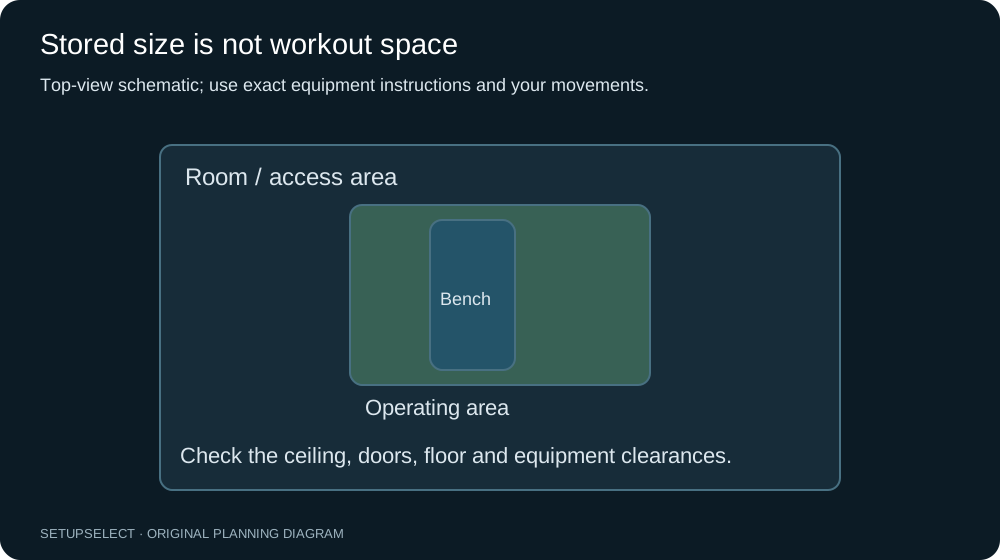
The diagram uses a bench to illustrate nested areas; none of these £150 plans requires one. The same principle applies to a mat or weights: stored dimensions do not describe the space needed to pick up equipment, perform the movement and return it safely.
Avoid buying a bench before you need it
A bench consumes budget, operating space and storage effort. Add one only when the intended programme calls for supported exercises that justify it and when the exact model's limits and adjustment system are suitable.
A folding label does not establish that it is easy to carry, safe to store upright or simple to unfold repeatedly.
Do not use an ordinary coffee table, bed or unverified stool as a substitute weight bench. The furniture's intended use and load behaviour may be very different.
If your current budget cannot fund a suitable support, choose an appropriately instructed routine that does not require that support.
The FLYBIRD and YOLEO model-comparison guide explains why identifying the exact bench matters.
It is a later decision for many small-flat setups, not an automatic component of the first shopping basket.
Evaluate second-hand equipment by complete cost
Used equipment can make a fixed budget go further, but only when its identity, condition and required parts can be established. Check the model, instructions, adjustment mechanism, fasteners and any relevant recall information.
A low price does not compensate for missing safety-critical components or an unknown history of damage.
Simple plates and handles still need compatible dimensions and serviceable collars. More complex selector dumbbells introduce locking mechanisms and model-specific parts.
The adjustable-dumbbell buying guide covers those checks, including current recall examples and the difference between package weight and usable settings.
Include collection, transport and replacement costs in the comparison. Ask whether you can inspect the equipment and whether legitimate support remains available. Do not improvise repairs to load-bearing or locking parts to preserve a bargain.
Keep enough budget flexibility to decline an unsuitable item.
Noise and building limits need separate decisions
This budget does not establish that an upstairs floor can support any proposed load. Nor does buying a mat guarantee that neighbours will not hear exercise. Repeated impacts, machine vibration and airborne sound involve different mechanisms.
The upstairs-flat guide examines those distinctions.
Prioritise controlled handling and a routine compatible with the room. Follow equipment restrictions on dropping or impact. If the building, lease or floor suitability is uncertain, resolve that uncertainty before buying heavy equipment.
A small financial budget does not automatically mean the physical load is insignificant.
Agree practical workout times in a shared household and keep access routes available. A quiet-looking piece of equipment can still be disruptive when dragged out of a cupboard early in the morning.
Storage wheels, lids and loose plates deserve attention alongside the exercise itself.
Use a staged purchase test
First establish the routine and clear the area. Next purchase the minimum suitable equipment for the first stage, retaining the reserve.
After several sessions, note the actual limitation: too large a weight increment, awkward storage, unsuitable mat grip or insufficient resistance for a planned movement.
Make the next purchase answer that observation. If the kit works, there is no obligation to complete every line in the illustrative budget. If the routine changes completely, pause and reassess before adding specialised accessories to the original plan.
Money retained is useful flexibility.
Keep a short log of setup time and which equipment was used. This is not a performance test or a promise of training results; it is evidence about whether the equipment fits your home routine.
A kit that takes two manageable trips from storage may be more sustainable than a larger one requiring the room to be rearranged each time.
Questions about a £150 small-flat gym
Can this budget include a treadmill? These examples do not. A machine introduces delivery, maintenance, operating clearance and model-specific safety requirements.
Compare a complete suitable machine separately using the compact-cardio guide, rather than forcing it into a resistance-kit budget.
Are bands always the cheapest long-term option? They can be compact and affordable, but suitability, replacement, anchors and progression matter. Choose them because they support the intended routine, not because their purchase price alone is low.
Should I spend more on heavier weights immediately? Check current useful settings, increment size and realistic progression first. A very heavy maximum does not help if the minimum is unsuitable or adjustments are too coarse.
Keep the budget attached to the movements you will actually perform.
What if the only available storage is under the bed? Verify clearance, retrieval and the equipment's permitted orientation. Avoid dragging heavy equipment across a vulnerable floor or storing it where bedding obstructs mechanisms.
Under-bed space is useful only when the complete handling routine works.
Can I start without buying anything? Often a suitable bodyweight routine and existing clear space can reveal what equipment would help. Use appropriate instruction and stable supports where required.
The first purchase should address an observed need, not satisfy the expectation that a home gym must look complete.
Continue researching