Buying guide
Compact cardio machines: operating space, storage and fit
A compact cardio machine must fit while you use it, not just while it is folded. Compare the operating footprint, the manufacturer's additional clearance, your body position, the storage route and the effort of setting it up.
A machine that disappears under a bed but is difficult to retrieve may be less practical than a slightly larger bike that remains ready in an appropriate corner.
This guide compares walking pads, folding treadmills, bikes and rowers through ownership and room-fit questions. Documented manufacturer examples illustrate the measurements; they are not hands-on rankings or claims that one model is best.
Prices, regional versions and specifications should be rechecked for the exact product before purchase.
Choose the movement before the storage mechanism
Identify what sessions the machine will support: gentle walking while taking a break, structured cycling, rowing practice or running. These are different activities with different equipment requirements.
A low-profile walking pad is not automatically a running treadmill, and a short belt may not suit every person's stride or intended speed.
Consider your current experience and any need for instruction or medical advice. Do not buy a machine solely because its advertisements promise a particular fitness outcome.
The NHS exercise guidance provides a starting point for activity information; a purchase cannot establish what intensity or movement is appropriate for you.
Write down when you will use it and whether the room must return to another function afterwards. A daily ten-minute session and a long weekend workout create different setup priorities.
If you dislike the movement itself, a sophisticated folding system is unlikely to make the machine useful.
Separate four sets of dimensions
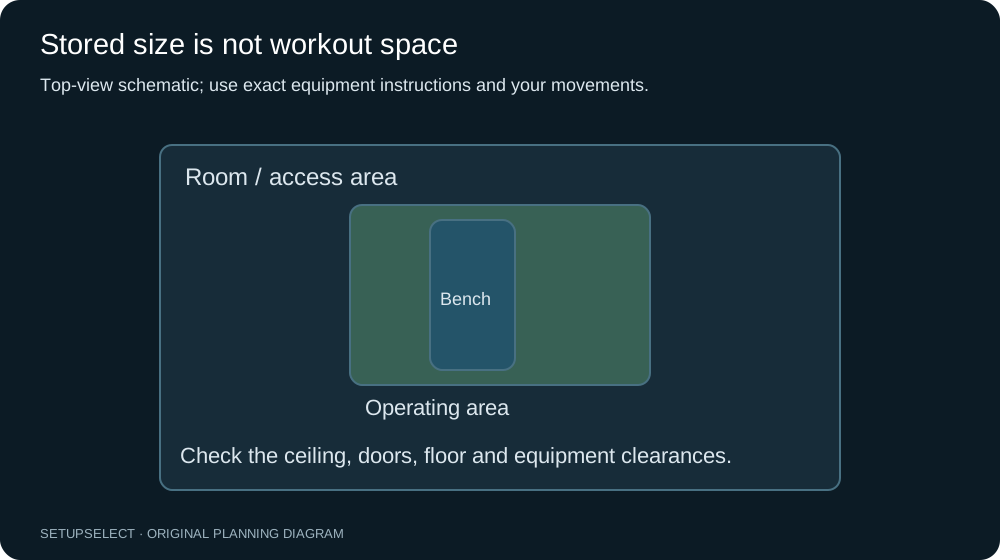
Record assembled dimensions, clearance for use, storage dimensions and delivery dimensions. The assembled footprint describes the hardware. Clearance includes the space needed around it according to its instructions.
Storage figures apply only in the permitted folded or separated state. Delivery dimensions determine whether the packaged machine can reach the room.
Do not substitute one set for another. A folded width does not prove doorway access while carrying the assembled machine, and a compact package may require substantial assembly.
Check whether handles, pedals, monitor arms or feet extend beyond the main body in any state.
Use the equipment fit checker and home-gym space planner to record the figures. The manufacturer's manual remains the source for clearances and permitted operation.
A planning rectangle is a useful rejection test, not a substitute for those instructions.
A documented rower-versus-bike comparison
| Measurement | Concept2 RowErg, standard legs | Concept2 BikeErg |
|---|---|---|
| Assembled footprint | 244 × 61cm | 122 × 61cm |
| Manufacturer's space including use clearance | 274 × 122cm | 152 × 122cm |
| Storage arrangement | Separates into two parts | Remains fully assembled |
| Manufacturer-listed machine mass | 26kg | 31kg |
These September 2026 examples come from the RowErg specifications and BikeErg specifications.
They show why a lighter machine can require a much longer operating area, while a shorter machine may have fewer storage transformations. They do not describe every rower or exercise bike.
For the standard-leg RowErg, Concept2 lists a separated storage envelope of approximately 63.5 × 83.8 × 137.2cm. That can be useful where the long operating space is temporarily available, but you still need a practical separation and handling routine.
Do not assume the upright-storage method of another rower is permitted for this model.
A realistic room-fit example
Imagine a spare room with a clear 2.8 × 1.6m rectangle after furniture is placed. The listed RowErg use-clearance rectangle of 2.74 × 1.22m fits mathematically, leaving only 6cm total along its long dimension.
That narrow remainder is a warning to inspect skirting, doors, obstructions and the route into the zone carefully, not permission to squeeze the machine against everything nearby.
The BikeErg's listed 1.52 × 1.22m use area leaves more of that same room available in plan view. However, the user still needs the correct seat fit, headroom and safe mounting access.
It also remains assembled in storage, so the space saved during use is not the same as disappearing into a cupboard.
These are illustrative comparisons using the manufacturers' figures. They do not account for your body, a particular floor or the full room geometry.
Draw the door swing and furniture access, then reject any arrangement that obstructs an exit or fails the complete instructions.
Walking pads need an operating check of their own
Walking pads can have low profiles and folding decks, but check the intended speed range, belt dimensions, controls and whether a support rail is provided. The absence of a rail is a meaningful design difference for some users.
Do not infer that using one while working at a desk is suitable for every task or person.
As a dimensional example, the UK WalkingPad C2 page lists an unfolded length of 1,445mm and width of 518mm, with a folded length of 825mm.
These hardware figures do not include every required operating clearance.
Obtain the exact current UK manual from the manufacturer's manual library, rather than importing requirements from a similarly named overseas version.
Check where the remote or controls will be during use, how stopping works and how the belt is kept clear. Keep children, pets and objects away from moving parts as instructed. A machine under a desk still needs a deliberately planned operating area.
Folding treadmills can remain substantial objects
A folding treadmill often reduces its floor length while retaining a tall console, frame and considerable mass. Measure the folded envelope, locking system and required space to raise or lower the deck.
Do not assume you can perform the operation alone or that transport wheels make every threshold easy to cross.
Check the operating clearance behind and beside the belt in the exact manual. Those spaces are part of the installation even when they seem inconvenient in a small room.
A wall or sofa immediately behind the machine may make an otherwise attractive footprint unsuitable.
Include electrical requirements and cable routing. Use the supply arrangement specified by the manufacturer, keep the lead away from moving parts and do not improvise an extension arrangement to reach an unsuitable location.
The best storage position may differ from the best operating position, which increases setup effort.
Fit the user as well as the room
For a bike, check the permitted user dimensions, saddle adjustment, reach and mounting method. Seat height alone does not describe the whole position. Compare the manufacturer's fit guide with your needs, and trial the movement where possible.
Pedals, footwear and any clip system require their own compatibility checks.
For a rower, check rail travel, foot adjustment, handle reach and the space your body occupies through the stroke. For a treadmill, check the belt's usable dimensions and the intended speed range.
A short person is not automatically suited to every compact machine, and a high maximum user weight does not establish correct fit for every body shape.
Read user-weight limits carefully, including how the manufacturer expresses or tests them. Concept2, for example, publishes different RowErg test figures with their corresponding standards.
Do not take the largest number from a specification page and discard the context attached to it.
Check headroom at the highest position
Measure the ceiling, beams, lights and any sloping section above the intended user position. Include the machine's platform or pedal height and the movement itself.
A treadmill's incline, a bike's riding position or a raised rowing seat can change where your head and arms travel.
Avoid inventing a universal headroom allowance. Use the equipment instructions and a safe unloaded room rehearsal where appropriate.
If the location is under stairs or a sloping ceiling, map the whole movement path rather than measuring only above the machine's centre.
Screens and lamps can become unexpected obstructions. A wall-mounted television may sit outside the floor rectangle but inside the user's reach or sightline. Place entertainment equipment after confirming the exercise position, not before.
Storage is a handling task
Trace the route from operating position to storage. Measure doorways, corners, thresholds and the floor surface. Check the manufacturer's lifting points, wheel use and number of people required.
A 25kg machine does not become easy to lift because a product page calls it portable.
Confirm permitted storage orientation. Do not lean a folding treadmill or walking pad upright against a wall unless the exact model supports that arrangement.
Check locking mechanisms and whether the machine must cool, be unplugged or have parts adjusted before storage.
Time a realistic setup demonstration where possible. Include moving the mat, connecting power, adjusting the machine and clearing the route.
If a shared room requires all of this every day, the process must fit your routine without shortcuts around the instructions.
Maintenance belongs in the buying decision
Read the maintenance schedule before purchase. Treadmills may require specified belt care or adjustments; rowers and bikes have their own cleaning, inspection and service requirements.
Do not assume a maintenance step from one machine applies to another, or use a general lubricant where the manufacturer specifies a particular product or no lubrication.
Check access for cleaning and service. A machine squeezed into an alcove may fit during use while making maintenance difficult. Identify replaceable parts, local support and how warranty service is delivered.
A return-to-base repair can be inconvenient for equipment that is difficult to move out of the room.
Keep model and serial details accessible after installation. Save the manual and proof of purchase. The useful ownership question is not only whether the machine works on delivery, but whether you can maintain the supported arrangement over time.
Assess sound without trusting a single label
Machines can create airborne sound, mechanical vibration and impact through different routes. A seller's quiet label or a sound figure without measurement conditions cannot predict what a neighbour will hear in your building.
Speed, user movement, floor construction and installation all affect the experience.
The upstairs-flat guide covers these distinctions. The flooring guide explains stable support and finish compatibility.
Neither supports a promise that a thicker mat will make a running treadmill silent upstairs.
If possible, assess the exact machine at the intended type of use and discuss practical hours with the household. A bike's footprint may suit the room while its location next to a bedroom does not suit early sessions.
Treat that as a room decision, not simply a machine specification.
Screens, apps and subscriptions come last
Determine what works without a subscription, internet connection or paired phone. Check whether the basic controls and useful session information remain available.
If you want structured classes or data export, verify the current service, supported devices and ongoing cost using the manufacturer's information.
A built-in screen may be enjoyable, but it does not compensate for poor fit, awkward storage or an unsuitable movement. Include the viewing position and cable needs of any separate tablet or television.
Avoid balancing a device on an unsupported surface near moving equipment.
Compare total ownership cost: delivery, assembly, suitable flooring, required accessories, maintenance and optional subscriptions. Use the home-gym budget planner to keep those figures visible.
An inexpensive purchase can become less attractive when essential installation costs are added.
Compact-cardio questions
Which format uses the least space? It depends on the exact operating, access and storage requirements. A walking pad may store low, a bike may use a short operating rectangle and a rower may separate into parts.
Compare the full cycle rather than a category label.
Can I put a machine upstairs? The product's portability does not establish structural suitability, permitted use or acceptable vibration. Resolve building and floor questions separately, and consider delivery and removal.
Seek appropriate advice where suitability is uncertain.
Are wheels enough to move a machine across carpet? Not necessarily. Follow the manufacturer's transport instructions and check the route, threshold and required handling effort. Do not drag equipment by a console or another unsupported part.
Can a walking pad replace a running treadmill? Only if the exact machine is designed for the intended activity and speed. Walking-only equipment should not be treated as a smaller running model. Check controls, belt dimensions and user requirements.
What should I verify before the return period ends? Confirm the correct model, assembly, adjustment, controls, permitted setup and storage process, and the intended movement under appropriate conditions.
Retain packaging as required and understand collection arrangements. A machine that cannot be used as planned should be addressed promptly with the supplier.
Continue researching