Buying guide
Adjustable dumbbells buying guide: settings, shape and safety
Choose adjustable dumbbells by their usable settings, adjustment process and physical shape before comparing maximum weight.
The right pair lets you select the loads your programme requires, verify the locking system and return the weights to storage without awkward handling. A large headline range is less useful if the lowest setting is unsuitable or the next increase is too large.
This guide compares mechanisms and documented examples, not hands-on performance. Product generations, packages and safety notices matter.
In particular, older BowFlex models appear in a major official recall; a familiar model name should never be treated as sufficient evidence that a used or discounted pair is suitable to buy or continue using.
Check identity and recalls before specifications
Record the exact brand, model, generation, serial number and seller. Check the manufacturer's current safety notices and the relevant official product-safety service for your country.
This is especially important with used selector systems, where an attractive price may conceal an affected model, missing parts or an uncertain repair history.
The US CPSC's June 2025 BowFlex recall concerns 552 and 1090 adjustable dumbbells whose plates can dislodge.
Although that notice lists serial ranges, BowFlex's current recall page explicitly includes all genuine affected 552/1090 products in the US regardless of whether their serial appears in the table, and instructs owners to stop using them.
An unlisted serial does not prove exemption. Identify the exact generation with the manufacturer and confirm regional arrangements; do not transfer US remedy terms automatically to the UK.
A separate 2026 CPSC Amazon Basics 55lb dumbbell recall reinforces why current checks matter.
These examples are safety information, not buying recommendations. A successful adjustment test at home does not override a recall or establish that an affected locking system is safe.
Understand the main adjustment mechanisms
Plate-loaded handles use removable plates secured by compatible collars or another specified retaining system. You can see the plate combination, but changes require handling several parts.
Check handle capacity, sleeve dimensions, collar engagement and the permitted plate arrangement. Similar-looking holes and threads are not proof that components from different systems are compatible.
Selector systems leave unused weights in a cradle or nested stack. A dial, pin or other mechanism selects the load that rises with the handle. The exact seating, selection and verification process comes from the manual.
These systems can reduce the space needed for multiple fixed dumbbells, while adding mechanisms and cradles that need inspection and supported handling.
Some designs combine broad selector changes with smaller insert weights. That can provide useful increments, but changing the smaller weights may take additional steps.
Evaluate the full adjustment sequence rather than the time required to move only the main selector.
| Mechanism | Practical advantage | Question before buying |
|---|---|---|
| Threaded or other plate-loaded handle | Visible plate combinations | Can the intended loads be assembled with secure collars? |
| Dial-and-cradle system | Convenient setting changes in its base | What checks confirm correct engagement, and what impacts are prohibited? |
| Selector-pin nested system | Compact range with clear selection points | Can you see and use the pin correctly at the storage height? |
| Selector plus micro-weights | Smaller changes within the wider range | How much handling is required for each desired increment? |
Write out the load ladder
List every setting you expect to use, not just the minimum and maximum. Check whether increments change across the range. A system might have finer changes at some loads and larger gaps elsewhere.
The difference matters when progressing a smaller movement or when two users need adjacent settings.
For an illustrative exercise, suppose your current suitable load is 6kg and the next available setting is 8kg. That is a one-third increase, not a trivial step just because the numerical difference is only two kilograms.
This calculation does not prescribe a progression rate; it explains why the relative size of an increment deserves attention.
Use the programme and appropriate instruction to judge acceptable progression. Do not add unsupported magnets, straps or loose objects to create an intermediate setting.
If the system cannot provide the required progression, choose a different supported format or discuss an appropriate programme adjustment.
A documented selector example
PowerBlock's Pro 100 EXP product information describes a magnetic selector pin, smaller insert weights and staged expansion.
It lists a 38mm grip diameter and 4.88-inch grip length for the specified knurled option, along with the actual selectable settings. Those dimensions help identify what to check; they do not prove the grip will suit every hand or movement.
Compare the exact stage and handle option being sold. An expandable base package is not the same purchase as the fully expanded system, and a retailer may sell one dumbbell where another sells a pair.
Verify the included stages, model-compatible expansion kits and local support before calculating total cost.
The example illustrates a buying method: read the complete settings list, physical dimensions and package contents together. It is not a claim that this model is best, quietest or most durable.
Those conclusions would require additional evidence and, for personal comfort, an appropriate trial.
Measure the handle and the surrounding shape
Grip diameter, usable grip length, surface texture and clearance around your hand affect how a dumbbell feels. A handle may be long enough for your hand but enclosed by side structures that contact the wrist during certain movements.
Compare the dimensions with equipment you already use comfortably where possible.
Check the dumbbell's total length at both light and heavy settings. Some systems retain a long outer shape even when a low weight is selected; others grow as more plates are lifted.
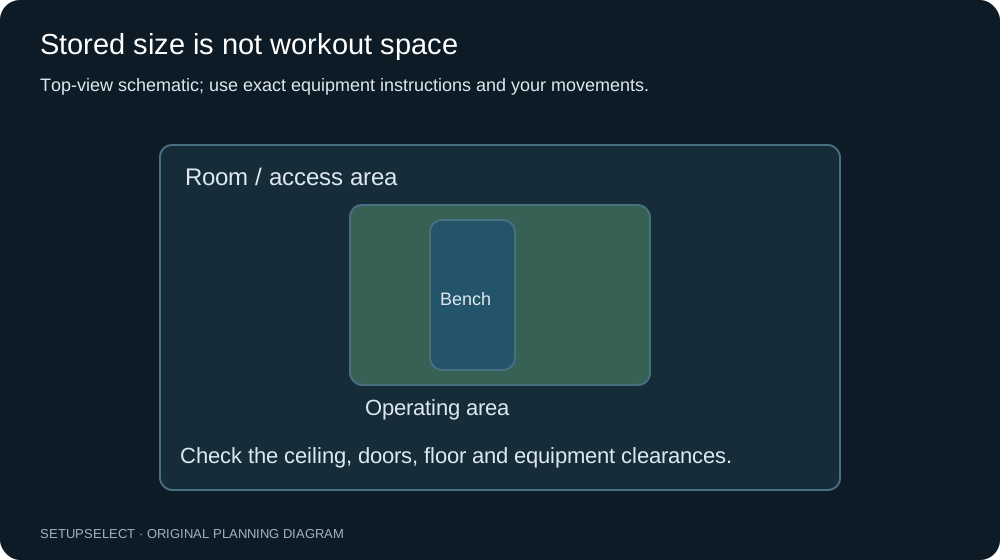
That can affect movements close to the body or bringing two weights near one another. Do not assume the compact stored footprint describes the shape in your hands.
Think about the ends when placing the weights down or preparing for an exercise. Follow the manufacturer's supported handling method rather than resting a selector mechanism against your body in the same way you might use a different dumbbell design.
Shape and mechanism can make familiar habits inappropriate.
Compare a pair with your actual routine
Two dumbbells matter for symmetry of settings, changes between exercises and shared use. Check that both are clearly marked and can be adjusted in the same sequence.
If small inserts are involved, identify where they go when removed so they do not become loose objects in the workout area.
Rehearse the changes required by a typical session, following the manual and using manageable loads. Include the slowest transition rather than demonstrating only a large, easy selector change.
If your routine alternates loads frequently, adjustment convenience may justify additional spending. If the same setting is used for most of the session, simpler plate loading may remain practical.
Do not deliberately rush the process to imitate a promotional video. Correct seating and verification are part of the change. A system whose markings or locking action you find confusing is a poor fit even if another person operates it quickly.
The cradle is part of the footprint
Measure both loaded cradles, their separation and the space needed to remove and replace handles correctly. A storage shelf just wide enough for two bases may leave no room for fingers or the prescribed lifting path.
Include any required stand and its feet, not only the weights themselves.
For a hypothetical pair of bases measuring 42 × 22cm each, placing them side by side starts with an 84 × 22cm rectangle before separation, access and stand structure. This is a planning example, not a product specification.
Compare the real dimensions with the available floor or stand location.
Use the equipment fit checker and the gym space guide to include pickup, exercise and set-down space.
A pair can fit in a cupboard while remaining awkward to lift out safely each day.
Read handling restrictions before purchase
Many adjustable systems have restrictions that differ from a solid commercial fixed dumbbell. Read the exact manual for dropping, impacts, supporting bodyweight, adjustment outside the base and moving the loaded assembly.
Do not assume a rubber outer surface means the internal mechanism tolerates dropping.
For example, an older BowFlex 552 manual explicitly warns against dropping because of damage to plates or the locking mechanism.
This is historical evidence of a handling restriction, not a recommendation to use recalled equipment. Current safety notices take priority for affected units.
Flooring cannot cancel a manufacturer's prohibition. A thick mat may protect a finish in certain supported uses, but it does not make an impact-permitted system out of an impact-prohibited one.
If your training relies on dropping weights, select equipment and a facility explicitly suited to that use with appropriate guidance.
Inspect delivery without inventing a stress test
Check the packaging and equipment for damage, missing components and mismatched model details. Follow the manufacturer's initial inspection and locking checks.
Ensure the cradle sits on the required stable surface and that plates are arranged correctly before attempting the supported adjustment sequence.
Do not test safety by shaking a heavy dumbbell overhead, forcing a dial or dropping it onto a mat. If something sticks, fails to engage or looks damaged, stop and contact the supplier.
A home inspection should follow the manual, not create a new hazardous test procedure.
Keep the serial number, invoice, manual version and photographs of the delivered condition. These help with warranty, parts and safety notices. Register the product where appropriate so the manufacturer can contact you about relevant updates.
Calculate complete ownership cost
Include the pair, necessary stand or supported storage, delivery, expansion stages and any required floor protection. Check replacement-part availability for the exact generation.
An inexpensive used set may become poor value if a damaged cradle or proprietary selector is unavailable.
Compare usable load range at the price you can actually pay now. A system advertised with its maximum expanded capacity may ship in a smaller base configuration. Calculate the later expansion cost separately and confirm the manufacturer supports that path.
Do not assume future plates will fit across product generations.
The £150 home-gym budget guide includes a simple plate-loaded scenario. It does not promise premium selector systems at that budget.
Retaining money for the right format may be better than buying an unsuitable compromise that needs replacement soon afterwards.
Sharing one pair between two people
Compare both users' starting loads, increments, hand clearance and planned exercises. The stronger user's maximum should not dominate the decision if the lighter settings are awkward for the other person.
A shared pair can save space while increasing adjustment frequency.
Agree a clear reset position and storage routine. Return handles to their correct bases and keep removable parts together.
If one person cannot see the markings or reach the storage safely, change the arrangement within the manufacturer's requirements rather than relying on the other person to prepare every session.
Separate fixed weights or bands may sometimes complement a shared adjustable pair more usefully than buying its largest expansion immediately. Base that decision on the actual programme and available room, not an ambition to own every possible setting.
When a different format makes more sense
Fixed dumbbells may suit a small number of frequently used loads, particularly when fast transitions matter and adequate supported storage exists. Bands may suit portable routines with suitable instruction and anchoring.
A gym membership or occasional facility access may be more practical for loads or exercises that exceed the room's capabilities.
The beginner equipment guide helps connect these choices to a staged programme. Adjustable dumbbells are a useful format, not a compulsory centrepiece of every home gym.
The best purchase is one you can use correctly through the intended routine.
Adjustable-dumbbell questions
Does a 40kg set provide 40kg in each hand? Not necessarily. Read whether the figure describes one dumbbell, a pair or all parts combined. Then write out the actual load configurations including handles and collars.
Can I use adjustable dumbbells as push-up handles? Only if the exact manufacturer explicitly permits that use. Some designs prohibit supporting bodyweight on the handles, and rolling or mechanism damage can introduce additional hazards.
Use equipment designed for the intended exercise.
Is a selector pin less reliable than a dial? The mechanism category alone cannot establish reliability. Examine model-specific instructions, safety notices, construction evidence and support.
A clear verified locking process matters more than a generic claim about one style.
Should I buy used BowFlex 552 weights? Establish the exact generation and current manufacturer recall position before purchase or use.
The manufacturer includes all genuine affected 552/1090 products in the US, even when a serial is absent from the CPSC table. A seller saying the weights work does not override a stop-use notice; confirm regional arrangements directly.
Can small weight gaps be fixed with third-party add-ons? Use only additions explicitly supported by the equipment manufacturer. Unapproved attachments can change balance, clearance or locking behaviour.
Choose an appropriate load ladder from the outset whenever possible.
Continue researching