Buying guide
Portable-AC window kits: measure, match and check the exhaust
A portable-AC window kit must connect the exact exhaust system to a suitable outdoor opening while keeping the appliance in its permitted position.
Identify the window type, measure the clear opening and obstacles, then check the panel or fabric seal, adapter and hose together. Buying a generic kit from the window's overall width alone can leave the most important compatibility questions unanswered.
The kit is part of the cooling installation. A loose hose near an open window can let hot exhaust return; an unsupported long hose can conflict with the manufacturer's instructions.
This guide provides a measurement and fitting decision process, with illustrative dimensions rather than universal construction instructions or claims that a temporary kit makes a window secure.
Start with the exact appliance and included parts
Record the complete model name and generation, then obtain its current installation manual. Identify the appliance-side adapter, hose, window-side adapter, supplied panel or fabric accessory, and any drainage parts.
Similar-looking circular connections can have different locking details or diameters.
Check what is actually included in the chosen sale. A photograph showing several accessories does not necessarily establish that every item is in the box.
A second-hand appliance may have a hose but lack the model-specific window connector, making an apparently inexpensive purchase difficult to install correctly.
Do not substitute a narrower duct or tape unrelated connectors together merely because the opening looks close. Ask the manufacturer which replacement parts or accessory kits are compatible.
The capacity-class comparison shows why the same capacity label does not define the mechanical connection.
Identify how the window actually moves
For a vertically sliding sash, a rigid panel may fit beneath the raised sash. For a horizontally sliding opening, a panel may fit beside the moving section.
Check the kit's permitted orientation and securing method; being adjustable in length does not mean it supports every installation direction.
Outward-opening casements often need a compatible fabric seal or a specifically designed rigid arrangement. The opening includes an angled sash and hinge side, not merely a flat rectangle.
Handles, restrictors and the sash's movement can all interfere with the seal and adapter.
Tilt-and-turn and roof windows need particular attention. The opening geometry changes depending on the selected position, and a generic casement accessory may not fit.
If the manufacturer does not support your configuration, seek a suitable approved product or competent advice instead of guessing from a listing that says universal.
Use a window-type decision table
| Observed window | Initial kit to investigate | Compatibility question |
|---|---|---|
| Vertical sliding sash | Manufacturer-supported rigid panel | Can the sash retain it at the required opening? |
| Horizontal slider | Supported upright panel arrangement | Does the permitted panel range fit the height? |
| Outward casement | Compatible fabric seal or designed panel | Do hinges, handle and opening perimeter fit? |
| Tilt-and-turn | Kit explicitly covering the chosen motion | Can the sash operate without damaging the seal? |
| Roof window | Model-specific or professionally assessed solution | Are angle, rain exposure and access suitable? |
| Fixed glazing | No ordinary opening kit | Is an authorised professional alteration appropriate? |
This is a route to the right compatibility enquiry, not a guarantee of fit. For fixed glazing or permanent alterations, obtain the property owner's authority where relevant and suitable professional advice.
Do not drill glazing or modify a window from generic online dimensions.
Measure the opening, not just the outside frame
Record the clear opening width and height at the position in which the window will actually operate. Measure the available supporting surfaces and frame depth, and note whether the sill slopes or projects.
For an adjustable panel, verify its minimum as well as maximum length; an aperture can be too small as easily as too large.
For a fabric seal, follow the supplier's measurement method for the relevant opening perimeter. It may not equal the window's advertised size or the distance around the outer trim.
Record the hinge side, direction of opening and intended attachment surface so the manufacturer can interpret the measurement.
Take photographs with a ruler or tape visible and label the important dimensions. Include the closed window, the intended open position and the nearby room layout.
This makes a support enquiry more useful than asking whether a kit fits a standard UK window, because there is no single physical opening matching that phrase.
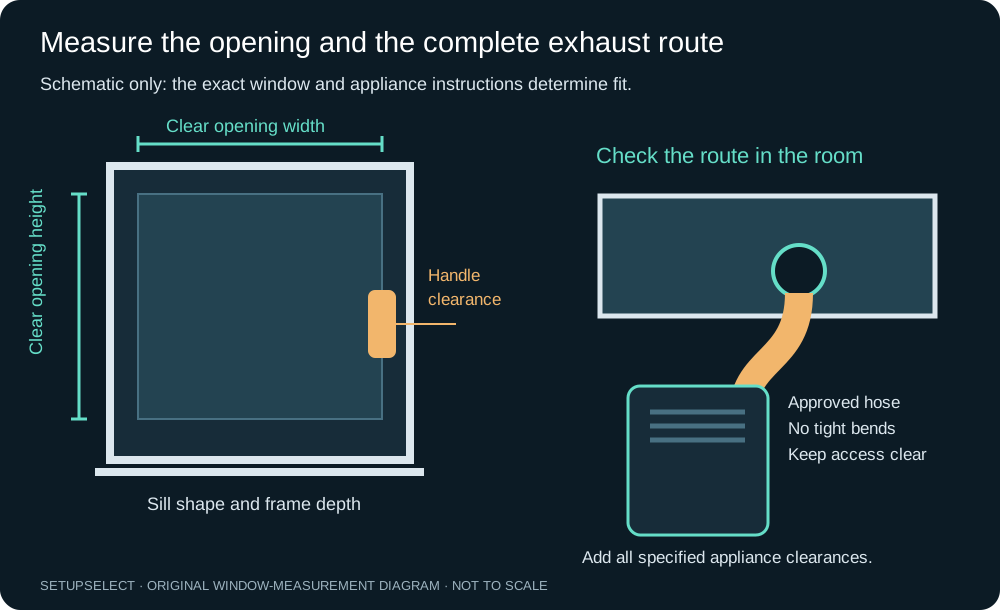
Map the obstacles and service access
Mark the handle, hinges, restrictor, blind mechanism and curtains. Check whether the window must open farther to install the adapter than it will during ordinary operation.
A kit that fits after removing a restrictor is not automatically acceptable; establish the restrictor's role and do not defeat a required safety feature.
Inspect attachment surfaces. Paint, seals, textured frames and aged finishes may react differently to adhesive systems. Follow the accessory instructions for surface preparation and removal, and test only where permitted.
Do not assume removable means no chance of marking or damage on every surface.
Check the user's reach as well. A seal or adapter that requires leaning dangerously out of an upper-floor window is not a workable daily routine. A roof-window arrangement may need professional assistance even if the nominal dimensions look compatible.
Installation and removal must be practical, not merely geometrically possible.
Position the appliance before measuring hose reach
Choose a stable floor position with the clearances specified by the exact manual. Add space for the inlet, outlet, filter access, controls and water handling. Include the electrical connection and the route people walk through the room.
The nearest empty corner is not automatically a permissible operating position.
Only then measure the route between the appliance exhaust and the planned window adapter. Account for outlet heights and permitted bends rather than measuring the straight line between the unit's centre and the window centre.
A hose stretched tight can pull on fittings; a crushed or sharply bent hose can restrict the intended airflow.
De'Longhi's hose-extension guidance advises against extending its supplied portable-AC hose. Use the equivalent instruction for your own model.
If the supported hose cannot reach, relocate the appliance or choose another approved arrangement rather than assuming extra ducting is harmless.
Keep one clear hose-routing rule
Use the supplied or explicitly approved hose within the manufacturer's permitted length, shape and connection arrangement. Avoid unnecessary extension, crushing and tight turns.
Do not add homemade insulation, substitute duct materials or enclose the hose unless the manufacturer permits that configuration.
The exhaust carries rejected heat, so some warmth around the hose is expected. That does not make every hot connection normal or every loose adapter acceptable.
Follow fault and installation guidance if there is an abnormal smell, damage, warning or unusual behaviour; do not keep operating merely because cold air still emerges at the front.
The hose should discharge outdoors at a location compatible with the instructions. An adjacent room, enclosed loft or corridor is not the outdoors. Also consider nearby openings that could admit the hot exhaust back into the conditioned space.
The purpose is a complete heat-rejection path, not simply hiding the warm end out of sight.
Illustrative fitting case: sliding window
Imagine a clear sliding opening 920mm high with an accessory panel supported for that orientation and an adjustment range covering 920mm.
The owner confirms the minimum overlap and securing method in the kit instructions, then checks the hose adapter's position relative to the sill and appliance outlet.
The first proposed panel location conflicts with a blind. The owner measures an alternative supported position and checks whether the blind can still provide useful shading without contacting the exhaust connection.
The correct result is a compatible arrangement, not an instruction to cut the blind or panel until something fits.
Before operating, the owner follows the kit's securing and sealing method and confirms that normal sash movement will not dislodge it. Any remaining gap is addressed using an allowed material or method.
The 920mm example is only a measurement exercise; it does not define a suitable panel size or fixing method for another window.
Illustrative fitting case: outward casement
Consider a casement with an accessible frame and a handle projecting into the area where a fabric seal might close.
The owner uses the accessory's own perimeter measurement instructions, checks the hinge-side fit and marks the intended zipper or hose opening position.
The appliance is placed where its approved hose reaches without crossing the doorway. The fabric must close around the connector without forcing the sash, pulling adhesive strips away or pressing against sharp hardware.
If the handle prevents a reliable closure, another approved kit or location is needed rather than stretching the material around an unsupported shape.
The owner also plans removal when the room is unattended or weather changes. A temporary fabric accessory does not restore the window's ordinary closed security or weather seal.
That practical limit can determine whether the arrangement is suitable for overnight bedroom cooling.
Preserve escape, ventilation and security
Establish whether the window has a required escape function and whether the kit interferes with it. Do not make a temporary cooling installation a reason to obstruct an escape route.
Where the role is uncertain, obtain appropriate property or fire-safety advice before installing a difficult-to-remove arrangement.
Keep required background ventilation and the home's mechanical ventilation arrangements in mind.
The government's existing-home ventilation guide advises that trickle vents remain open and unblocked.
Sealing the exhaust opening does not authorise sealing every designed ventilation route in the room.
Assess security honestly. A slightly open sash held around a panel or a casement covered with fabric may not have the protection of its normal locking arrangement.
A kit manufacturer should not be assumed to certify resistance to entry unless it explicitly provides such evidence for the complete installation. Choose a routine compatible with the actual exposure.
Check weather and water handling
Consider rain direction, sill drainage and whether the accessory is suitable for the expected exposure. Do not obstruct drainage paths in the frame with improvised sealing.
Inspect after weather changes; a setup that stayed dry on one still day is not proof against wind-driven rain.
Keep electrical parts and connections protected as the appliance instructions require. Water handling inside the AC is a separate issue from rain at the window: establish cooling-mode condensate requirements and access to the drain or collection arrangement.
A good window seal does not eliminate that maintenance task.
For a rented home, a removable kit may reduce the need for permanent alterations, but it can still affect surfaces or window operation. Confirm any relevant property requirements and preserve the original components.
Do not treat a temporary accessory as authority to modify glazing, hinges or ventilation equipment.
Inspect the completed installation while operating
Begin with the manual's transport-rest and setup requirements already satisfied. During the first cooling session, inspect the connections and seal from a safe position.
Check that the hose remains attached, the material does not collapse or move into an opening, and curtains stay clear of the intake and outlet.
Look for obvious hot-air return around the kit and listen for new rattling from a panel or connector. Do not reach into the appliance or dismantle a running unit to investigate.
If the installation is unstable or a fault appears, stop and follow the product's troubleshooting instructions.
Record the window position and successful accessory arrangement, including photographs. This is useful if the kit is removed daily or packed away seasonally.
A repeatable setup avoids gradually changing hose shape, panel overlap or the attachment location until the original fit is lost.
Evaluate cooling only after the installation is sound
If the room remains hot, check that cooling mode is selected and the supported exhaust arrangement is intact. Then revisit heat gains and room boundaries using the sizing guide.
Do not jump immediately from a poor seal to a larger BTU class; the same installation fault can undermine the replacement.
Use the air-conditioner finder for the shortlist and the running-cost calculator for electrical scenarios.
The kit does not create extra rated capacity, but it enables the selected appliance to reject heat as intended. That makes fit verification a purchase requirement, not a finishing detail.
Can I use a universal kit with any hose?
Only after confirming the actual diameter, adapter geometry and supported installation. Universal usually describes a range of applications, not guaranteed compatibility with every appliance.
Keep the model-specific connectors unless the manufacturer explicitly approves alternatives.
Can I close the window on the bare hose?
Do not crush the exhaust duct or improvise a closure that damages it. Use the supported adapter and kit arrangement. A hose pinched by a sash may still pass some air while failing the intended airflow and mechanical requirements.
Can the hose go through a wall instead?
Some products permit specific wall-vent arrangements, but that is a model- and building-dependent installation. Obtain the manufacturer's requirements and appropriate professional and property advice before altering the wall.
A portable window-kit guide is not a design for a permanent penetration.
Should I buy the kit before choosing capacity?
Investigate window feasibility first, then choose a suitable capacity and compatible complete product. A final kit purchase needs the exact appliance connection and supported accessories.
Resolve both together so you do not own a correctly sized machine with no workable exhaust, or a panel that fits the window but cannot connect to the unit.
Continue researching