Buying guide
What size air conditioner do I need? Three room examples
Choose air-conditioner size from the room's cooling load and a workable installation, then compare capacity classes.
Floor area is a starting measurement, not a complete answer: sunlight, glazing, roof exposure, equipment, occupants and connections to other rooms can change the load substantially. A portable unit also needs an effective route for rejecting heat outdoors.
Use the air-conditioner finder to organise those inputs and produce an initial shortlist. This guide explains what the inputs mean and how to challenge a result.
The room examples are illustrative planning cases; they are not cooling-load surveys, product tests or promises that a particular appliance will maintain a specified temperature.
Define what needs cooling and when
Start with the actual problem period. A west-facing bedroom that is hottest at bedtime differs from an office occupied during the afternoon or a living room used briefly after sunset.
Write down the hours when people need the room, the observed temperatures where available, and the intended outcome. Cooling one occupied room is a different project from trying to cool an entire floor through open doors.
Decide whether personal airflow is enough or whether the room temperature itself needs to fall. A fan can provide useful comfort without the installation and electricity demands of refrigerated cooling.
The portable AC versus fan comparison helps separate those outcomes before you size equipment for a problem that may have a simpler answer.
Do not use a shopping calculation as a health threshold.
During hot weather, follow the current UKHSA advice on keeping cool at home, especially where someone is more vulnerable to heat.
A shortlist estimate does not establish that a room is safe for every occupant.
Measure the complete space
Measure internal length and width, then ceiling height. A rectangular room 3.5m long and 3.0m wide has 10.5m² of floor area; at 2.4m high its volume is 25.2m³. These are geometry calculations only. They do not yet tell you the cooling requirement.
For an irregular room, split the floor plan into simple rectangles and record each part. Include an open bay or permanently connected dressing space.
With sloping ceilings, record the shape and varying height rather than pretending the entire room has its lowest or highest ceiling. A difficult loft may justify specialist assessment because the roof and geometry add uncertainty beyond a simple calculator.
Mark openings that will remain open during use. A living room opening directly into a dining area does not have an invisible insulated wall across the opening.
Equally, do not add the entire house simply because doors exist: define the area you will realistically contain and cool, while preserving required ventilation and safe access.
Record glazing and sunlight separately
Measure the approximate area of windows and glazed doors, and note their direction. More importantly, observe when direct sun reaches them during the hours that matter.
A room with afternoon sun may continue feeling hot after the outdoor temperature falls because the building and furnishings have stored heat.
Record available shading and how it will actually be used. A blind that cannot close around an exhaust hose is not fully available during operation.
External shading and suitable internal shading can reduce heat gains, but their effectiveness depends on the construction and position; do not claim a fixed percentage reduction without relevant evidence.
The Energy Saving Trust cooling guide recommends reducing unwanted heat gains and using cooler outside air when appropriate. Treat these measures as part of the room plan.
Sizing around avoidable solar heat while leaving practical shading unused can create a more demanding and expensive cooling task.
Look beyond the window to the room envelope
Note whether the room is below a roof, has several external walls or adjoins an unconditioned space. Insulation and construction influence heat entering through those surfaces.
Building age is a clue, not proof: later extensions, insulation work and replacement glazing can make neighbouring rooms behave differently.
An upper-floor loft bedroom with roof windows is not equivalent to a shaded ground-floor bedroom of identical area. A conservatory or substantially glazed extension can also sit outside the useful assumptions of an ordinary room-area chart.
Flag these cases early instead of repeatedly adding arbitrary percentages until the estimate reaches the largest portable unit in a shop.
Record what is unknown. If roof insulation is uncertain, do not turn that uncertainty into a precise invented U-value.
A shortlist can use a cautious scenario range, while a professional cooling-load assessment investigates the information required for a final design. The aim is to expose assumptions, not conceal them behind a detailed-looking number.
Count internal heat during occupancy
List the equipment actually running in the room: desktop computer, displays, television, lighting and other appliances. A power-supply label is a maximum capability, not necessarily the equipment's normal draw.
Where practical, a suitable electricity measurement during representative use gives a more useful input than assuming every rated maximum occurs continuously.
People also add heat, but a room used by one seated person should not automatically be modelled like a crowded gathering. Record usual and occasional peak occupancy separately.
If the unusual peak occurs twice a year, decide whether the cooling purchase must cover it or whether another room arrangement will be used then.
For an illustrative equipment calculation, a desktop and displays drawing a combined 300W over the relevant period contribute roughly 300W of heat within the room, subject to what energy leaves the space. That is a meaningful continuous load.
It does not mean buying an AC with only 300W of cooling: solar, fabric, air exchange and occupants remain in the total.
Understand cooling capacity before comparing labels
Cooling capacity is commonly expressed in BTU per hour or kilowatts of cooling. Using the usual conversion, 7,000BTU/h is about 2.05kW, 9,000BTU/h about 2.64kW and 12,000BTU/h about 3.52kW.
These are heat-removal rates under the product's stated rating conditions, not electricity consumption.
Electrical input is listed separately. A unit with 2.64kW of rated cooling does not necessarily draw 2.64kW from the socket. Use the input specification for the running-cost calculator.
Keep the two quantities in separate columns to prevent a sizing estimate turning into an incorrect electricity budget.
Rating systems and assumptions can differ between markets and product types. When comparing portable units, preserve the label and test basis attached to each capacity figure.
Do not combine an adjusted capacity from one method with a headline value from another as if they were directly equivalent. Ask for clarification if the listing omits that information.
Treat a rule of thumb as an initial range
A floor-area multiplier can be useful for a first pass, but it embeds assumptions about ceiling height, climate, construction and heat gains. It cannot inspect the room.
The US Department of Energy's room-AC purchasing guidance notes both the need for correct sizing and drawbacks of oversizing.
Its room-AC advice is not a UK portable-unit sizing certificate.
Avoid adding the same allowance twice. If a calculator already includes sunlight and equipment inputs, adding another generic sunny-room percentage to the final result may double-count them.
Save the inputs and result together so someone reviewing the shortlist can see what has already been included.
Similarly, a range crossing two capacity classes does not automatically demand the larger one. Investigate the uncertainty: is it an unknown roof construction, a permanent opening or equipment that only occasionally runs?
Resolving that question can be more valuable than adding a blanket margin to every room.
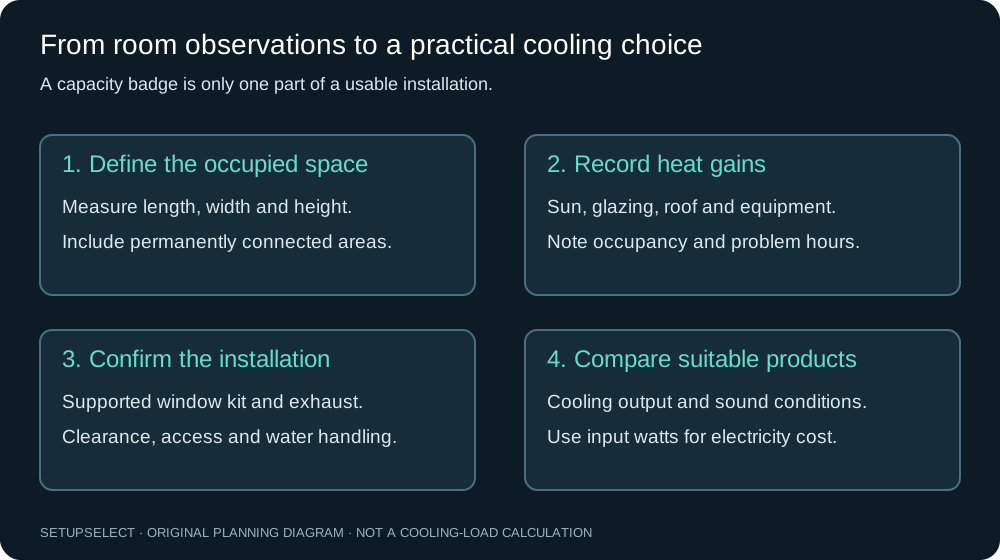
Worked room A: shaded small bedroom
Imagine a 3.0 × 3.4m bedroom with a 2.4m ceiling: 10.2m² and approximately 24.5m³. It has one modest window, effective shading, no desktop computer and a door that can remain closed during the cooling period. The target use is pre-cooling before bedtime.
Those details make the lower-load end of a portable shortlist plausible, but they do not establish a universal 7,000BTU/h recommendation.
The owner enters the actual dimensions, window and occupancy information in the finder, records the result, and checks a candidate's applicable room guidance and rating basis.
The decisive next check is physical: can the machine stand near the window with its required clearance and an approved hose route? If the bed blocks that location, the nominal capacity match is not enough.
The bedroom AC guide explains how to combine window feasibility with sleep and access requirements.
Worked room B: west-facing office with equipment
Now consider a 3.8 × 4.0m office, 2.6m high, giving 15.2m² and about 39.5m³. It has a larger west-facing window, two regular occupants and computer equipment operating through the afternoon.
Its load cannot be inferred by scaling the bedroom's floor area alone.
The owner records equipment use and the time of direct sun, then compares two scenarios in the finder: normal working occupancy and occasional heavier use. The example deliberately does not assign fabricated watts to the building fabric.
Instead, it identifies which inputs differ and why a higher capacity class may enter the shortlist.
Before choosing, the owner checks cooling-mode sound during calls, the complete installed footprint and the window panel arrangement. A larger unit that forces the hose around a desk or prevents shading from closing might deliver a less workable system.
The installation and load assumptions must be considered together.
Worked room C: open living and dining space
Suppose a 4.5 × 4.0m living area opens permanently into a 3.0 × 3.0m dining area. Treating only the first 18m² as the cooling space ignores the connected nine square metres and the airflow between them. Glazed doors and evening occupancy may add further load.
This is the point to question whether a portable appliance can meet the intended outcome.
The owner might choose to cool a different closable room, investigate suitable permanent cooling with a professional, or accept local comfort measures for part of the day. Selecting a 12,000BTU/h label does not make connected space or heat gains disappear.
A meaningful result can therefore be that the proposed portable setup is unsuitable. The finder is most useful when it reveals that constraint before purchase, not when every input is forced into a product recommendation regardless of uncertainty.
Complete the installation check before ordering
Measure the window type, opening and hose connection location. Keep the hose within the exact manufacturer's limits.
De'Longhi's hose-extension guidance advises against extending its supplied portable-AC hose; other appliances must follow their own instructions.
A convenient distant socket or empty corner is not a reason to invent an unsupported duct route.
Check water handling, filter access, electrical requirements, storage and transport instructions. Portable usually describes a movable unit, not necessarily one person can easily carry upstairs.
The window-kit guide addresses the detailed measurement sequence, while the capacity-class comparison helps evaluate actual product specifications after sizing.
Keep a final record with the room dimensions, heat-gain observations, intended schedule, shortlist capacity, source of the rating and outstanding uncertainties.
That record makes a manufacturer enquiry precise and allows the decision to be revisited if the room layout or product availability changes.
Can one portable unit cool two separate bedrooms?
Do not assume equal cooling through doorways. Air paths, heat gains and closed doors can leave one room quite different from the other. Size and assess the actual connected arrangement, or plan separate operating periods.
A single temperature display beside the appliance does not demonstrate conditions at the far bed.
Does setting the thermostat very low make an undersized unit stronger?
No. It changes the requested endpoint, not the machine's rated cooling capacity. A very low setting may keep it running without achieving the desired room condition.
Check heat gains, installation and capacity rather than using the minimum set point as a substitute for a suitable design.
Is a larger unit always safer against a heatwave?
Extra capacity is useful only within a suitable system and permitted operating conditions. Larger products can add space, sound and installation demands, while oversizing can change cycling behaviour.
For extreme heat, combine an appropriate cooling plan with current public-health advice rather than relying on a capacity badge as a safety guarantee.
Continue researching