Buying guide
Portable air conditioner vs fan: room cooling or personal airflow?
Choose a fan when moving air gives the people using the room enough relief. Choose portable air conditioning when the room itself needs active cooling and you can install a suitable exhaust to the outdoors.
These products solve different problems, so the cheaper appliance is only good value if its effect matches the need.
For many households the decision changes through the day: shading and a fan may suit an ordinary warm afternoon, while a persistently hot bedroom may justify refrigerated cooling.
The examples below compare mechanisms, practical constraints and transparent electricity arithmetic. They are not product tests or promises that a particular arrangement will make every hot room safe.
What changes when you switch on a fan?
A fan moves air. Air movement around a person can improve comfort, including through evaporation from skin, but the fan is not a refrigeration system removing the room's heat to the outdoors. Its motor also consumes electricity.
A thermometer does not normally show a room-temperature reduction simply because a freestanding fan is running in a closed room.
Energy Saving Trust's home-cooling advice distinguishes this personal cooling effect from air conditioning.
That distinction explains why running a fan in an empty room does not generally provide the same pre-cooling outcome as running AC before someone arrives.
A fan can also help move air through an available ventilation route, but that is a separate setup dependent on indoor and outdoor conditions. Opening a window when outside is hotter may increase the heat entering the room.
Do not label every fan pointed towards a window as a cooling system without checking what air is actually moving and when.
What changes when you switch on portable AC?
A refrigerated air conditioner transfers heat from the indoor side of its system to the outdoor side. For a typical portable single-hose appliance, the hot exhaust must leave through a suitable opening.
If the exhaust returns indoors, it brings back the rejected heat and the appliance's electrical input ultimately adds further heat.
The hose and window kit are therefore part of the cooling system, not optional accessories. Check the exact appliance instructions for the approved installation, operating environment and water handling.
A unit producing a cold stream at its front does not prove that the room as a whole is being cooled successfully if hot air is leaking back nearby.
The air-conditioner size guide explains the room-load assessment. That assessment matters because an appliance may run continuously while heat entering the room prevents it achieving the desired conditions.
Active cooling is a capability that still needs an appropriate product and installation.
Compare the practical job, not just the mechanism
| Question | Fan | Typical portable refrigerated AC |
|---|---|---|
| Main outcome | Air movement for personal comfort | Heat transfer out of the room |
| Window exhaust | Not needed for ordinary circulation | Required for the cooling arrangement |
| Water handling | None for an ordinary dry fan | Condensate arrangements vary by model |
| Operating space | Base and safe airflow area | Body, clearance, hose and service access |
| Sound sources | Fan and motor | Fan, compressor and exhaust airflow |
| Unoccupied pre-cooling | Does not refrigerate the room | Can cool the room if suitably sized and installed |
| Typical setup burden | Position and suitable electrical connection | Window fit, exhaust, electrical and water checks |
This table describes ordinary dry fans and portable refrigerated appliances. Tank-fed evaporative coolers are a third category with different humidity and ventilation requirements.
Use portable AC versus air cooler if a product listing describes water tanks, wet media or ice chambers and calls the device an air conditioner.
Use a room observation before a purchase decision
Record when discomfort occurs, where people sit or sleep, and whether measured temperature remains high after shading and appropriate ventilation. Note equipment use and direct sun.
A brief warm spell in one chair may call for a different response from a room that retains heat through the night.
Try an existing suitable fan if one is available, positioned according to its instructions, and assess whether it provides the required comfort in the actual occupied position.
Do not infer success from strong airflow felt immediately beside the grille if the person normally sits several metres away or behind furniture.
If the room remains uncomfortably hot despite sensible measures, check whether portable AC can be installed properly before shopping for capacity. The finder helps organise room inputs.
A window that cannot accommodate a safe, effective exhaust may rule out the proposed portable arrangement regardless of how attractive the cooling claim looks.
Heat prevention changes both options
Suitable shading can reduce solar gain before the room heats up. Limiting unnecessary equipment and lighting can reduce internal heat. When outdoor conditions are cooler and ventilation is safe and appropriate, bringing in cooler air may help.
These measures can improve the usefulness of either a fan or AC.
Keep the sequence practical. A west-facing window may need shading before late afternoon, not after the room is already hot. A computer left operating after work can keep adding heat during the evening.
Observe your room rather than following a universal timetable that ignores its orientation and use.
The current UKHSA keep-cool checklist includes actions for reducing heat at home.
It also provides specific guidance on fan use in hot conditions. Consult it directly for current health precautions; equipment comparisons should not be treated as a substitute for heat-safety advice.
Understand the limits of fans during extreme heat
Fans are not a guarantee of protection against heat-related illness. UKHSA's checklist advises using electric fans when air temperature is below 35°C and gives further precautions concerning their use.
Follow the complete current guidance, especially when someone is vulnerable or becomes unwell, rather than interpreting a fan's presence as evidence that a room is safe.
Similarly, an air-conditioner badge is not a safety certificate. The appliance must actually deliver useful cooling under the conditions, and people may need access to a cooler location if it cannot.
Avoid making budget savings or a fixed timer schedule the overriding consideration during dangerous heat.
This article does not prescribe a medical room temperature or individual care plan. Its purpose is to explain what the appliances do and how to assess a practical setup.
For health concerns, use appropriate public-health and clinical advice alongside the equipment decision.
Compare electricity with explicit assumptions
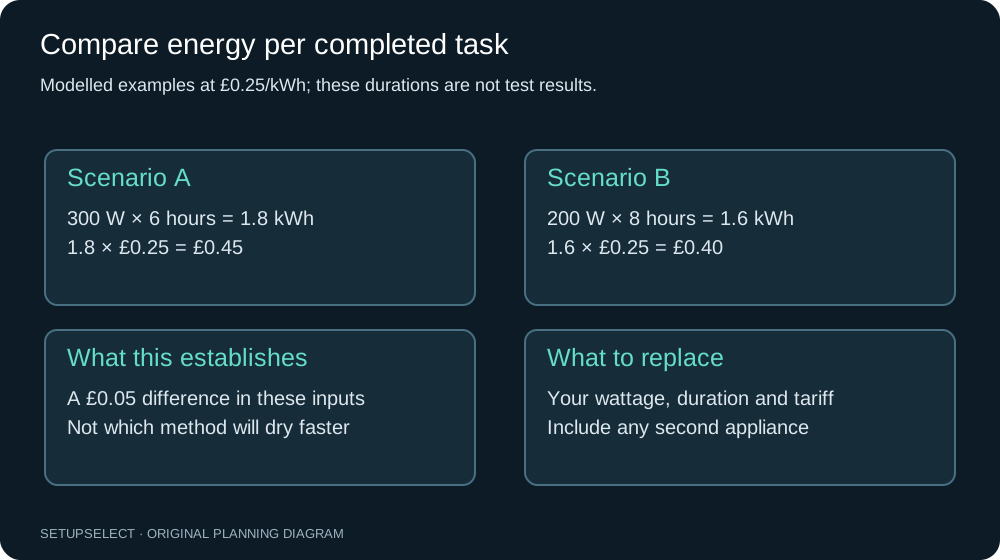
Consider an illustrative 40W fan and a 1,000W-input AC, each running at that input for six hours. The fan uses 0.24kWh and the AC uses 6kWh. At an example £0.25/kWh, their costs are £0.06 and £1.50.
These are invented input scenarios, not specifications of all fans or air conditioners.
The large arithmetic difference is meaningful, but it is not a like-for-like cooling-efficiency comparison. The fan moves air; the AC transfers heat outside. A lower bill does not prove that the fan could deliver the room-temperature outcome expected from AC.
Actual AC energy can differ because the compressor cycles or modulates and the fan may continue. A fan can also have several speed-dependent inputs.
Use the exact model information or a suitable energy monitor, and enter the result in the running-cost calculator.
The cost guide explains why assumed duty cycles should remain labelled scenarios.
Compare sound where people actually use the room
Fan sound changes with speed, placement and design. Portable AC adds compressor and exhaust behaviour, which can include starts and stops. Compare published values only when the operating mode and measurement basis are compatible.
A fan's maximum sound figure and an AC's quietest fan-only figure do not make a useful comparison.
For a home office, listen from the normal chair and assess microphone pickup during a test recording. For a bedroom, consider the bed position, display lights and control changes after the target is approached.
A product that sounds acceptable during a daytime demonstration may be more noticeable in a quiet room at night.
Do not cover equipment or block airflow to suppress sound. If the appropriate operating setting is too intrusive, the options are a different permitted location, a different schedule or a different product.
The bedroom AC guide focuses on those routine decisions rather than promising that one universal decibel threshold guarantees sleep.
Installation can decide the result before cost does
A fan still needs a stable position and a suitable electrical connection, with its cable away from trip routes. Check reach to the occupied position, oscillation clearance and whether the base interferes with doors.
Small does not automatically mean practical if the fan must stand in a busy walkway.
Portable AC needs a larger plan. Measure the machine, required clearances, exhaust route and window adapter.
De'Longhi advises against extending its supplied hose in its portable-AC guidance.
That reinforces the need to fit the exact manufacturer's supported arrangement rather than locating the machine wherever a corner happens to be empty.
Check water handling and the route to storage as well. A wheeled unit may be manageable between rooms on one level but difficult up stairs. Follow transport and storage instructions.
The fan's simplicity can be a decisive advantage where it provides enough comfort, while a workable AC installation can justify the extra effort where actual room cooling is needed.
Scenario one: one person working at a desk
Imagine a shaded office occupied by one person for several afternoon hours. The temperature is tolerable, but still air causes discomfort. A suitable fan can be aimed or oscillated to provide useful airflow without a window kit.
The owner checks sound during calls and keeps papers and loose items clear of the airflow.
Here the starting decision is personal comfort, not a calculated cooling load. Buying AC would add installation and energy requirements that may not be needed.
If stronger sun or computer use later changes the room substantially, the decision can be reviewed using temperature observations and the sizing finder.
The example does not establish a universal office temperature at which a fan is sufficient. It demonstrates how defining the outcome prevents a capacity calculation from becoming the first step in every cooling purchase.
Scenario two: a hot bedroom before sleep
Now imagine an upstairs bedroom that stays hot into the evening despite shading and appropriate ventilation. A fan improves local airflow but does not reduce the measured room temperature.
The owner checks window feasibility, heat gains and a portable AC shortlist, with sound and night-time access as hard requirements.
A possible routine is pre-cooling while awake and then reassessing conditions before bed. Another is humidity- and temperature-appropriate overnight cooling according to the model controls and household need.
Neither routine has a guaranteed duration; the room's response must be observed.
If the only exhaust route compromises required window use or creates an unacceptable security problem, the decision may need a different room or a professionally assessed solution.
A fan remains a separate comfort tool, but it should not be presented as an equivalent replacement for active cooling when it cannot meet the actual need.
Scenario three: a shared living room used intermittently
In a shared room, think about everyone rather than the person nearest the fan. A narrow airflow stream may help one seat while missing another.
Oscillation, multiple suitable positions or a different room arrangement may address that without lowering the entire room temperature.
If the room is consistently hot, portable AC may be useful, but connected dining or kitchen space changes the load. Cooking and repeated door opening can be significant practical factors.
Use the actual occupied arrangement rather than a photograph with doors closed and equipment off.
A combined strategy can be reasonable: operate AC during the most demanding occupied period and use a fan when conditions permit. Count both appliances' energy if comparing cost.
Do not promise a saving merely because two products are used together; the result depends on the changed settings, duration and comfort outcome.
Keep a simple decision record
Write down the required outcome, problem hours, observed room conditions, installation constraints and acceptable operating routine. For a fan, record whether it reaches the occupied places comfortably.
For AC, retain the room estimate, exact input power, window-kit compatibility and noise basis.
Then make the decision in that order. Establish that the option can do the required job, confirm it can be used correctly, and compare the complete cost and convenience of suitable candidates.
This avoids treating low electricity use as the only measure of value or maximum cooling capacity as the only measure of usefulness.
Should I leave a fan running while I am out?
An ordinary room-circulating fan does not refrigerate the room for your return. If it is part of a specific safe ventilation arrangement, assess that arrangement and its conditions separately.
Follow the appliance's instructions and avoid assuming continuous unoccupied use creates stored cooling.
Can a fan make portable AC work better?
It may help distribute air in a particular room, but it cannot fix inadequate cooling capacity, an unsupported exhaust or blocked airflow. Check the basic installation first.
Any claim about reduced energy should be supported by comparable observations, including the fan's own electricity use.
Is a tower fan an air conditioner?
No. Shape does not establish the cooling mechanism. Look for documented refrigerated cooling capacity and the required heat-rejection arrangement.
A water tank instead suggests an evaporative product, which needs the separate air-cooler comparison.
What if neither option meets the need?
Reconsider the room, reduce avoidable heat gains and seek advice about an appropriate permanent or alternative cooling arrangement where necessary. During severe heat, follow current guidance on accessing a cooler place.
Do not keep escalating fan speed or lowering an AC set point when the observed room conditions remain unsuitable.
Continue researching