Buying guide
Portable AC vs air cooler: humidity, ventilation and real use
Portable refrigerated air conditioning and a tank-fed evaporative air cooler are different technologies. Choose refrigerated AC when you need heat transferred out of the room and can provide its approved exhaust installation.
Consider an evaporative cooler only where evaporation is useful in the actual air conditions and the required ventilation can remove the added moisture.
A product without an exhaust hose is not automatically a convenient form of the same air conditioning. Read the mechanism, cooling specifications and instructions before comparing price.
This guide concerns direct evaporative room coolers, not every specialist indirect or industrial evaporative system. The examples are planning cases, with no invented temperature-drop tests or product rankings.
Identify the mechanism behind the product name
A refrigerated portable AC has a refrigerant circuit that absorbs heat on one side and rejects it on the other. The portable domestic cooling arrangement normally sends the hot exhaust outside through a duct.
The presence of a cold outlet stream alone is insufficient: the rejected heat must also have a suitable destination.
A direct evaporative cooler passes air across wetted media. Water evaporating into that air can lower its dry-bulb temperature while increasing its moisture content.
The effectiveness depends on the entering conditions and the device, and it should not be assumed to provide the same whole-room temperature control as refrigerated AC.
Honeywell's CL603AE product guidance explicitly distinguishes its evaporative product from an air conditioner and discusses cross-ventilation.
This manufacturer example illustrates why the operating instructions matter more than a retailer's broad cooling category.
Use a mechanism and installation matrix
| Feature | Portable refrigerated AC | Direct evaporative room cooler |
|---|---|---|
| Main process | Refrigeration transfers heat to an exhaust | Evaporation changes passing air conditions |
| Water relationship | May collect or discharge condensate | Consumes tank water and adds vapour |
| Outdoor route | Supported hot-exhaust arrangement | Ventilation arrangement appropriate to the cooler |
| Humidity consequence | Cooling can remove moisture | Direct evaporation adds moisture |
| Main performance evidence | Rated cooling capacity with test basis | Airflow, conditions and relevant cooling data |
| Routine maintenance | Filters, exhaust and water handling | Tank, wet media, pump and hygiene care |
An ordinary fan remains a useful third comparison when the goal is local airflow and added humidity is undesirable. The AC versus fan guide explains that simpler option.
Do not assume the most feature-filled cooling product is best before identifying the room problem.
Humidity is part of the starting condition
Direct evaporative cooling has more scope to lower air temperature when the entering air is relatively dry. As the air becomes more humid, further evaporation has less cooling potential.
A room that already feels humid or suffers condensation is therefore a different candidate from a dry, well-ventilated space.
Record both temperature and relative humidity at the time the room is uncomfortable. One reading during a cool morning may not describe a hot afternoon.
Keep the meter away from the cooler's immediate wet-air stream if you want a room observation, and note whether doors and windows are open.
Do not assign a universal temperature drop from a tank size or fan-speed label. Neither tells you the entering wet-bulb conditions, media effectiveness or ventilation.
A large water tank can increase time between refills without proving greater useful room cooling. Ask for the manufacturer's performance conditions if a listing promises a specific reduction.
Why the two ventilation strategies differ
Refrigerated AC needs its heat rejected outdoors and its intended conditioned space defined. Uncontrolled hot-air entry can increase the load.
That does not mean disabling required building ventilation; it means installing the product within the home's ventilation and safety arrangements and sealing the exhaust opening as instructed.
An evaporative cooler adds moisture to the air it supplies. Keeping that air indefinitely inside a tightly closed room can increase humidity and reduce the process's usefulness.
The Energy Saving Trust cooling guide describes evaporative coolers' moisture contribution and the importance of ventilation for their use.
These different strategies explain why advice to close a room around refrigerated cooling cannot simply be copied to a tank-fed cooler.
Likewise, advice to provide cross-ventilation for an evaporative product is not a reason to leave a portable AC exhaust badly sealed. Follow the exact instructions for the chosen mechanism and model.
Look closely at mini and personal cooling claims
Small desktop products may use a wet cartridge, water tank or ice pack while being advertised with air-conditioning language.
Identify whether the unit has documented refrigerant-based cooling and a heat-rejection arrangement, or whether it mainly supplies a local evaporatively cooled air stream.
Ask what the claim describes: outlet temperature at a particular distance, perceived comfort for one person, or sustained room-temperature reduction under stated conditions. These are different outcomes.
A photograph of cool-coloured air is not a performance test, and a very small power input does not by itself prove exceptional whole-room efficiency.
For a desk user, a modest local effect may still be useful. The problem is the mismatch between that effect and an expectation of cooling an entire bedroom.
Keep the scope visible in the purchase decision, and compare a suitable ordinary fan for the same personal-airflow role.
Check the room before selecting either appliance
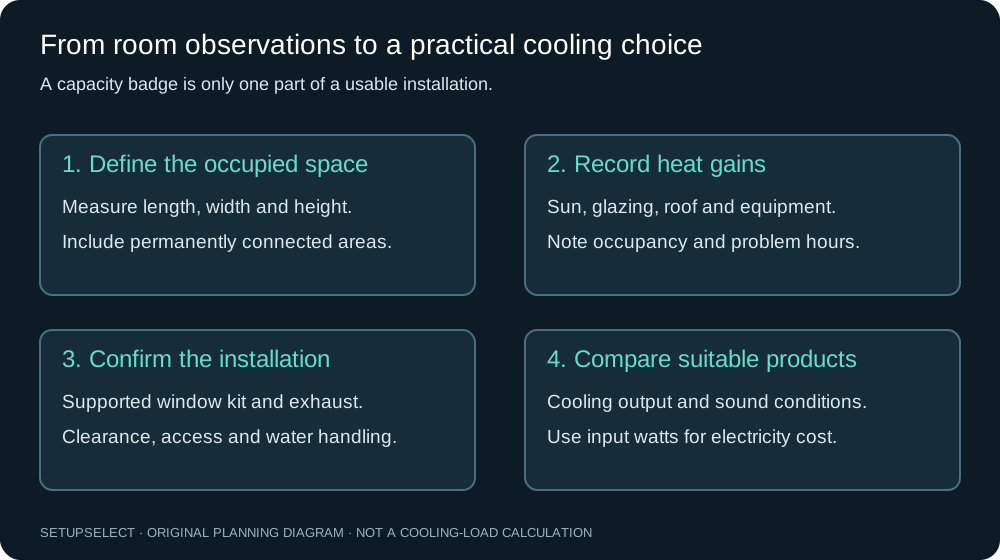
Write down the room dimensions, glazing, direct sun, equipment and occupancy. Those observations explain the heat load and whether it can be reduced. Use suitable shading and limit avoidable heat sources before deciding how much additional cooling is required.
For refrigerated AC, continue with what size air conditioner do I need? and the finder.
For an evaporative cooler, check whether the actual humidity, available ventilation and location match the manufacturer's use conditions. A generic maximum-room-area label does not make that decision for you.
Consider practical window constraints for both. AC may fail because no supported exhaust is possible. An evaporative unit may fail because its required fresh-air route cannot be maintained during use.
The absence of a large hose does not remove every installation constraint.
Water handling is a recurring task
An evaporative cooler needs water in the permitted quantity and condition. Follow its instructions for filling, refilling, draining and cleaning. Do not add fragrance, disinfectant, salt or other substances unless the manufacturer specifically allows them.
An ice chamber or ice-pack compartment should be used only as designed; it is not permission to modify the tank or pump.
Plan where the tank can be filled without spilling onto electrical parts and how residual water will be removed. Check whether the tank is removable, how far it withdraws and whether the appliance must be moved to drain it.
A large tank can be convenient between refills but cumbersome during cleaning.
Read the wet-media cleaning or replacement requirements. Storing the cooler with water or damp media contrary to instructions creates a maintenance problem, even if it performed acceptably during a short heatwave.
The ownership comparison must include this routine, not just the first fill.
Refrigerated AC has a different water task
An air conditioner may condense moisture while cooling. Depending on the model and conditions, some water may leave with the exhaust or require draining.
Read the cooling-mode instructions separately from any dedicated dry mode, because the approved connections can differ.
Avoid assuming a self-evaporating label means no water check is ever needed. Establish the warning behaviour, drain access and suitable disposal route before a long session.
If continuous drainage is permitted, make the entire hose route reliable rather than attaching a hose to an arbitrary container.
The bedroom AC guide discusses overnight access and interruptions.
Water handling should be known before choosing a sleep routine, just as tank filling and media care should be known before depending on an evaporative cooler.
Compare electricity without claiming equivalent service
For an illustrative calculation, suppose an evaporative cooler draws 70W and a refrigerated AC draws 1,000W during the selected modes. Six constant-input hours use 0.42kWh and 6kWh respectively.
At an invented £0.25/kWh tariff, those sessions cost about £0.11 and £1.50.
The calculation does not prove that the cooler offers equivalent cooling for a small fraction of the cost. The mechanisms, room conditions and delivered outcomes differ.
Exact input power varies by model and setting, and AC compressor operation may change over the session.
If ice is prepared in a freezer for a permitted cooler accessory, the energy used to make that ice is not included in the simple appliance-input comparison. Nor are water use and cleaning time.
They may be modest in a particular routine, but should not be silently treated as zero when claiming complete-method savings.
Use the running-cost calculator for transparent electricity scenarios and the cost guide for measurement.
Choose the technology's required outcome first, then compare the cost of suitable ways to provide it.
Scenario A: a humid bedroom with no convenient exhaust
Imagine an upstairs bedroom that feels hot and humid, with a window that is difficult to adapt. A tank-fed cooler initially seems attractive because it has no exhaust hose.
However, adding water vapour does not solve the window problem for refrigerated cooling and may be poorly matched to the humid room.
The owner records conditions, compares a suitable fan for personal airflow and investigates whether a supported AC window arrangement is possible. If it is not, a different room or professionally assessed cooling option may be needed.
The conclusion is not that every room without a hose must use evaporation.
This example also avoids treating one humidity percentage as a universal ban or permission. The actual conditions, ventilation and manufacturer's limits determine suitability.
The key is to test the mechanism against the problem instead of accepting a convenient-looking product category by default.
Scenario B: a dry, ventilated work area
In a second illustrative room, hot conditions coincide with relatively dry air and a safe ventilation route compatible with the cooler's instructions. The user needs relief at a work position rather than a tightly controlled room temperature.
A direct evaporative product may enter the shortlist alongside an ordinary fan.
The comparison focuses on the occupied position, sound, water handling and the room's humidity over time.
If moisture rises or the expected local effect is weak, the user revisits the setup rather than adding more ice and assuming the unit must eventually behave like refrigeration.
No specific degree reduction is predicted here. A useful decision record states the observed starting conditions and required outcome, then compares products with relevant documented evidence.
This is more honest than assigning a tank size to a floor area and calling the result a cooling calculation.
Scenario C: temperature control for a home office
A third user wants a hot office to remain suitable for several hours of work, with computers adding heat and windows subject to afternoon sun. Localised airflow alone has not met the need.
The user assesses a refrigerated AC installation and capacity using the actual room data.
The product shortlist includes input power, cooling-mode sound, kit compatibility and storage.
The evaporative cooler is not dismissed because it uses water; it is set aside because its mechanism and ventilation requirements do not match the defined temperature-control task in that room.
That reasoning remains useful if products change. It can be applied to another model without relying on a favourite brand or an unsupported claim that one technology is always best in an entire country.
Questions to resolve before ordering
Ask the seller or manufacturer for the exact model manual, the cooling mechanism, performance conditions and required room arrangement. For AC, establish the exhaust-kit contents and input power.
For evaporation, establish water and media care, ventilation and any environmental limits.
Compare complete practical costs: appliance, any kit, water-handling accessories permitted by the manufacturer, consumables and storage. Check dimensions with service access, not only the body.
A cooler whose tank cannot be removed beside the desk can be just as inconvenient as an AC whose hose cannot reach the window.
During extreme heat, follow current UKHSA hot-weather advice. Neither a cool air stream nor a low-cost device guarantees protection against heat-related illness.
Equipment should support an effective cooling plan, with a different location or appropriate help when conditions remain unsuitable.
Will adding ice turn an air cooler into AC?
No. Permitted ice accessories may affect the immediate operation, but they do not create a refrigerant system continuously rejecting heat outside. Follow the product instructions and account for the preparation and handling involved.
Do not translate a temporary cold stream into a claim of sustained whole-room cooling.
Can I run a dehumidifier beside an evaporative cooler?
That arrangement adds moisture with one appliance and removes moisture with another, while both consume electricity and affect room heat. It is not a general replacement for properly designed AC.
If the room needs simultaneous temperature and humidity control, assess suitable equipment for that outcome rather than assembling opposing processes by guesswork.
Is a large water tank evidence of strong cooling?
It mainly indicates water storage. Airflow, entering conditions, wet-media design and ventilation affect the useful result. Tank volume alone does not establish a cooling capacity comparable with BTU/h or a guaranteed room-temperature reduction.
Continue researching