Buying guide
Bedroom air conditioning: window fit, noise and night routines
Choose a bedroom air conditioner only after confirming three things: it can handle the room's heat load, it can exhaust outdoors through a workable window arrangement, and its operating sound fits your sleep routine.
A quiet label is not enough if it applies only to fan mode, and a suitable cooling capacity is not enough if the hose or machine blocks the route from the bed to the door.
The most practical plan may be pre-cooling before bed, controlled overnight cooling, or using a fan when personal airflow is sufficient. This guide explains how to choose between those routines and lay out the room.
The worked bedroom is illustrative, and no claims here come from hands-on product testing or measured sleep outcomes.
Check the window before the shopping shortlist
Find the actual opening through which hot exhaust can leave the building. Identify whether the window slides, lifts as a sash, opens outward as a casement, tilts or sits in a sloping roof.
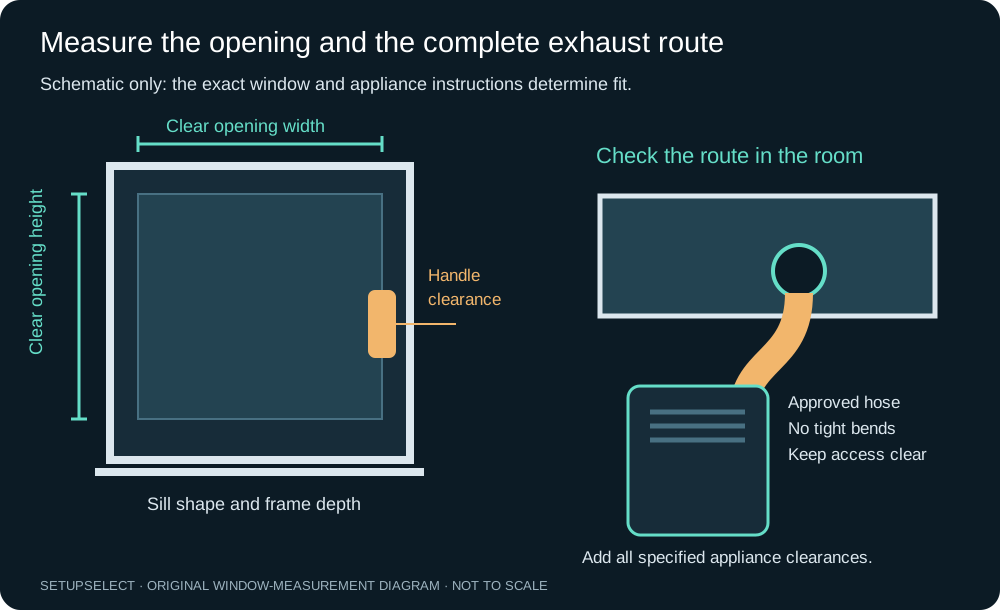
Measure the clear opening and note handles, restrictors, blinds and curtains. A supplied kit pictured beside an appliance may be intended for a different window type.
Check whether the proposed arrangement preserves the necessary use of the window, including any escape role, and whether it provides suitable security and weather protection. A fabric seal is not equivalent to a closed, locked window.
If the opening cannot support an appropriate installation, stop treating the available floor corner as an AC location until that issue is resolved.
Use the portable-AC window-kit guide for detailed measurements.
The window decision should happen before choosing a model for its colour, app or capacity: those features cannot provide a missing route for rejecting heat outside.
Measure heat gains at the time you sleep
Record room dimensions, ceiling height and connected spaces. Add window size and direction, useful shading, roof exposure and equipment used in the evening.
A television and gaming computer may operate during exactly the period when you want the room to cool, so do not size it as an empty bedroom.
Observe when the room is hottest. A room that gains strong afternoon sun may remain warm after sunset even when the window view looks shaded at bedtime. A converted loft can also have different exposure from a ground-floor room of the same size.
The main sizing guide explains how these factors qualify floor-area estimates.
Enter the information into the air-conditioner finder, keeping the result and assumptions together. Avoid jumping automatically to the largest portable class for every upstairs room.
If the loft or glazing makes the estimate highly uncertain, professional cooling advice may be more useful than increasingly generous guesswork.
Choose between pre-cooling and overnight operation
Pre-cooling means running the appliance before the room is occupied for sleep, then stopping or changing the routine. It can avoid compressor sound while someone falls asleep, but stored heat and ongoing gains may warm the room again.
Check what happens later rather than judging success only from the temperature at switch-off.
Overnight operation places different demands on the product. Compressor starts and stops, display brightness, alerts, fan behaviour and drainage all matter. A timer that stops two hours after bedtime cannot guarantee the remaining night stays comfortable.
Conversely, keeping the unit running for a fixed eight hours is unnecessary if a shorter routine meets the observed need.
A mixed routine is another possibility: pre-cool, review the room, and use a suitable fan or continued cooling according to conditions. Do not assume the combination always saves energy; record what runs and for how long.
For anyone vulnerable to heat, follow the current UKHSA home-cooling guidance rather than making a fixed off time the priority regardless of room conditions.
Read sound data for the mode that actually cools
A portable refrigerated air conditioner contains more than a fan. Its compressor and exhaust airflow can contribute to the sound in the room. Compare the stated measurement type, mode and fan setting.
A low number attached to fan-only operation is not evidence of the same sound while actively cooling.
Sound power and sound pressure are not interchangeable measures. Even comparable sound-pressure figures do not capture every difference in pitch, cycling or vibration.
If one listing omits the basis, ask the manufacturer rather than deciding from the difference between two unexplained decibel numbers.
The older MeacoCool manuals, for example, explicitly identify their quoted noise as a low-fan figure in the MC Series specification table.
That qualification is the useful lesson; it should not be turned into a claim about what any current machine sounds like at a particular pillow.
Assess sound during the intended routine where you can do so under the seller's applicable terms. Include the period after the target is reached, when control behaviour may change.
A recording made through a phone is not a calibrated comparison between products or rooms.
Work out what sleep mode means
Manufacturers may use sleep mode to lower fan speed, alter the temperature target over time, dim indicators or change control behaviour. Read the exact description for the chosen appliance.
Do not assume it stops the compressor or retains your starting temperature unchanged throughout the night.
Check the remote and on-unit controls too. Can you make a simple adjustment without turning on a bright display? Can the unit be operated if an app or wireless connection is unavailable?
Does it beep when a button is pressed or when water handling needs attention? These details are easier to verify before purchase than to solve with improvised coverings afterwards.
Do not cover the appliance, vents or alarms to suppress sound or light. If the product's normal behaviour is unsuitable, choose another permitted routine or product.
An improvised acoustic enclosure can obstruct airflow and is not a responsible solution to an appliance that is too intrusive for the room.
Draw the bedroom with the hose installed
On a simple plan, include the bed, bedside furniture, wardrobes, door swing and the route people use at night. Add the machine body and all manufacturer clearances.
Then draw the hose between the appliance outlet and window adapter, following its permitted length and bends.
De'Longhi's official hose-extension advice is a useful warning against solving a difficult layout by adding unsupported duct length.
Follow the exact model instructions. A bed placed between the unit and window may force a route that does not work even though both objects individually fit the room.
Consider curtains when closed and bedding when someone is asleep. Neither should be able to fall over an intake, outlet or hot exhaust arrangement. Avoid directing an uncomfortable cold stream at the sleeper where the outlet design allows a better direction.
Keep the electrical cable and any drain hose away from the night-time walking route.
An illustrative double-bedroom plan
Imagine a room 3.6m long and 3.2m wide, with a 1.5m-wide bed and a wardrobe facing its foot. The window is on a side wall and the door opens into the opposite corner.
A free patch near the wardrobe initially appears attractive because a socket is nearby, but it places the hose across the walking route to the window.
The owner instead assesses a position near the side window, checking whether bedside furniture can move without narrowing access unacceptably.
A cardboard outline represents the candidate body; additional marked space represents its required clearances and hose. If curtains conflict, their planned position is reconsidered without covering vents or defeating required shading and ventilation.
The cooling shortlist comes from the room and heat-gain assessment, not these dimensions alone. The example's useful result is a feasible operating zone.
A candidate with more cooling but greater depth might fail that zone, making a different model or room arrangement preferable.
The proposed routine is an evening cooling period followed by an observation at bedtime and another later check on a representative hot night. These are planning steps, not an assurance that one hour, two hours or any specific duration will be enough.
Record the room's response before making the schedule automatic.
Deal with water before the first overnight session
Read the cooling-mode condensate instructions, including any full-water indication and required drainage procedure.
Some units discharge part of the moisture through the exhaust under suitable conditions, but that does not justify assuming draining will never be needed. Dehumidifying mode may have different requirements from cooling mode.
Identify where you will empty or drain the unit and how it can be reached without moving furniture in darkness. Do not connect a hose uphill or to an open container and assume it inherits an internal tank's overflow protection.
If continuous drainage is permitted, the complete route and destination must be suitable and inspectable.
For the first representative session, observe the setup while awake. Check that the exhaust remains connected, the seal does not loosen, water is handled normally and warnings are understood.
This practical inspection also reveals whether the remote, display and ordinary cycling are acceptable before you depend on the arrangement overnight.
Prevent heat before spending more on removal
Use suitable shading before sunlight has heated the room, reduce avoidable equipment use and consider ventilation when outdoor conditions are cooler.
The Energy Saving Trust cooling advice supports combining these approaches. Keep them compatible with the exhaust installation and the home's required ventilation.
Do not place a hot computer or entertainment system in the room unnecessarily during pre-cooling. If the bedroom is also an office, shut down equipment no longer needed and record whether it stays on overnight.
A room used continuously for work, gaming and sleep has a different heat pattern from one occupied only at night.
Choose an attainable temperature target and observe comfort. Selecting the minimum displayed temperature does not increase the appliance's cooling capacity.
If it cannot approach a reasonable target with a sound installation, revisit load, room boundaries and product suitability rather than repeatedly lowering the setting.
Budget for your actual sleep routine
Use electrical input watts, not the cooling BTU/h label, in the running-cost calculator. For an illustrative 1.0kW input held for three hours, energy is 3kWh; at an example £0.25/kWh, that is £0.75.
Holding the same input for eight hours would be £2.00. Neither scenario predicts compressor cycling or uses a claimed current tariff.
If the unit alternates between compressor operation and fan-only periods, a suitable energy monitor can record the combined result. Note the start and end times, target, room conditions and whether a separate fan also ran.
The AC running-cost guide explains how to compare sessions without presenting assumed duty cycles as measurements.
Include the kit and seasonal storage in the ownership decision. A window adapter that must be removed every morning, a heavy unit carried up stairs, or an awkward drainage routine can be more burdensome than a modest difference in electricity.
Portable convenience depends on the room and household, not the presence of wheels alone.
A first-week bedroom review
| Check | Record | What the result can reveal |
|---|---|---|
| Before cooling | Room temperature, shading and equipment | Starting heat conditions |
| At bedtime | Temperature and chosen operating mode | Whether pre-cooling met the immediate aim |
| Later or next morning | Comfort observations and available readings | Whether heat returned after stopping |
| During operation | Cycling, light, vibration and alerts | Practical sleep compatibility |
| Installation | Hose, seal, curtains and water | Setup problems that affect performance |
Avoid treating one cool evening as a successful hot-weather trial. Equally, a single unusually difficult night does not isolate the cause of poor performance.
Use the observations to identify a change: better shading, a different schedule, a corrected kit, a different product or a professional assessment if the room remains unsuitable.
Can I put the machine outside the bedroom and blow cold air in?
Only use arrangements supported by the manufacturer. Ordinary portable units and their exhaust systems are designed for particular positions and air paths.
Moving the machine outside a doorway or improvising additional supply ducts can change the system without solving the heat load or noise problem as intended.
Will a small bedroom always suit 7,000BTU/h?
No. Roof exposure, solar gain, equipment, ceiling height and installation can change the requirement.
Use the capacity-class comparison after assessing the room, and keep the class separate from the product's sound and physical fit.
Is a fabric window seal secure enough overnight?
It is primarily an exhaust-sealing accessory, not a replacement for the window's normal security. Assess the actual opening, access from outside, weather exposure and escape requirements.
If the arrangement is unsuitable overnight, that constrains the cooling routine regardless of the machine's features.
Can air conditioning guarantee better sleep?
No. This guide addresses cooling equipment and room setup, not health or sleep treatment. Temperature, sound, individual preferences and other factors vary.
Choose an arrangement that meets the observed room need and follow appropriate health advice when heat becomes a concern.
Continue researching