Buying guide
7,000 vs 9,000 vs 12,000BTU air conditioners: class comparison
The 7,000, 9,000 and 12,000BTU/h labels describe cooling-capacity classes, approximately 2.05, 2.64 and 3.52kW respectively.
Choose the class after assessing the room, then compare the actual machines' electrical input, dimensions, noise evidence, exhaust arrangement and handling. A capacity class is not a fixed floor area, a price tier or an electricity rating.
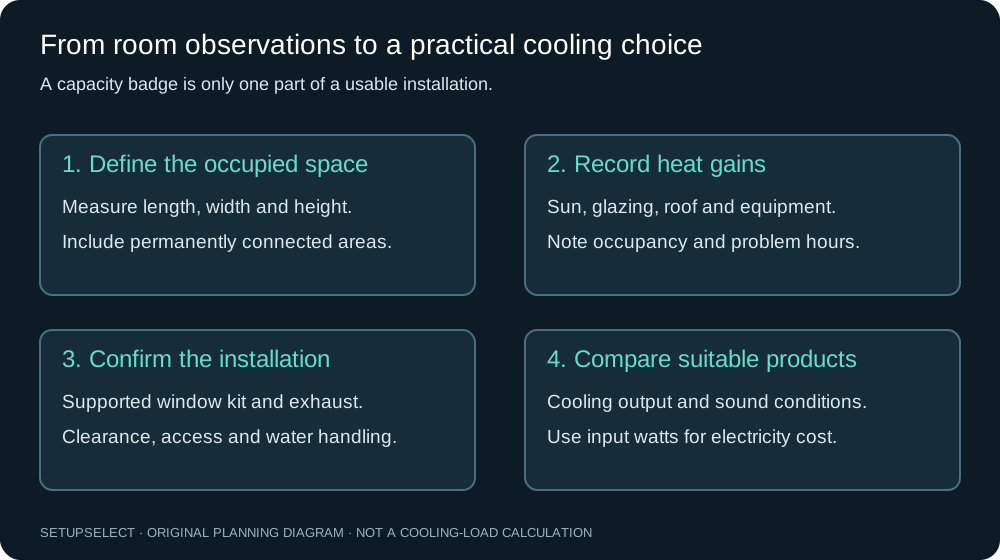
If you have not yet measured the room and recorded its heat gains, begin with what size air conditioner do I need? and the air-conditioner finder.
This article starts at the next decision: what changes when your shortlist crosses these three common labels, and what specifications are needed to compare them fairly?
Put the three labels into the same units
BTU/h means British thermal units per hour, a rate of heat transfer. Dividing by approximately 3,412 converts BTU/h to kilowatts. Retailers often shorten the label to BTU, but in this context they normally mean cooling output per hour.
Preserve the full unit in your notes so it cannot be confused with energy over a whole session.
| Capacity label | Approximate cooling kW | Difference from the preceding class |
|---|---|---|
| 7,000BTU/h | 2.05kW | Starting comparison |
| 9,000BTU/h | 2.64kW | About 0.59kW additional cooling |
| 12,000BTU/h | 3.52kW | About 0.88kW additional cooling |
Those increments are arithmetic, not performance measurements in your room. They do not establish how many degrees faster a bedroom cools or how much larger a space can be treated. Heat entering the room, test basis and installation all affect that outcome.
The percentage step also differs: 9,000 is about 29% above 7,000, while 12,000 is about 33% above 9,000. It is therefore misleading to treat each label as an identical one-step upgrade.
Use the actual figures and the reason your load estimate calls for additional capacity.
A documented comparison from one manufacturer generation
The table below uses the older MeacoCool MC Series cooling-only models documented in the manufacturer's 7,000–10,000 manual and 12,000–14,000 manual.
These manuals were checked on 29 September 2026. The examples show how to read comparable specifications; they are not current stock recommendations or independent test results.
| Published MC Series field | 7,000 model | 9,000 model | 12,000 model |
|---|---|---|---|
| Cooling label | 7,000BTU/h | 9,000BTU/h | 12,000BTU/h |
| Electrical consumption | 780W | 1,003W | 1,337W |
| Body H × W × D | 701 × 350 × 348mm | 701 × 350 × 348mm | 762 × 353 × 470mm |
| Net cooling-only weight | 20.5kg | 23.5kg | 29.5kg |
| Duct diameter | 150mm | 150mm | 150mm |
| Supplied duct length | 1.8m | 1.8m | 1.8m |
| Stated low-fan noise | 53dB | 53dB | 53dB |
Do not transfer these numbers to a later Pro, Cirro, heating-capable or similarly named product. The exact model and generation are part of the specification.
In particular, a product listing that combines a newer photograph with an older manual should be clarified before ordering.
What this example does and does not establish
The two smaller examples have identical body dimensions despite different capacity and weight. The 12,000 model is substantially deeper, not dramatically wider.
This is a useful reminder that looking only at front-view photographs can hide the dimension that matters beside a bed or desk.
The identical published low-fan noise figures also prevent a simple claim that each larger class must be louder. They do not prove identical perceived sound or identical performance on every mode.
The manuals provide a stated comparison point; your shortlist should still identify sound pressure versus sound power, operating mode and any measurement details available.
Finally, the common duct diameter and supplied length do not mean the same installation works everywhere. Hose exit height, adapter shape, clearances and window-kit compatibility can still differ.
Read the installation drawing for the actual candidate, especially when moving between product generations or manufacturers.
Separate electricity input from cooling output
The 9,000 example's approximately 2.64kW cooling label and 1.003kW electrical input describe different sides of the process. Cooling capacity measures heat transfer; input measures power drawn from the supply.
A retailer may place both under a field called power, so check the original specification before calculating costs.
For a transparent illustration, assume each listed input continues for four hours and electricity costs £0.25/kWh. The 780W example uses 3.12kWh and costs £0.78; 1,003W uses 4.012kWh and costs about £1.00; 1,337W uses 5.348kWh and costs about £1.34.
These are equal-time arithmetic scenarios, not claims that all three would deliver the same room condition in four hours.
The larger appliance may cycle differently, the smaller may run continuously, and fan-only periods may consume less. Use the AC running-cost guide for those distinctions.
Do not announce a cheaper class solely from the equal-time illustration without checking whether it can meet the cooling task.
Compare the rating basis before comparing the number
Product pages can show different capacity measurements, particularly across countries and appliance types. Keep the exact rating label and stated test conditions with the number.
If one page offers several cooling capacities, establish which one the room recommendation and efficiency figure use.
Do not quietly select whichever number makes a preferred model look strongest. A fair comparison uses the same basis, or explicitly marks the products as not directly comparable from the available data.
Manufacturer technical support can often clarify an ambiguous retailer field more reliably than another shopping filter.
Similarly, maximum recommended room area is not a universal conversion table. One manufacturer's guidance may assume conditions unlike another's. Use your recorded room assessment consistently, then consult the manufacturer's relevant limitations.
The class badge should answer how much rated cooling is available, not replace the whole room calculation.
Evaluate the complete installed footprint
Draw the appliance body from above and add its instructed clearance. Then draw the hose route and the floor space needed to remove or drain collected water. Mark the nearest furniture, curtains, door swing and normal walking route.
This is the operating footprint, which can be much larger than the casing alone.
For an illustrative bedside position with only 420mm of unobstructed depth, the 470mm-deep example fails even before hose and clearance are added. The smaller 348mm body is not automatically acceptable: it still needs those additional operating spaces.
The right conclusion may be that neither fits the proposed corner.
The window-kit guide provides the measurement sequence for the outlet.
De'Longhi's official hose advice illustrates why an unsupported hose extension should not be used to rescue an otherwise unsuitable position.
Each appliance's own instructions remain the authority.
Portability includes stairs and seasonal storage
Check the empty appliance weight and the lifting arrangements in the instructions. A unit that rolls easily on a level floor may still be awkward on stairs or through a narrow landing. Plan where it can be put down safely and who will move it.
Do not include water left inside as an accidental extra load; follow the draining and transport instructions.
Measure storage height, depth and the cupboard opening. Keep the hose, adapters and kit components together so next season's setup does not begin with a missing connector.
Check storage restrictions, including any minimum room or ventilation requirements associated with the refrigerant, in the exact manual.
If a 12,000-class candidate will remain upstairs all summer, its handling penalty may matter only twice a year. If one appliance is expected to move between office and bedroom every day, the same weight difference can dominate the ownership experience.
Compare the intended routine rather than giving every portability feature equal importance.
Shortlist controls according to the job
A timer can support pre-cooling, a thermostat can control the room target, and a remote can make adjustment easier from a desk or bed. Check how sleep mode changes operation and whether the display can be dimmed.
None of these features increases the fundamental cooling capacity, but they can make an otherwise suitable product practical.
Drainage behaviour matters during long sessions. A self-evaporating description does not guarantee that manual draining will never be needed under every condition. Confirm cooling-mode and dehumidifying-mode instructions separately.
A tank-full stop in the middle of a hot night can matter more than a minor difference in headline output.
For a working room, check whether controls are usable without an app and what happens after a power interruption. For a bedroom, prioritise the operating sound and light behaviour.
The bedroom AC guide considers those details without assuming any one capacity class is inherently sleep-friendly.
Three purchase decisions that avoid badge-led shopping
A calculated range close to the smaller class. The room is compact, the installation is sound and the lower class is plausible. Compare actual products for supported capacity, noise and controls.
Do not buy a 12,000 label merely because the price difference seems modest if its footprint and handling create daily problems.
An estimate between 9,000 and 12,000. Investigate what drives the uncertainty. Strong afternoon sun, a permanently open area or equipment running at uncertain power are different issues.
Confirm practical shading and real use, then decide whether additional capacity is justified. Keep the unresolved assumption visible if it cannot be resolved before purchase.
A demanding glazed or open-plan room. The largest of these three labels is not necessarily adequate. If the room assessment points beyond practical portable cooling, consider another closable space or obtain professional advice on an appropriate system.
The product range available at one retailer should not define the cooling requirement of the building.
Build a comparison sheet you can audit
Use one row per exact model, with a link to its technical source and date checked. Include cooling capacity and basis, electrical input, relevant noise data, dimensions, weight, required clearances, duct connection, supplied kit and drainage arrangement.
Add a separate column for unresolved questions.
Then identify hard failures before comparing preferences. An unsupported window connection or unsuitable operating environment is not something to average against an attractive control feature.
Once all candidates pass installation and capacity checks, compare convenience, measured or documented sound, complete purchase cost and storage.
If a model sells out, the sheet lets you replace it without restarting from a marketing headline. Match the required specification, not only the BTU label.
Use the finder again if room use changes, and the running-cost calculator when candidate input power changes.
Include an acceptance note beside every shortlisted product. For example: the window adapter is confirmed for this opening; the operating footprint clears the chair route; and the sound information applies to the intended cooling setting.
If one of those statements cannot yet be supported, write the unanswered question instead. This prevents an incomplete candidate looking equivalent to a fully checked one simply because both have the same capacity.
Keep a record of the accessory cost separately from the appliance price. A supplied rigid panel may be unsuitable for your casement, while another model includes a compatible alternative.
Without that distinction, the apparently cheaper capacity class may require an extra purchase before it can be used at all.
Is 12,000BTU/h automatically better value than 9,000?
Only if the extra capacity is useful and the complete product fits. Additional depth, weight, input power, accessories and installation changes can matter more than the ticket-price difference.
A good value comparison includes the intended operating routine and any unresolved capacity uncertainty.
Why do two 9,000BTU/h units recommend different room sizes?
They may use different assumptions, rating methods or marketing guidance. Check the technical basis and compare both against the same room assessment.
Do not infer that the larger advertised area proves better real performance without supporting conditions or comparable tests.
Will a bigger unit cool every room faster in the same proportion?
No. Heat gains, air movement, the exhaust arrangement and controls affect the result, and the room changes as it cools. The capacity ratio is not a guaranteed time ratio.
Only a relevant controlled comparison or observations under matched conditions could support that stronger claim.
Can I compare an old manual with a current product listing?
Only after confirming the exact model and generation match. Similar names may cover changed specifications or different heating and cooling versions.
If the manufacturer cannot confirm that the manual applies, keep the candidate unresolved rather than copying the older figures into a current purchase decision.
Continue researching