Buying guide
Air-conditioner running costs: calculate and measure your use
Air-conditioner electricity cost is energy used in kilowatt-hours multiplied by your electricity price per kilowatt-hour. If a portable unit draws 1,000W for five hours, it uses 5kWh; at an illustrative £0.25/kWh that costs £1.25.
Use electrical input, not the cooling-capacity label, and replace the example tariff with your own.
The air-conditioner running-cost calculator makes that arithmetic convenient. This guide explains how to choose sensible inputs, create transparent scenarios and measure a real session.
All costs below are calculations using stated assumptions, not verified household bills, product tests or forecasts of current electricity prices.
Find the right power figure
A product may show 9,000BTU/h of cooling, about 2.64kW of cooling, and around one kilowatt of electrical input. These numbers can all describe the same appliance.
Cooling output measures how quickly heat is transferred; electrical input measures how quickly electricity is consumed. Only the latter belongs in a simple electricity-cost calculation.
Look for input power, power consumption or rated electrical input in the exact model's technical information. A retailer field simply called power may be ambiguous.
Confirm whether the number applies to cooling, heating, fan-only operation or a maximum electrical condition. Do not use the current in amperes multiplied by an assumed voltage as a substitute for available real-power data.
Model identity matters. A similarly named heating-and-cooling version can have different operating specifications.
The capacity-class comparison shows published input and cooling output in separate columns so they cannot accidentally be interchanged.
Convert watts to kilowatt-hours
Divide input watts by 1,000 to obtain kilowatts. Multiply by operating hours to estimate energy if that input remains constant. Multiply the resulting kWh by the unit rate in pounds per kWh. Keep pence and pounds distinct: 25p is £0.25, not £25.
For an illustrative 1,100W appliance, 1,100 divided by 1,000 is 1.1kW. Six hours at that input gives 6.6kWh. At £0.25/kWh the session costs £1.65. Seven identical sessions would cost £11.55.
The word identical carries the assumption: the same input, duration and tariff apply every time.
Keep sensible rounding until the final result. If the calculator displays £1.65, there is no benefit in describing the result to fractions of a penny when runtime and input are approximate.
Use the precision to check arithmetic, not to imply a level of forecast certainty the assumptions do not support.
Use the tariff on your own bill
Electricity unit rates vary with contract, region, payment arrangement and time period. Ofgem's unit-rate and standing-charge information explains that distinction.
A national headline or a manufacturer's example pence-per-hour claim is not necessarily the rate your household pays.
For a flat-rate tariff, enter the applicable electricity unit price, including tax consistently with your bill. Check its effective dates.
If you are costing use next season, label the tariff assumption rather than presenting today's contract as a guaranteed future rate.
The standing charge is normally payable regardless of whether the AC runs that day. Do not add the entire daily standing charge to one cooling session when estimating its additional cost.
If you are comparing complete electricity contracts, standing charges belong in that wider comparison; that is a different calculation from appliance marginal energy use.
Build hourly, evening and weekly scenarios
The table uses three invented electrical inputs and the same illustrative tariff. It compares arithmetic only. It does not associate a power draw with every product in a particular capacity class or predict equal comfort from each row.
| Constant input assumption | Energy in one hour | Four-hour cost at £0.25/kWh | Eight-hour cost at £0.25/kWh |
|---|---|---|---|
| 800W | 0.8kWh | £0.80 | £1.60 |
| 1,100W | 1.1kWh | £1.10 | £2.20 |
| 1,400W | 1.4kWh | £1.40 | £2.80 |
To plan a week, count the sessions you actually expect. Four eight-hour nights at the middle row would total £8.80 under the constant-input assumption. Adding three short two-hour sessions would add 6.6kWh, or £1.65, making £10.45.
This schedule is more informative than multiplying one hour by every hour of an entire summer.
Keep a high-use and a lighter-use scenario. For example, a hot week may involve longer occupied periods and more continuous cooling than an ordinary warm week. Label the distinction in hours and assumptions rather than inventing a universal summer duty cycle.
Clock hours are not always compressor hours
Once the room approaches its target, the compressor may cycle or vary its operation, while the fan may continue. Model controls differ.
Rated input multiplied by every clock hour can therefore differ from actual energy, especially when the load changes during the session.
The opposite assumption is also risky: a unit may operate for much of the session if solar gains, a poor seal or connected space keep the cooling demand high. Do not promise that the compressor runs only half the time.
A fixed percentage without observations is merely another scenario input.
For an explicitly invented eight-hour cycle, suppose a machine draws 1.1kW during four hours of active cooling and 0.06kW during four fan-only hours. Energy is 4.4 + 0.24 = 4.64kWh, costing £1.16 at the example tariff.
That illustrates why the remaining hours are not necessarily zero consumption. It is not a claimed operating pattern for any named model.
A meter can answer what a rating cannot
If suitable for the appliance, use an appropriately rated energy monitor according to both devices' instructions.
It must be compatible with the electrical load and connection; do not create an unsupported extension or overloaded arrangement just to obtain a reading. Seek competent advice where compatibility is uncertain.
Record the starting kWh, begin the intended cooling routine, then record the final kWh and time. The difference is the measured energy for that interval. Record the temperature target, room use, shading and whether doors or windows changed.
A kWh number with no context is less useful for predicting another session.
Do not mistake instantaneous watts for the accumulated energy total. A reading during a compressor-off moment can be far below active cooling input. Likewise, the highest observed wattage multiplied by the entire session can exaggerate measured consumption.
The energy register integrates what actually happened during the selected period.
Make a repeatable household observation sheet
| Field | What to record |
|---|---|
| Date and interval | Start and finish time, including any pre-cooling |
| Energy | Final minus initial kWh, using the same suitable monitor |
| Controls | Cooling mode, target and fan setting |
| Room conditions | Useful temperature observations and unusual heat events |
| Installation | Window kit, door arrangement and any changes |
| Occupancy and equipment | People and significant equipment operating |
| Tariff | Unit rate and whether time periods differ |
| Outcome | Whether the intended room use was comfortable enough |
Review a few representative sessions before declaring a typical cost. A shaded evening and a sunny afternoon do not make a controlled appliance comparison. They can still help you budget your own routine if you label the different conditions honestly.
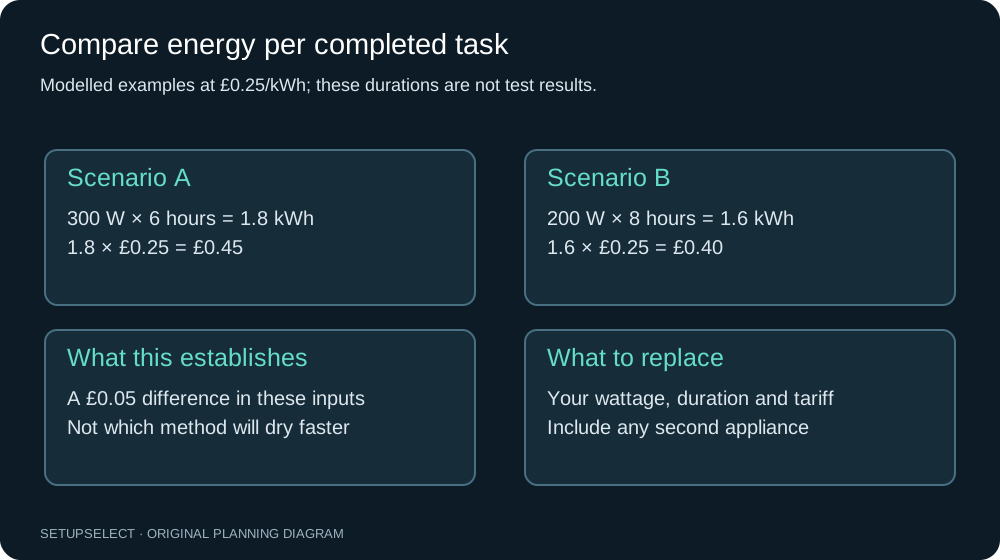
If the goal is to compare two settings, change one main variable where practical and preserve the others. Avoid changing the thermostat, room, fan speed and operating hours together and attributing the cost difference to one feature.
Household observations are useful without being advertised as laboratory tests.
Time-of-use tariffs need separate intervals
When electricity prices change during the session, split energy by the relevant periods. Suppose a hypothetical evening uses 2kWh at £0.30/kWh and a later period uses 3kWh at £0.15/kWh. The total is £0.60 + £0.45 = £1.05.
Multiplying all five kWh by the cheap rate would understate the cost.
If you only have a total energy reading, you cannot precisely allocate it across changing rates without further timing information. A rough allocation can be a labelled estimate, but it should not masquerade as an exact bill reconciliation.
Suitable interval data can improve the calculation where available.
Do not shift cooling to an inconvenient or unsafe time simply because electricity is cheaper. Pre-cooling and stored heat vary by building, and a room may warm again before occupancy.
Check whether the changed schedule still provides the intended outcome before calling it a saving.
Why a larger unit is not automatically more expensive per useful session
A larger candidate may draw more power while actively cooling, yet its operating pattern can differ. A smaller candidate may run continuously without achieving the same room condition.
Compare both capacity suitability and actual energy rather than assuming lower watts always means lower useful cost.
That does not mean oversizing is a guaranteed efficiency strategy.
The Department of Energy's room-AC guidance cautions that oversizing can increase cycling and impair humidity removal.
The practical choice needs appropriate sizing and comparable evidence, not a rule that either smallest or largest always wins.
Use the sizing guide to establish the task, then cost candidates that can plausibly do it.
If a unit cannot maintain the intended conditions, a cheap session may simply describe insufficient cooling rather than good value.
Reduce avoidable load and verify the effect
Suitable shading, reducing unnecessary heat-producing equipment and using cooler outdoor air when appropriate can reduce the cooling task. Energy Saving Trust's home-cooling advice discusses these measures.
The amount saved in your home depends on its layout, exposure and use, so do not attach an unsupported percentage to every blind or thermostat change.
Inspect the exhaust installation. A loose connection or poorly fitted panel can allow hot air to return, while a restricted hose conflicts with intended operation.
Use the window-kit guide and exact manufacturer instructions before interpreting disappointing energy results as a fundamental product problem.
Keep filters maintained as instructed. Also check whether the room boundary is realistic: repeatedly opening a door to a large warm area changes the load. Once the setup is sound, measure a comparable session and record what changed.
This creates evidence for your household rather than a generic savings claim.
Include ownership costs without confusing them with electricity
A complete purchase decision may include the appliance, compatible window accessories, delivery, any approved installation work and future maintenance items. Record these separately from per-session electricity.
No fixed prices are assumed here because model availability and household installation needs differ.
Seasonal storage and moving effort also have practical value even if they do not appear as a tariff line. A setup that is too awkward to assemble may be used less effectively.
If comparing a portable unit with a professionally installed system, obtain complete quotations and compare the intended service, rather than treating headline purchase prices as equivalent projects.
For a simple seasonal budget, state the assumed number of sessions and multiply by a representative energy-based session cost. Give a range if weather and occupancy are uncertain.
Do not multiply a maximum-power hot-day example by every day of the year and present the result as a normal annual bill.
Does a 12,000BTU/h label mean 12kW of electricity?
No. It describes approximately 3.52kW of cooling output, not 12kW of electrical input. Find the separate input watts for the exact operating mode.
Confusing these quantities can make a cost estimate wrong by several times before runtime or tariff is considered.
Is the manufacturer's pence-per-hour claim my likely cost?
Only if its input, tariff and operating assumptions match your situation. Often it is a useful example rather than a personalised figure. Recalculate with your bill and model data, then measure a representative session if you need a closer answer.
Should a fan's cost be compared directly with AC?
You can compare electricity arithmetic, but they provide different outcomes. A fan mainly moves air for personal comfort; AC transfers heat outdoors.
Use portable AC versus fan to decide which outcome is required before choosing on cost alone.
Why did my second night cost less?
Possible reasons include different weather, starting room conditions, occupancy, equipment, settings or compressor operation. The energy difference is real if measured correctly, but one pair of nights does not isolate its cause.
Use the observation sheet to identify plausible changes before crediting a single feature or claiming a repeatable saving.
Continue researching