Buying guide
Pressure washer pressure and flow explained: bar, L/h and water use
Pressure tells you about the force of water in a pressure-washer system; flow tells you how much water the system delivers. Read both, alongside the nozzle and the conditions attached to the figures.
Neither the highest bar rating nor the highest litres-per-hour rating identifies the best machine for every surface.
This guide brings pressure and flow into one comparison. It explains units, separates maximum figures from working figures, and shows how to estimate water use without inventing cleaning-speed claims.
For the wider purchase decision, including storage and mixed jobs, use the pressure-washer chooser and the main buying guide.
What bar actually measures
One bar equals 100,000 pascals, a unit of pressure. In a washer specification it describes pressure in the water system under the manufacturer's stated conditions. It does not directly describe the force on every square centimetre of a car door or paving slab.
The nozzle turns water into a jet, and the jet's pattern, movement and distance determine how the water reaches the surface.
That distinction matters when reading a product name containing a number. A machine advertised as 135 bar is not a promise that all its cleaning modes operate at that pressure.
Nor does a 135 bar badge mean it is appropriate to use the strongest setting on a surface that another machine could damage. A maximum is a capability boundary, not an operating instruction.
Treat pressure as one part of the machine's specification. A listing that supplies only a large bar number leaves unanswered questions about working pressure, water volume, accessories and control.
Those omissions should lead you to the manual, not to a conclusion that the machine must outperform a more fully documented alternative.
Maximum pressure and rated pressure are different fields
Some manufacturers distinguish maximum permissible pressure from rated operating pressure. Others show a headline maximum on the product page and more detail in the manual. Compare the same fields between models.
A maximum from one machine and an operating figure from another are not a fair head-to-head comparison.
The Bosch UniversalAquatak manual is an example of the more detailed technical information available behind a sales listing.
Check the exact model and product code because related versions and regional packages can differ. Keep the label attached when copying a figure into your shortlist: write “maximum pressure”, not simply “pressure”.
Also distinguish adjustable output from interchangeable spray patterns. A different nozzle may change the shape and concentration of the jet without giving you a calibrated pressure reading at the surface.
A display marked soft, medium or hard is meaningful within that product's instructions, but it is not a universal scale shared across brands.
What litres per hour tells you
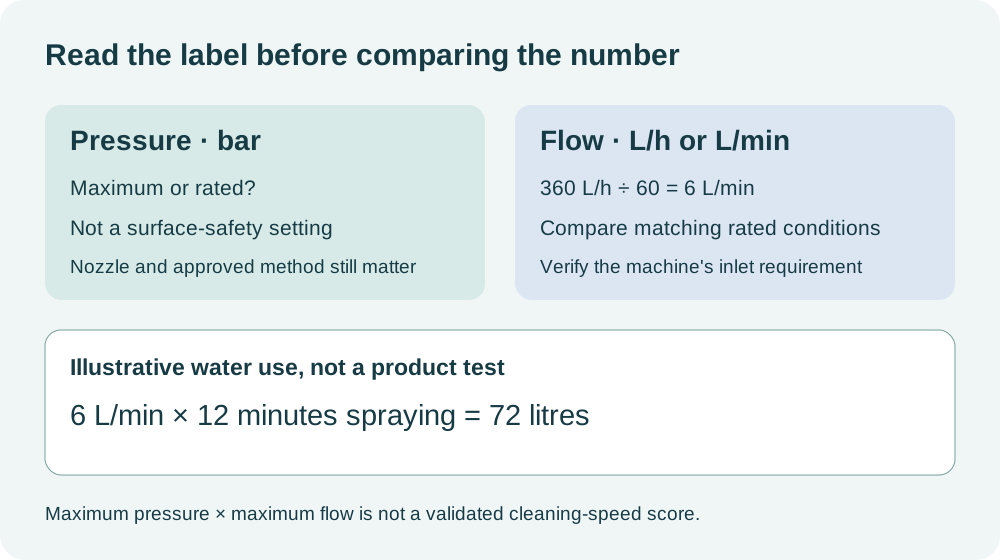
Flow rate describes water volume over time. The usual domestic listing uses litres per hour, written L/h. Divide by 60 to convert it to litres per minute. A published 360 L/h corresponds to 6 L/min; 450 L/h corresponds to 7.5 L/min.
These are conversions of the stated figures, not measurements of your tap or your selected cleaning mode.
Flow is relevant when moving loosened dirt and rinsing a broad area. However, it does not justify predicting that a machine with 25% more maximum flow will finish a patio 25% faster.
Actual progress also depends on the surface, contamination, attachment, overlap, preparation and the operator's working method. Some of the extra water may be spent rinsing rather than increasing useful coverage.
As with pressure, distinguish maximum flow from rated flow where both appear. Do not silently substitute one for the other in a comparison.
A manufacturer might publish several figures for good reasons; the useful response is to retain their definitions and ask what conditions produced each number.
A comparison that exposes the trade-offs
The following machines are invented specification profiles, not products we tested or recommend. The numbers demonstrate how two headline figures can point in different directions.
| Illustrative profile | Maximum pressure | Maximum flow | Converted flow | Useful question |
|---|---|---|---|---|
| A: compact | 120 bar | 360 L/h | 6 L/min | Does its control and reach suit the small job? |
| B: higher pressure | 150 bar | 360 L/h | 6 L/min | What practical benefit justifies the extra pressure? |
| C: higher flow | 135 bar | 450 L/h | 7.5 L/min | Can the supply support it, and will rinsing help? |
Profiles A and B move the same stated maximum water volume. B's larger pressure number alone cannot establish better rinsing. Profile C has less maximum pressure than B but a larger maximum flow.
That could be relevant to a broad cleaning task, yet it still says nothing about whether its nozzle is appropriate for vulnerable paint or weathered pointing.
The next comparison should therefore add operating figures, approved accessories, minimum supply requirements and hose reach. If those details are unavailable, the ranking remains uncertain.
That is a more useful conclusion than constructing a league table from incomplete specifications.
Why multiplying bar by flow is not a cleaning score
Pressure multiplied by volume flow has a physical relationship to hydraulic power, provided both describe the same operating point and units are handled correctly.
That does not make a retailer's maximum-bar-times-maximum-flow calculation a reliable domestic cleaning score. Those maxima may not occur together, and the result does not account for the attachment or the surface.
For an illustrative engineering calculation, 100 bar is 10 million pascals and 6 L/min is 0.0001 cubic metres per second. Multiplying them gives 1,000 watts of hydraulic power at that assumed operating point.
It is not the electrical input power, because the conversion from electricity to water movement is not lossless. It also does not predict square metres cleaned per hour.
You do not need this calculation to buy a washer. Its value is showing why a seemingly precise score can conceal assumptions. If a comparison cannot say whether its pressure and flow values are simultaneous rated values, its apparent precision is misleading.
Use a documented task demonstration or comparable test where available, rather than presenting arithmetic as a performance test.
Check the supply before paying for more flow
A washer cannot be assessed independently of its inlet water supply. Read its requirements for supply flow, inlet pressure, hose specification, inlet temperature and filters.
A domestic garden tap, a long supply hose and a water butt are different arrangements; do not assume a machine supports all three.
A bucket test can provide a rough observation of your supply flow at the end of the intended inlet hose. For example, collecting 10 litres in 75 seconds gives 10 ÷ 75 × 60 = 8 L/min. Collecting the same volume in 100 seconds gives 6 L/min.
Compare the result with the manufacturer's minimum inlet requirement, allowing for variation when other taps are being used. The outlet maximum is not automatically the correct inlet minimum.
This test does not measure supply pressure or confirm that the installation satisfies every requirement. It also does not diagnose an intermittent fault.
If the arrangement fails a stated requirement, shorten or correct the supply arrangement within the manual's instructions or choose a suitable machine; do not run it in the hope that its larger motor will compensate.
Water use: count trigger time, not the whole afternoon
A useful starting calculation is water volume = flow × time while water is actually being delivered. At an assumed average 6 L/min, 12 minutes of spraying uses 72 litres. At 7.5 L/min, the same trigger time uses 90 litres.
These are transparent examples, not measured consumption for either a car or a patio.
| Assumed delivered flow | 8 minutes spraying | 12 minutes spraying | 20 minutes spraying |
|---|---|---|---|
| 6 L/min | 48 litres | 72 litres | 120 litres |
| 7.5 L/min | 60 litres | 90 litres | 150 litres |
The session may include sweeping, applying a chemical, waiting, moving furniture and packing away. Those periods do not all use water. Conversely, filling buckets and flushing equipment adds water outside the main spray calculation.
If consumption matters, record the complete process or use a suitable meter; do not quote the table as a guaranteed total.
A higher-flow machine might finish some jobs with less trigger time, but that has to be observed rather than assumed. Suppose one setup uses 6 L/min for 18 minutes and another 7.5 L/min for 12 minutes. Their illustrative totals are 108 and 90 litres.
Change the second duration to 16 minutes and its total becomes 120 litres. Completion time changes the conclusion.
Pressure, nozzle and surface must be considered together
A wide fan and a concentrated jet distribute water differently. This is why transferring advice from one nozzle to another can be a mistake even on the same machine.
Use the attachment and control setting the manufacturer permits for the specific task, and follow the surface or vehicle manufacturer's restrictions as well.
The Tesla Model 3 cleaning instructions, for example, state a model-specific minimum nozzle distance and restrictions around vulnerable areas.
That illustrates why a generic “safe bar for cars” answer is incomplete. It is not permission to apply that distance to every vehicle and attachment.
For paving, the soundness of the surface and joints can be more important than a small difference in maximum pressure. Follow the patio guide for that assessment.
For vehicles, the car guide covers control and equipment selection. A broad surface label such as concrete or car does not replace inspection of its actual condition.
A worked shortlisting decision
Imagine a household cleaning a small car regularly and a 30-square-metre paved area occasionally. Its tap test gives an observed 9 L/min through the planned supply hose.
The owner has identified suitable car-cleaning accessories and sound paving, but has not yet checked the manuals' inlet requirements.
First, the owner checks those inlet requirements against the measured arrangement. Second, they verify that the vehicle-appropriate spray is included or available. Third, they compare the two remaining machines' working flow, hose reach and handling.
A model's larger maximum pressure does not compensate for missing control or an unsuitable accessory.
Now suppose the higher-flow option needs moving once, while the shorter-hose option requires three relocations around obstacles. That reach difference may matter more to this household than a small change in bar.
It should be recorded as a practical advantage, not falsely converted into a percentage improvement in cleaning power. The finder helps organise these requirements, while the manuals settle exact compatibility.
Build a specification sheet you can trust
Keep one row per exact product code. Record maximum pressure, rated pressure if published, maximum flow, rated flow if published, inlet requirements, included nozzle, approved extension options and the source date.
Leave unknown fields blank instead of filling them from a similarly named model. Add a separate column for the retailer bundle because an attachment shown in marketing photographs may not be included.
When you find conflicting numbers, first check the product revision, region and unit. A figure in L/min may look much smaller than one in L/h without actually being different. An older manual or another regional model may also explain a discrepancy.
Ask the manufacturer if the exact product cannot be matched confidently; do not average conflicting specifications.
For a final comparison, write one sentence describing the actual benefit of each extra feature. “Longer hose reaches the far side without moving the unit” is actionable. “More powerful” is not sufficiently specific when the additional pressure will not be used on the intended surface.
Questions about pressure and flow
Is 150 bar always better than 120 bar?
No. Those figures may be maxima, and suitability depends on the task, control and water delivery. A higher maximum does not override surface restrictions. Compare the complete setup at a setting and with an attachment permitted for your task.
Can I compare litres per minute with litres per hour?
Yes. Multiply L/min by 60 to obtain L/h, or divide L/h by 60 to obtain L/min. Keep maximum and rated labels attached after converting; a correct unit conversion does not make different test conditions equivalent.
Will my tap's bucket-test result predict cleaning speed?
No. It helps assess supply flow at that moment. It does not measure the washer's operating pressure, actual delivered flow in every mode, nozzle effectiveness or the time required for your surface. Use it to check the inlet requirement.
Does lower flow always save water?
Only for the same spraying time and other water use. The whole-job total depends on duration. Measure or clearly label assumptions before claiming one machine saves water over another.
Should I buy the largest machine and turn it down?
Only if its permitted control range, accessories, handling, supply needs and cost suit your tasks. A large machine may be useful for mixed work, but unused maximum capacity provides no benefit by itself.
Confirm the gentle setup exists before treating adjustability as the answer.
Continue researching