Buying guide
What pressure washer do I need for a patio?
Choose a patio pressure washer by the surface condition, area, water flow, controllable pressure and hose reach. Maximum bar alone is a poor buying rule.
A powerful machine used on unsuitable paving or damaged joints can create an expensive problem, while a modest machine with appropriate control and access may suit a smaller sound surface.
This guide uses hypothetical patio layouts and specification checks, not hands-on tests of named washers. It is not a repair method for unstable paving or a guarantee that pressure washing is suitable for a particular material.
Follow the paving, jointing, cleaning-product and washer manufacturers' instructions, and obtain specialist advice where the surface or risks are unclear.
Identify the surface and its condition
Record whether the patio is concrete, a particular natural stone, porcelain, block paving or another material, and identify the jointing system. Similar-looking surfaces can require different cleaning methods.
If the material or finish is unknown, resolve that before selecting a pressure setting or cleaning chemical.
Inspect for loose slabs, failing joints, cracks, flaking finishes and drainage problems. A pressure washer is not a substitute for repair.
Concentrated water can worsen an existing weakness, so do not interpret stubborn dirt as an instruction to apply more pressure indefinitely.
Check manufacturer cleaning guidance for the actual paving and jointing products. Kärcher's patio-slab guidance illustrates why method and surface suitability matter, but it does not approve every pressure washer or surface combination.
Measure the area and the route
Measure the patio's working area and divide an irregular shape into manageable rectangles. For example, a 4 × 5m rectangle is 20m². A second 2 × 3m section adds 6m², producing 26m² before subtracting any areas that will not be cleaned.
These are planning calculations, not machine-capacity requirements.
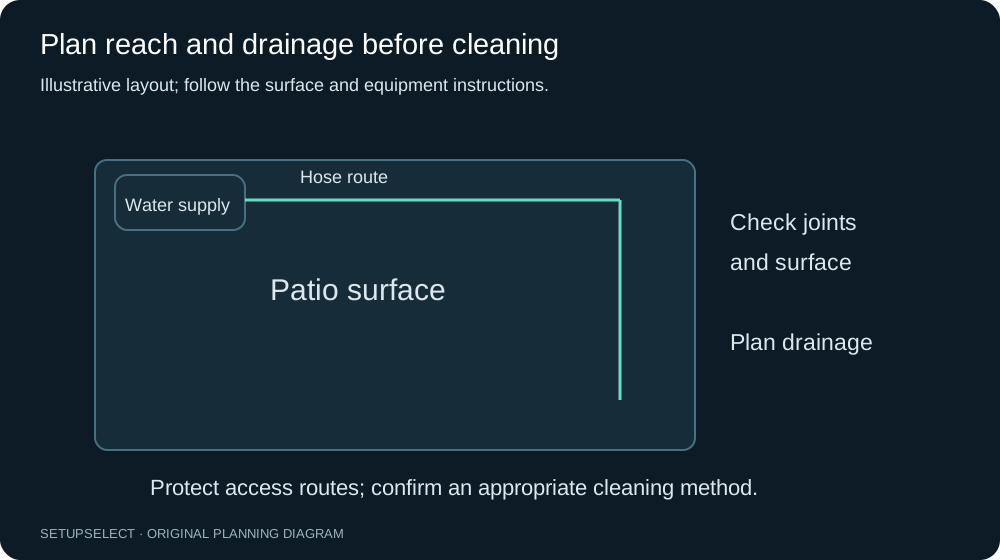
Next measure the route from the water supply and suitable power location, including corners and obstacles. A straight-line distance on a sketch may understate the hose length needed around furniture, planting or walls.
Record where the machine itself can stand according to its instructions.
Draw a route that avoids pulling the hose across vulnerable plants, sharp edges or a frequently used doorway. A longer hose can improve convenience, but compatibility, permitted length and pressure behaviour are product-specific.
Do not assume any generic extension can be added to any machine.
Pressure and flow do different jobs
Pressure is commonly stated in bar, while flow is commonly stated in litres per hour. They describe different aspects of the machine.
A high maximum pressure does not automatically mean faster or safer cleaning, and a maximum figure may differ from the operating specification relevant to the intended setup.
Flow influences the water available for rinsing and moving loosened dirt, while pressure control helps adapt the action to the surface. The nozzle, attachment, distance and technique also matter.
Compare the complete system rather than choosing the largest bar number within the budget.
Read bar explained and flow rate explained before comparing models.
Keep rated and maximum figures labelled so a retailer summary does not turn unlike specifications into a misleading ranking.
Scenario one: a small sound patio
Imagine a 3 × 4m patio, giving 12m² of surface, with a nearby suitable water supply and clear access. The first shortlist can focus on a controllable machine with an appropriate attachment and enough verified hose reach.
There is little value in paying for a large unit if its extra capability is unnecessary and it is awkward to store or move.
Check the exact surface instructions and start with the gentlest approved method in an inconspicuous area. Do not infer a universally safe pressure from the small patio size.
A small area of delicate stone can require more caution than a larger area of robust paving.
Include setup, rinsing and storage in the practical comparison. A machine that is easy to connect and put away may be more useful for occasional cleaning than one with a larger specification but an inconvenient hose and accessory arrangement.
Scenario two: a larger patio with awkward access
Consider a 6 × 7m area, or 42m², with a corner between the tap and the far side. Flow, hose reach, handling and a compatible surface-cleaning attachment become more important to investigate.
This is not a rule that every 42m² patio needs a particular pressure or power class.
Measure the complete route and decide where the unit will move during work. Avoid relying on repeatedly dragging the machine by its hose or cable. Check wheels, handles, hose management and the permitted operating arrangement for the exact model.
A surface cleaner may help on suitable broad paving, but verify compatibility and the surface instructions. It changes the way the jets are applied; it does not make damaged joints or an unsuitable material safe.
Include the attachment's cost and storage size in the comparison.
Scenario three: mixed car and patio use
If one washer must serve a car and patio, controllability and suitable attachments are especially important. The techniques and risks differ, so do not use one aggressive setting as a universal answer.
Verify the vehicle and surface guidance as well as the washer instructions.
Compare the practical accessory changes and storage. A package containing many attachments is only useful if they are suitable for the actual tasks and compatible with the specific machine.
Check what is included rather than assuming a promotional image shows the supplied set.
Read the car-and-patio guide before choosing a combined-use shortlist.
A balanced, controllable setup can be more appropriate than maximising pressure for the patio and trying to compensate with technique on every other surface.
Surface cleaners and nozzles
A surface-cleaning attachment can cover a wider area and manage splash differently from an open lance, depending on its design. Check the supported washer range, flow requirements and adjustment instructions.
A connector fitting physically does not prove the accessory is appropriate for the machine.
Nozzles change the spray pattern and action. Follow the instructions for each attachment and material, and do not assume a concentrated or rotating jet is suitable for all paving.
Keep required distances and control methods as specified by the relevant manufacturers rather than copying a universal number from another product.
If an attachment is not supplied, compare the complete ready-to-use price. A cheaper base machine plus the necessary compatible accessories may cost more than another verified package. Do not count an unsuitable free accessory as useful value.
Water supply and electrical requirements
Check the washer's required water supply, connection method and permitted inlet conditions. A machine's published output assumes an appropriate supply.
Do not diagnose poor performance solely as a need for a more powerful washer if the supply or connection is inadequate.
Follow the electrical instructions for the exact equipment and outdoor use. Keep connections away from water exposure and trip routes as required, and obtain qualified advice where the arrangement is uncertain.
This article does not specify an extension lead, circuit or protective arrangement for your property.
Do not improvise adapters or use damaged hoses and cables. Inspect equipment as directed and stop if it behaves unexpectedly. The convenience of reaching the far corner does not justify an unsupported connection or a hazardous cable route.
Plan runoff and the surrounding area
Consider where water and loosened dirt will go before starting. Protect surrounding items according to the relevant instructions and avoid directing runoff towards vulnerable areas.
Cleaning chemicals, if used, require their own product and environmental guidance.
Keep other people and pets away from the operating area as appropriate, and manage slippery surfaces, hose loops and cable routes. Wear the protective equipment required by the manufacturer and task.
Never direct the jet at people, animals or equipment not intended for it.
If drainage is poor or the surface has a history of water problems, resolve that context rather than assuming faster cleaning will help. The patio's condition and surroundings can matter more than the difference between two machine specifications.
A comparison sheet for shortlisted washers
| Field | Candidate A | Candidate B |
|---|---|---|
| Exact model and supplied package | ______ | ______ |
| Rated/maximum pressure, clearly labelled | ______ | ______ |
| Published flow and conditions | ______ | ______ |
| Hose length and compatible extensions | ______ | ______ |
| Pressure control and appropriate attachments | ______ | ______ |
| Water and electrical requirements | ______ | ______ |
| Moving weight and storage dimensions | ______ | ______ |
| Delivered price including necessary extras | ______ | ______ |
Add the source and check date for critical figures. If a retailer lists a different hose length or accessory bundle from the manufacturer, identify the actual package being sold. Similar model names can hide materially different included equipment.
Work rate without invented cleaning times
It is tempting to promise that a particular washer will clean a patio in a fixed number of minutes. In reality, dirt, surface condition, water supply, attachments, technique and setup affect the task.
Unless there is a comparable documented test, treat time estimates as uncertain.
For planning, divide the area into sections and account separately for moving furniture, preparation, cleaning, rinsing and putting equipment away. A machine with higher output may reduce one part of the process without changing the others.
Compare the whole job if convenience is the goal.
If you later record your own timings, state the area, surface, dirt condition, attachment and method. Do not present a single household observation as a universal product test.
Reproducible context makes modest evidence more useful than a confident but unexplained speed claim.
Storage and winter care
Measure the machine, hose and accessories in their stored arrangement. A compact upright body may still need a large shelf or floor area once the hose and lance are included.
Check the manufacturer's handling and storage orientation rather than balancing equipment in a convenient but unsupported position.
Follow the model's draining, frost-protection and maintenance instructions. Do not invent a universal winterising procedure, because pumps, connections and accessories differ.
Keep the manual and identify any consumables or replacement parts likely to be needed.
Store equipment so hoses and cables are not sharply bent or damaged and so children cannot use it unsupervised. Inspect before the next season rather than assuming that a machine which worked last year is ready without checks.
Buying versus hiring
For occasional larger tasks, hiring suitable equipment can be worth comparing with ownership. Include the correct accessories, transport, operating instructions and any cleaning or return requirements.
Hiring does not remove the need to understand the surface and safety considerations.
For regular use across suitable tasks, ownership may be convenient if there is storage and a practical maintenance routine. A less elaborate machine that matches the actual work may be more useful than a large unit bought for a rare hypothetical job.
Where paving is delicate, damaged or difficult to identify, professional assessment or cleaning may be the better route. Compare the risk of damage with the apparent saving on equipment.
A pressure-washer purchase should not become an experiment on an expensive unknown surface.
Common errors
Choosing by maximum bar, ignoring flow, underestimating hose route length and assuming a surface cleaner prevents all damage are common mistakes.
Another is comparing a fully equipped package with a bare machine without adding the missing accessories to the price.
Do not treat a larger patio as permission to use a more aggressive method on every part of it. Edges, joints and weathered areas may need different handling or repair. Stop if the surface is being damaged rather than continuing to achieve a uniform appearance.
Avoid transferring a successful method from one paving material to another. Product-specific instructions and the actual condition remain the best starting evidence.
When information is missing, seek clarification rather than replacing it with a higher setting.
Final checklist and next step
- Identify the paving, jointing and condition before selecting equipment.
- Measure the cleaning area and the full hose and power routes.
- Compare controllable pressure, flow and compatible attachments together.
- Verify the water supply, electrical arrangement and safety instructions.
- Plan runoff, access, storage and maintenance.
- Check the complete delivered or hire cost, not only the base machine.
Use the pressure-washer finder to organise area, surface and reach requirements, then verify the shortlisted models and packages.
Consult the paving manufacturer's guidance and Kärcher's patio-cleaning explanation for relevant context.
All layout figures here are illustrative and no cleaning time, damage-free result or product performance has been personally tested by SetupSelect.
How many bar do I need? There is no safe universal answer from patio area alone; surface suitability, control and the complete system matter. Is higher flow always better? It can affect rinsing and work rate, but supply, accessories and the actual task still constrain the result. Can a patio attachment be used on any washer? No; confirm the exact compatibility and operating requirements before buying.
Continue researching