Buying guide
What pressure washer do I need for a car? Control, reach and compatibility
A pressure washer for a car should be easy to control, compatible with the vehicle's cleaning instructions and practical to move around the entire vehicle. Start with the approved spray pattern, detergent arrangement and hose route.
A large maximum-pressure figure is not a car-cleaning target, and there is no single pressure or nozzle distance that makes every vehicle safe to wash.
This is a selection and preparation guide. It does not replace the manuals for the vehicle, washer or cleaning products.
The pressure-washer finder can narrow equipment choices once you know those requirements; the decisions below explain what to check before accepting a shortlist.
Read the vehicle instructions before the washer brochure
The vehicle manual is the starting point because it identifies restrictions that a generic cleaning accessory cannot know. Search its cleaning section for pressure washing, cameras, sensors, seals, paint finishes, charging ports and aftermarket accessories.
A car with repaired paint, a wrap or other modifications may require additional advice from the installer or repairer.
For a concrete example, Tesla's Model 3 cleaning guidance specifies at least 30 cm between the nozzle and body surface, tells users to keep the jet moving and warns against direct jets at certain components.
Those are instructions for that vehicle, not a universal setting for every car. Check your own model and market version, including any car-wash mode requirements.
Write the restrictions on a short preparation card. The important output is a list of approved areas, prohibited targets and any required preparation.
If a manual prohibits a method or the paint condition is doubtful, a different washing approach may be appropriate. Buying a lower-pressure machine does not make a prohibited technique acceptable.
Choose control before maximum output
Look for a clearly described way to select a vehicle-appropriate spray. This may be an adjustable lance, a defined nozzle or a compatible accessory. Establish how settings are changed and how the selected mode is identified.
Controls that are obvious while holding the gun are more useful than an ambiguous dial whose effect you must guess.
Do not assume every supplied attachment belongs on the car. A package intended for paving may include concentrated or rotating jets with quite different purposes.
A familiar connector proves only that an attachment can physically connect; it does not establish that its spray is suitable for paint, trim or tyres.
Ask the seller which included attachment the manufacturer identifies for vehicle cleaning, then verify that answer against the instructions.
If the response is simply that the washer has a modest bar number, the main compatibility question remains unanswered. Pressure and flow explained shows why maximum ratings cannot settle it.
Make a complete car-cleaning equipment comparison
The following table is a worksheet, not a ranked product list. It makes omissions visible before purchase.
| Requirement | Evidence to obtain | Why it changes the decision |
|---|---|---|
| Vehicle-compatible spray | Exact nozzle or lance instructions | Establishes the permitted working method |
| Useful pressure control | Manual description of settings | Helps avoid relying on the maximum rating |
| Hose reach | Included length and approved extensions | Determines whether the machine must be relocated |
| Chemical application | Compatible detergent and dilution instructions | Prevents treating all foam bottles as interchangeable |
| Supply compatibility | Inlet flow, pressure and hose requirements | Confirms the available tap arrangement is suitable |
| Storage | Unit, hose and accessory dimensions | Determines whether setup remains practical |
Compare complete packages. One offer may include the correct vehicle accessory while another requires an extra purchase. Conversely, a large bundle may contain several patio accessories you do not need.
Make the actual car-cleaning configuration the unit of comparison, including any required connector and compatible extension.
Manufacturer range information such as Kärcher's car and bike care page can help identify intended accessory families. The exact product instructions still decide fit and use.
Avoid mixing regional product descriptions when ordering connectors or detergent equipment.
Measure a route around the car
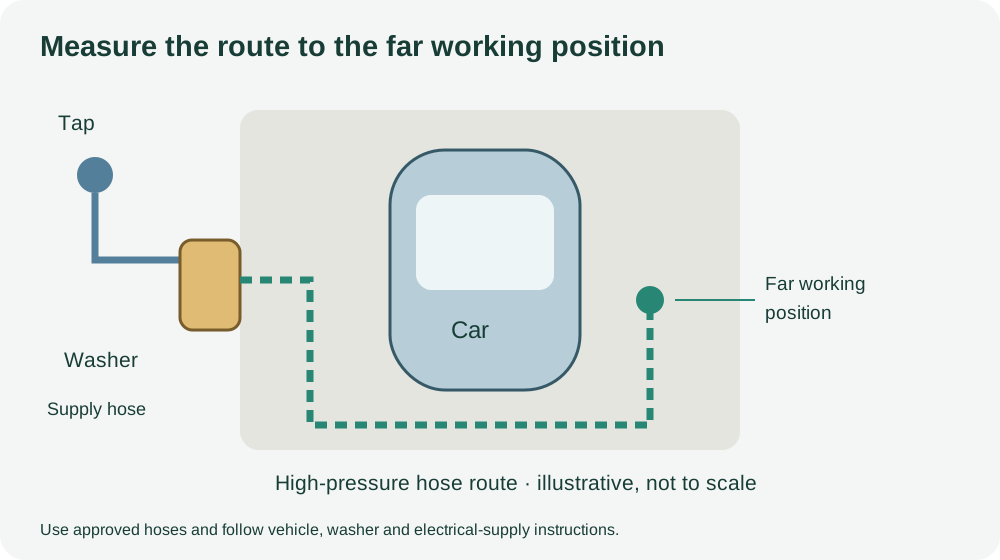
Hose length is not the straight-line distance from the tap to the bonnet. The high-pressure hose starts at the washer; the inlet hose runs from the tap to the washer. Those are separate routes with separate compatibility requirements.
The electrical supply introduces another route that must follow the washer's instructions.
Park where you intend to wash and walk the working route. Include the far rear corner, the space needed to stand back, and any obstacle that prevents moving in a straight line.
Keep the equipment where it can remain stable without the hose pulling it towards the vehicle. A longer hose is useful only if it is approved for the system and can be managed without creating another obstruction.
For an illustrative driveway, suppose the machine stands near the front-left corner. The route to a comfortable working position behind the opposite rear corner measures 7 metres around the car.
A 5-metre hose would require repositioning; an approved longer arrangement may avoid it. This is a measured-route comparison, not a recommendation that every car needs a particular length.
A small-driveway worked example
Consider a fictional household with one hatchback, a narrow driveway and a garage tap. They wash monthly and store the machine on a shelf after use. Their car's manual permits a defined pressure-washing method.
Their main inconvenience is reaching the passenger side without brushing dirty hoses against the body.
They compare two complete setups. Setup A is compact with a shorter hose and requires one planned move. Setup B occupies more storage space but accepts an approved longer hose that reaches all sides.
Both meet the tap requirements and offer the approved vehicle spray. Neither earns extra credit simply for a higher maximum bar rating.
The household draws the route, measures the storage shelf and handles both gun-and-lance arrangements in a shop if possible. If moving A is straightforward and its packed dimensions fit substantially better, A may be the sensible choice.
If the move is awkward every time, B's reach may justify the larger package. This is a practical trade-off that specifications alone do not resolve.
Notice what the example does not claim: no timed wash, measured cleaning superiority or damage-free guarantee. Those would require different evidence. The useful result is a shortlist whose compromises are understood before money is spent.
Foam accessories: check the whole connection
A foam bottle needs the correct connection, operating compatibility and chemical instructions. Identify the gun or lance fitting precisely, including the model generation.
An adapter may add length, weight or another connection point; verify that it is approved for the components concerned. Do not treat a broad brand name as a complete compatibility specification.
Then check the detergent. The chemical must be suitable for the vehicle finish and permitted by the washer or applicator. Product dilution, application and rinsing directions matter more than achieving a visually impressive blanket of foam.
A concentration specified for a bottle may not equal the concentration reaching the paint after the applicator mixes in water.
For example, an invented instruction requiring 100 ml of concentrate in a 1-litre bottle describes the bottle mixture. If the nozzle adds more water during application, the final surface concentration is lower.
Without the accessory's dilution information, it is not honest to state an exact final ratio. Follow the combination's instructions instead of borrowing another person's bottle recipe.
Prepare the working session before introducing chemicals
Set out only the equipment needed for the chosen method. Check the nozzle, hose connections and supply arrangement before applying a product that has a limited dwell time.
Confirm how the washer starts, stops, changes mode and depressurises according to its manual. Learning these controls while foam is drying creates unnecessary pressure to rush.
Inspect the car in ordinary light. Note loose trim, paint chips, peeling coatings and areas where previous repair advice applies. These observations affect the method; they should not be answered by holding the nozzle closer to “finish the job”.
If a surface is uncertain, use the appropriate specialist guidance before proceeding.
Plan where equipment will go between stages. Keep wheel-cleaning equipment separate from bodywork equipment so you can follow the chosen cleaning product's intended process without accidentally swapping dirty tools.
This organisational step costs nothing and helps preserve a repeatable routine, especially when several people share the equipment.
Follow a manufacturer-led workflow
Build the sequence from your vehicle, washer and chemical instructions.
Typically the planning questions are whether loose contamination should be rinsed first, how the product is applied, how long it may remain, whether contact cleaning is required and how it is rinsed away.
The answers depend on the specified products and finish; this guide does not invent a universal dwell time.
Maintain the permitted spray pattern, distance and movement throughout the approved areas. Do not use stronger pressure to compensate for a chemical that is unsuitable, a missed preparation step or contamination that requires another method.
Stop if the surface reacts unexpectedly or components become loose. Reassess the method before continuing.
The Bosch UniversalAquatak operating manual provides machine-specific instructions and warnings, including preparation and permitted operation.
Read the corresponding manual for the unit you own rather than copying a sequence across machines. Never direct the jet at people or animals, and follow its electrical and protective-equipment requirements.
Tyres, sensors and delicate parts need their own checks
The car is not a single uniform surface. Tyres, seals, camera lenses, sensor housings, decorative trim and exposed electrical areas can have different restrictions.
Keep a separate note of them instead of treating the body-panel instruction as permission for all nearby parts. Wheel appearance does not establish that every cleaner is compatible with its finish.
For modified or older vehicles, the original manual may not cover every added component. A roof rack, aftermarket camera, repaired wheel finish or decorative film introduces another manufacturer's instructions.
Check those before assuming that normal bodywork cleaning directions apply. If the additional guidance conflicts, resolve the conflict before washing that area.
Avoid using a jet to investigate a loose seal or blocked opening. Pressure washing is a cleaning process, not a diagnostic test of waterproofing.
A newly visible gap or detached trim piece should prompt inspection and repair advice, not repeated spraying to see whether it gets worse.
Estimate water use realistically
For planning only, assume an average delivered flow of 6 L/min and 10 minutes of actual spraying. That produces an estimate of 60 litres through the washer. If spraying takes 15 minutes, it becomes 90 litres.
Add separately any bucket filling and equipment flushing. Time spent setting up or applying product with the trigger released does not automatically consume water at that rate.
Do not substitute the full session length into the calculation unless water flows continuously. Equally, do not use the machine's maximum-flow label as a measured average.
A simple log of trigger time and, where practical, observed water use is more informative than repeating a general claim about pressure washers saving water.
Check current local water-use restrictions when they apply to your circumstances. Equipment efficiency claims do not establish permission to use it during a restriction.
For the comparison itself, the combined pressure and flow guide provides the arithmetic and explains its limits.
When the same machine also cleans a patio
A mixed-use purchase needs two verified working configurations. Record the car nozzle, chemical equipment and handling requirements separately from the paving attachment and supply requirements.
Store attachments so their purposes remain clear, particularly if the machine is shared.
The patio may influence required flow and reach, but it does not define the setting used on the car.
Read the main pressure-washer guide for the combined buying scenario and the patio guide for surface assessment.
A bundle is valuable when its actual components match both jobs, not merely because the box contains many accessories.
Car-cleaning questions
Is a 130 bar washer too powerful for a car?
The maximum number does not answer the question. Check whether the machine provides a vehicle-appropriate configuration that complies with your car's instructions.
An unsuitable nozzle or method remains unsuitable even on a machine with a smaller maximum figure.
Can a foam cannon make pressure washing safe?
No accessory overrides vehicle restrictions or damaged-surface concerns. A compatible applicator can distribute a suitable chemical, but pressure, spray pattern, distance and the condition of the surface still need to be managed correctly.
Can I use the same brush on wheels and paint?
Choose equipment and separation according to the vehicle and cleaning-product guidance. Keeping clearly labelled wheel and body tools avoids accidental mix-ups.
Do not assume a pressure-washer brush is appropriate for every painted or coated surface simply because it was included.
Should I replace my existing washer just to get more foam?
First verify chemical dilution, accessory compatibility and the existing washer's instructions. Foam appearance alone is not a measurement of cleaning quality.
If the approved process works and the equipment is serviceable, a higher maximum-pressure model has no demonstrated benefit solely on that basis.
What should I check after the first wash?
Record whether reach, setup time, storage and control worked as planned. Inspect equipment and surfaces normally, following the manuals.
Adjust the organisation or accessory choice where permitted; do not respond to inconvenience by exceeding the vehicle's cleaning limits.
Continue researching