Buying guide
What pressure washer do I need? Cars, patios and practical fit
The right pressure washer is the one that can clean your intended surfaces with suitable control, enough water supply and a workable hose route. Maximum bar is only one specification.
Before comparing machines, identify the most delicate surface, the largest regular job and the distance from the water and electricity supplies to the working area.
For a car and patio combination, do not simply buy the most powerful model you can afford. You need a machine and approved accessories that suit both jobs, plus the ability to follow each surface manufacturer's cleaning restrictions.
This guide combines the general buying decision and mixed car-and-patio planning so that you can build one coherent shortlist.
Start with a surface list
Write down exactly what you intend to clean: painted vehicle panels, tyres, paving slabs, jointed block paving, timber decking, garden furniture or another material. Add known damage, loose joints, flaking coatings and previous treatments.
A surface that looks robust may have a vulnerable coating or jointing material.
The list should distinguish routine dirt from problems that need another treatment. A washer is not a universal solution for every stain or biological growth. Before choosing equipment, look for the surface or coating manufacturer's cleaning instructions.
If they prohibit pressure washing, a higher specification does not overcome that restriction.
Mark the most delicate approved task and the largest frequent task. The delicate task determines the need for appropriate control and accessories. The large task may make flow, comfortable handling, reach and an approved surface cleaner more important.
This is more useful than starting with a product range named after increasing power levels.
Where the surface is unknown, damaged or historic, seek suitable advice before attempting an aggressive method. Do not test on a conspicuous area merely to find out whether the washer is too strong.
A buying guide cannot establish the condition of your paving or paint remotely.
Understand pressure, flow and input power
Pressure describes force per unit area; consumer washers commonly quote it in bar. Flow describes water volume delivered over time, often litres per hour. Electrical input describes the power drawn by the machine, usually watts or kilowatts.
These numbers answer different questions and should stay in separate columns on your shortlist.
A product's maximum pressure may not describe every working mode. Likewise, a maximum flow figure should not be assumed to occur at the same setting as maximum pressure.
Look for the manufacturer's definitions and specifications, and compare like with like rather than treating the biggest number in each listing as the whole story.
For illustration, Kärcher's K 4 WCM Flex eco!Booster Car Plus specification lists a pressure range separately from maximum flow and rated input.
That distinction is useful when reading any shortlist; it is not an endorsement or evidence that this particular package suits your surfaces.
The dedicated pressure and flow explanation covers unit conversions and comparisons.
Here, the practical question is whether the complete machine offers documented suitability for your tasks, not which seller displays the largest bar figure.
Check the water supply before buying
Find the proposed machine's required supply conditions, including minimum feed, permitted inlet temperature and approved connection arrangements. A garden tap, water butt and other source are not automatically interchangeable.
Some machines support alternative water sources with particular accessories; others do not.
If the manual calls for a supply-flow check, perform it using its procedure or ask the supplier how to establish suitability. A simple volume divided by time calculation can describe a measured tap flow, but it does not verify every supply requirement.
Hose length, restrictions and the connection itself still matter.
Do not run a washer dry or improvise a supply arrangement because the connector happens to fit. Before ordering, identify every required approved hose, connector and filter.
Include these in the purchase cost and storage plan instead of discovering missing parts when the machine arrives.
For shared taps, check that the arrangement is practical and permitted. Consider whether a hose crosses a footpath or access used by other people.
Moving the washer closer to the job may solve high-pressure hose reach while creating a different problem at the supply end.
Plan the complete working route
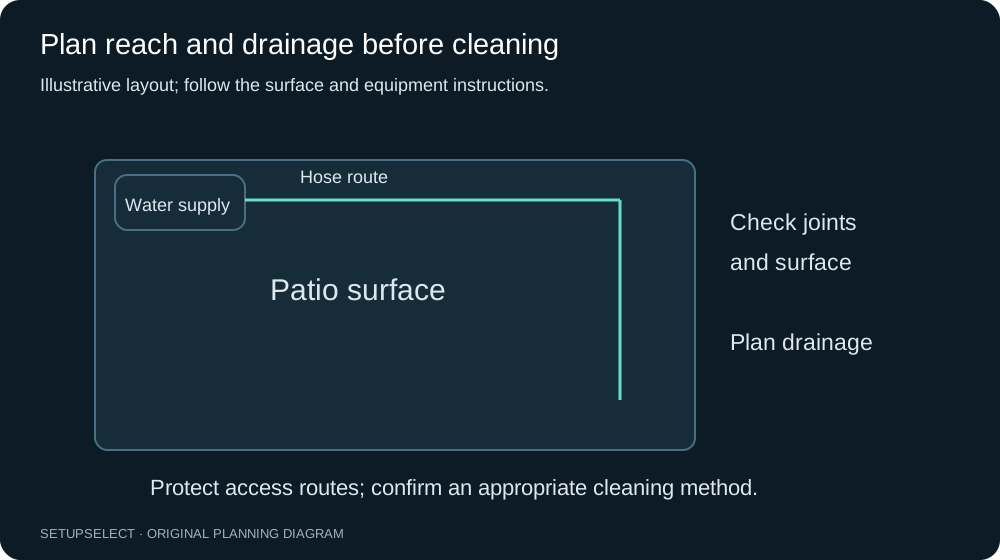
Draw the tap, suitable electrical supply, machine position, working surface and route between them. There are several separate lengths: supply hose, power cable and high-pressure hose.
One long cable does not compensate for a short hose on the other side of the machine.
Use the actual route around corners and furniture, not the straight-line distance across the plan. Leave the movement and connection allowances required by the equipment instructions.
Avoid a layout that depends on pulling the machine by its hose or placing connections in standing water.
Follow the washer's electrical instructions and use appropriate outdoor arrangements. Do not assume an indoor extension lead or an arbitrary cable reel is suitable for a high-load outdoor appliance.
If the required connection cannot be provided safely, change the plan or obtain qualified advice before buying.
For a car, walk around the whole vehicle while considering where the machine and hoses will sit. For a patio, think about the far corner, the exit route and where displaced water will go.
A usable setup lets you reach the job without constantly moving supplies through freshly cleaned areas.
Decide which accessories solve an actual problem
A bundle can contain useful equipment or duplicate accessories that will stay in the box. Make a task-to-accessory table before comparing package prices. Confirm compatibility by model or approved connection system, not by visual resemblance.
| Intended task | Evidence to request | Purchase implication |
|---|---|---|
| Vehicle washing | Vehicle and washer instructions; permitted nozzle or lance | Suitable controllable setup, not a maximum-pressure target |
| Broad compatible paving | Paving instructions; approved surface-cleaner compatibility | Consider coverage and splash control alongside cost |
| Distant garden area | Measured route; approved hose options | Verify reach before adding an extension |
| Detergent use | Chemical and equipment compatibility instructions | Confirm dosing method and any extra attachment |
| Frequent storage | Full machine and accessory dimensions | Include hose, lance and supply equipment in the footprint |
A rotary or concentrated cleaning attachment is not a general-purpose substitute for a broad, surface-appropriate spray. Never assume that an accessory included in a kit is suitable for every object you plan to wash.
Its instructions and the surface limitations must agree.
Likewise, detergent compatibility is more than whether a bottle fits a holder. Check the chemical, material and machine instructions, including handling and disposal requirements.
Do not mix cleaning products or improvise formulations to compensate for an unsuitable cleaning method.
Worked example: one washer for a car and patio
Imagine a household that washes one car occasionally and cleans a 24-square-metre patio a few times a year. These are illustrative circumstances, not a recommended machine rating. The car is the more delicate planned surface; the patio is the larger area task.
The household first checks whether both surfaces permit pressure washing and what restrictions apply. It then records the tap and socket positions and sketches two operating layouts.
The driveway arrangement requires walking around the vehicle; the patio arrangement requires reaching the far corner without stretching a hose across the doorway.
The shortlist contains three packages. Package A has a lower initial price but needs a compatible approved accessory for the paving. Package B includes that accessory but has awkward storage dimensions.
Package C has generous headline specifications but offers no documented advantage for either approved task. The best choice cannot be read from maximum bar alone.
The household prices only the required additions and compares the complete baskets. If the patio accessory would rarely be used, it considers whether buying it later is reasonable.
If storage makes Package B difficult to put away every time, the apparent bundle saving may not justify the inconvenience.
The result should be a machine that supports both documented workflows, not a compromise where one task is performed with inappropriate settings.
Use the car-cleaning guide and patio guide for the distinct surface decisions.
Worked example: a large patio behind the house
Consider a fictional 60-square-metre paved area behind a narrow side passage. The nearest tap is at the front.
This household may care more about supply arrangements, suitable hose reach and accessory handling than about a small increase in advertised pressure.
It measures the actual route down the passage and identifies any shared access that must remain clear. Before selecting a machine, it checks whether an approved water-supply arrangement can meet that machine's requirements at the intended position.
If not, the first problem to solve is infrastructure, not washer specification.
It also checks the paving material and joints. A faster cleaning claim is irrelevant if the proposed method risks damaging the surface.
Once an appropriate method is established, the owner compares approved accessories, reach and the practical work pattern, including pauses and moving garden furniture.
Any manufacturer's area-performance figure should be read with its conditions, rather than treated as a guaranteed appointment length.
Real preparation, edges, obstacles, cleaning condition and cleanup are not necessarily represented by a single advertised square-metres-per-hour number.
Compare storage and handling honestly
Measure the storage space with the hose, gun, lance and accessories included. A machine photograph often shows these arranged neatly on the housing, but the supply hose and other equipment may still require separate space.
Check whether the handles and reels operate comfortably where the washer will live.
Find out what a listed weight includes. Bare-machine weight, assembled working weight and packaged shipping weight answer different questions.
If you must lift the machine over a threshold or into a car, consult its handling instructions and assess that task realistically.
Consider maintenance and winter storage before purchase. Follow the manufacturer's procedures for draining, frost protection and storage temperature. Do not assume a garage is frost-free or that the machine can be left outside because it is used outdoors.
Damage from unsuitable storage can undermine an otherwise sensible selection.
Hose management also affects convenience. A hose that is difficult to uncoil or put away may make quick cleaning sessions less appealing.
Where possible, inspect the actual reel, connectors and accessory storage rather than evaluating them solely by the accessory count in a listing.
Build a shortlist with evidence, not a score alone
Give each candidate a row containing exact model identifier, permitted uses, pressure definition, flow definition, supply requirements, hose length, electrical requirements, compatible accessories and total cost. Mark missing information explicitly.
An empty cell is a question for the manufacturer, not permission to assume the best.
Then add the practical columns: overall dimensions, handling, storage, service support and replacement-parts availability. These do not need an invented numerical score.
A single failed essential requirement, such as unsuitable supply or prohibited surface use, can eliminate a product regardless of its other specifications.
Avoid comparing bundles with different included parts as if their prices were directly equivalent. Keep dated notes if you record live retailer prices, and recheck the exact package at checkout.
A similarly named version may have a different hose, lance or accessory set.
The pressure-washer finder can organise the starting requirements. Its shortlist is decision support, not permission to ignore the washer or surface manufacturer's instructions.
Retain the evidence sheet for the final two candidates and verify anything the tool cannot know about your property.
Questions that often change the decision
Does more bar mean a better washer? Not by itself. Control, appropriate accessories, flow, supply and the surface's limitations can matter more. Compare stated operating conditions rather than isolated maxima.
Can a patio washer also clean a car? Possibly, if the exact machine, settings and accessories are suitable and the vehicle's instructions allow the proposed method. A package name or a picture of a car is not a complete compatibility check.
Will a longer hose solve awkward access? Only if the manufacturer approves it and the rest of the arrangement remains suitable. Check pressure-hose compatibility separately from the water-feed hose and electrical connection.
Should I buy the largest bundle? Buy the parts needed for your verified tasks. Optional accessories can be useful later, but a box full of attachments does not fix poor access, unsuitable surfaces or missing supply capacity.
The final buying decision should be straightforward to explain: these are the surfaces, this is the permitted cleaning method, these supplies and routes work, and this complete package meets those requirements.
If an essential part of that explanation is still an assumption, resolve it before ordering.
Continue researching