Buying guide
Radiator Delta T explained: worked low-temperature examples
Radiator Delta T is the difference between the mean water temperature through the radiator and the room temperature. It explains why the same radiator produces different heat output under different system conditions.
A catalogue output at Delta T 50 should not be treated as the output at Delta T 30 without using the applicable manufacturer correction data.
This guide shows the arithmetic and the questions to take to an installer. It is not a heating-system design, a room heat-loss assessment or advice to change operating temperatures yourself.
The worked room requirements and radiator outputs are hypothetical unless a manufacturer source is explicitly identified.
Calculate mean water temperature
For the common simple calculation, add flow and return temperatures and divide by two. Then subtract the room temperature. If flow is 75°C, return is 65°C and the room is 20°C, mean water temperature is 70°C and Delta T is 50°C.
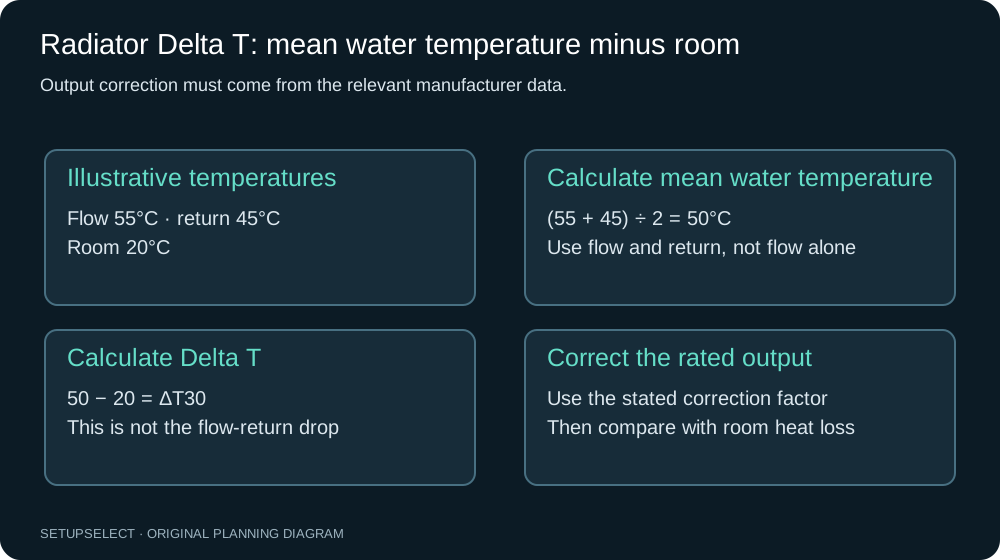
Written as a formula: Delta T = ((flow + return) ÷ 2) − room temperature. This temperature difference is not the same as the difference between flow and return. In the example, flow minus return is 10°C, while radiator Delta T is 50°C.
Confusing those two differences produces the wrong output comparison.
Use the intended design conditions consistently. Do not combine a flow temperature from one operating scenario with a return temperature or room target from another.
The system's actual operation can vary, so a design calculation and a momentary measured temperature are not automatically interchangeable.
Three temperature examples
At 75/65/20°C, the mean water temperature is 70°C and Delta T is 50. At 55/45/20°C, the mean is 50°C and Delta T is 30. At 45/35/20°C, the mean is 40°C and Delta T is 20. These are arithmetic examples, not recommended operating settings for your system.
| Flow | Return | Room | Mean water | Radiator Delta T |
|---|---|---|---|---|
| 75°C | 65°C | 20°C | 70°C | 50°C |
| 55°C | 45°C | 20°C | 50°C | 30°C |
| 45°C | 35°C | 20°C | 40°C | 20°C |
The same radiator cannot be assumed to retain its Delta T 50 output across these examples. The available temperature difference changes, so output must be assessed using appropriate data.
A lower Delta T is not a defect in the radiator; it describes a different operating condition.
Why output does not scale linearly
It is tempting to assume that Delta T 30 produces exactly 30/50 of the Delta T 50 output. Radiator heat transfer does not generally follow that simple linear rule.
Manufacturers provide correction factors or an exponent method for the relevant products and rating basis.
Use that information rather than inventing a universal percentage. If an exponent is supplied, a common form is output at the new condition equals rated output multiplied by the ratio of temperature differences raised to that exponent.
The exponent must belong to the applicable product data, not an assumed value borrowed from a different radiator.
For a published example, Stelrad's correction table lists factors relative to its stated rating basis.
Use the correct table and product scope, and have the interpretation checked as part of the heating design where necessary.
A worked correction example
Suppose a hypothetical radiator is rated at 1,500W at Delta T 50, and the applicable manufacturer table gives a factor of 0.513 for Delta T 30. Multiplying 1,500 by 0.513 gives 769.5W, or about 770W.
The factor is not a universal promise for all radiator constructions.
The important conclusion is that 1,500W on a catalogue page does not mean 1,500W at the lower-temperature condition. A buyer who ignores the correction could substantially overestimate available output.
Keep both the original rating and corrected figure in the comparison table.
If the verified room requirement were 900W under the corresponding design assumptions, this example radiator would fall below it. That is a demonstration of the selection process, not a design for a real room.
The heat-loss requirement itself must be established appropriately.
Working backwards from required output
You can also use an applicable correction factor to estimate the required rating at the catalogue condition. With a hypothetical 900W room requirement and a factor of 0.513, the required Delta T 50 rating would be approximately 900 ÷ 0.513 = 1,754W.
That helps shortlist products whose published ratings may deliver the required output at the intended lower-temperature condition. It does not automatically determine the final size, location, flow requirements or installation.
Those remain part of the system design.
Do not add an unexplained large margin to compensate for uncertain inputs. Resolve the heat-loss and operating-condition assumptions instead. An arbitrary margin can hide an error without establishing that the resulting installation will behave as intended.
Room temperature is part of the calculation
Changing the assumed room temperature changes Delta T even when flow and return remain the same. For example, at 55°C flow and 45°C return, a 20°C room gives Delta T 30, while a 22°C room gives Delta T 28.
The output comparison should reflect the intended room condition consistently.
Do not select a catalogue output using one room temperature and compare it with a heat-loss calculation based on another without understanding the difference.
Bathrooms, bedrooms and living spaces can have different design assumptions, but those should be set as part of an appropriate assessment.
Actual thermostatic operation and weather conditions can vary through the day. A design figure is a planning reference, not a claim that every part of the system stays at a fixed temperature continuously.
Keep design calculations separate from short observations during normal operation.
Heat loss is not calculated by Delta T alone
Radiator Delta T helps estimate emitter output at a water-to-room temperature difference. It does not by itself determine how much heat the room loses through walls, windows, ventilation and other paths.
Those are different calculations which must be brought together consistently.
Room volume can support a rough starting estimate, but insulation, glazing, exposure, adjoining spaces and ventilation can materially affect the requirement.
An unusual room or a system upgrade may need a detailed room-by-room assessment rather than a simple area multiplier.
Use the radiator sizing tool to organise initial information, then verify the final requirement and system suitability with an appropriately qualified professional.
A calculator result is not permission to alter a heating system without that assessment.
Comparing two radiator types
When comparing Type 21 and Type 22 radiators, put both outputs on the same temperature basis. A Type 22 figure at Delta T 50 cannot be fairly compared with a Type 21 figure already corrected to Delta T 30.
Record exact height, length, depth, rating condition and source for each model. Then apply the appropriate correction separately if their data differs. Do not assume all products share one exponent or factor simply because they are both panel radiators.
Finally, compare installed projection, mounting and connection requirements. A product with adequate corrected output may still be unsuitable for the wall or room.
Thermal arithmetic is one part of a complete selection, not a replacement for physical fit and installation checks.
Boiler and heat-pump context
Lower-temperature operation can be relevant to different heating-system designs, including some boiler and heat-pump arrangements. Whether a particular temperature regime is appropriate depends on the whole system and building.
This article does not recommend changing a boiler or heat-pump setting to match an example table.
If a proposed upgrade changes flow and return assumptions, reassess the emitter outputs and room requirements together. Existing radiators may or may not be adequate at the new conditions. The type label or physical size alone cannot settle that question.
Ask the designer or installer to show the heat-loss basis, intended temperatures and corrected outputs. A transparent schedule makes it easier to understand which rooms need changes and why.
Avoid relying on a generic claim that every radiator must be replaced or that none will need changing.
Multiple radiators in one room
Where a room uses more than one emitter, outputs must be considered at consistent conditions and with the actual system design. Adding catalogue figures at mismatched Delta T values creates a misleading total.
The placement and distribution also matter; one large number does not describe how the room is served.
A long or open-plan space may have requirements that a simple single-room example does not capture. Discuss the intended layout, furniture and control zones with the installer.
Do not add a second radiator purely by dividing an uncertain total requirement in half.
Keep the documentation for each model and the final installed arrangement. Future changes to furniture, insulation or system temperatures can alter the context, so a clear record is more useful than a remembered catalogue wattage.
Units: watts and BTU per hour
Radiator heat output is a rate of heat transfer. Watts and BTU per hour can describe that rate, but the units should be stated correctly. A common conversion is approximately 1W = 3.412 BTU/h.
Do not confuse output in watts with electrical consumption of a different appliance or with stored energy.
For example, 1,000W corresponds to approximately 3,412 BTU/h. The conversion changes units, not rating conditions. A Delta T 50 figure remains a Delta T 50 figure after conversion, and still needs the relevant correction for another operating condition.
Read the BTU explanation if product listings use mixed units. Keep the calculation sheet in one unit until the final presentation to reduce avoidable arithmetic errors.
A comparison worksheet
| Field | Record |
|---|---|
| Room and design requirement | ______ W, source/assumptions: ______ |
| Intended flow/return/room temperatures | ______ / ______ / ______ °C |
| Calculated radiator Delta T | ______ °C |
| Exact radiator and dimensions | ______ |
| Published output and rating condition | ______ W at Delta T ______ |
| Applicable correction source/factor | ______ |
| Corrected output | ______ W |
| Installation and system checks | ______ |
Keep unknowns as unknowns. If the product listing does not state its rating condition, ask for the technical data before comparing it with another model. A precise number without its condition is incomplete evidence.
Common errors to avoid
Do not confuse flow minus return with radiator Delta T. Do not apply a factor twice to a figure which has already been corrected. Do not use a factor intended for one rating basis against a different starting condition without checking the method.
Another mistake is using a radiator's nominal output as the room heat-loss requirement because that is what is already installed. The existing installation may reflect different conditions, previous alterations or an imperfect earlier choice.
Assess the current room and proposed system rather than treating history as proof.
Finally, avoid presenting an illustrative low-temperature calculation as a guaranteed energy saving. Output correction is not a complete efficiency or bill model. Purchase, installation, controls, building performance and use all affect the wider outcome.
Keep the calculation attached to the product record
Write the three temperatures beside the radiator specification rather than saving only the corrected output.
For example, a result labelled simply “800 watts” does not reveal whether it represents a catalogue rating, an estimated output at a lower temperature or the room's heat requirement.
Include the source and basis of the correction factor as well. If a manufacturer supplies a model-specific table, retain that reference so a later change of product can trigger a fresh check.
Do not assume that a rounded factor used for one planning example becomes a universal certification of performance.
When discussing the calculation with an installer, separate what you measured, what you assumed and what still needs professional assessment.
That distinction is particularly important when the operating temperatures or the room heat loss have not yet been established.
Questions and next step
What does Delta T 50 mean? The mean water temperature is 50°C above the room temperature under the stated rating conditions. Is it the same as the flow/return difference? No; that is a separate temperature drop. Can I assume Delta T 30 gives 60% output? No; use applicable manufacturer correction data.
Does a lower Delta T mean the radiator is inefficient? It describes a different driving temperature difference, not a standalone product-quality score. Can I use the example factor for any radiator? No.
Check the product's technical information and the scope of the table or exponent.
Start with the radiator calculator, then take the completed worksheet to the relevant professional.
Consult Stelrad's published correction information as an example of manufacturer data, not a universal installation instruction.
The numerical room and product scenarios here are original explanatory calculations and have not been tested as a heating design.
Continue researching