Buying guide
Type 21 vs Type 22 radiators: depth, output and room fit
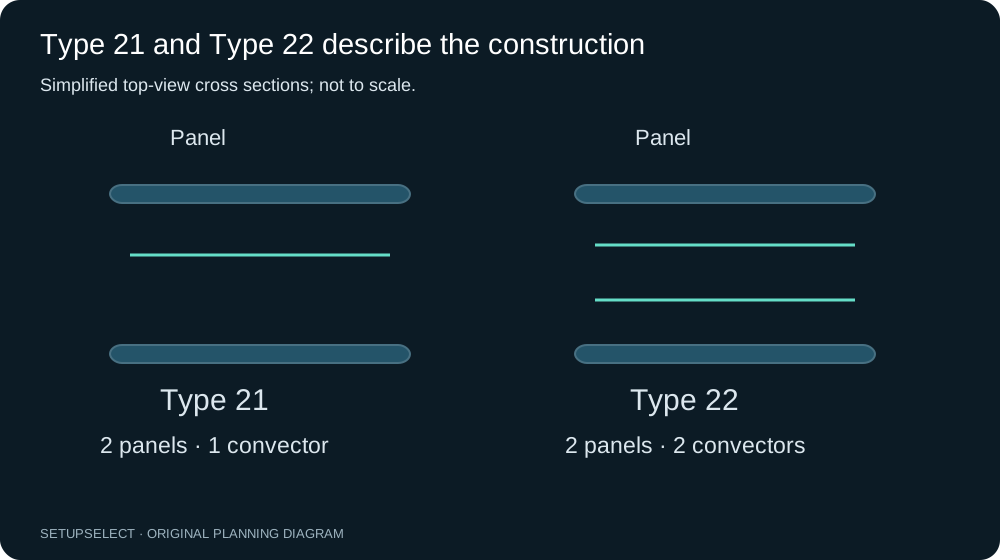
Type 21 and Type 22 panel radiators both have two panels, but Type 21 has one convector layer and Type 22 has two. The additional convector arrangement can increase output for a comparable size, while also changing depth and installation fit.
Choose by verified heat output at your system's conditions, available wall space and the complete installed projection—not the type number alone.
This is a buying and calculation guide, not a heating-system design or installation instruction. Room heat loss, system temperatures, flow and installation details should be established with appropriate professional input.
The worked numbers below are hypothetical unless explicitly identified as manufacturer data.
Understand the type labels
The two digits describe the panel and convector arrangement in this common classification. The first digit refers to panels and the second to convector layers.
That helps distinguish construction, but it does not provide a universal wattage, physical depth or efficiency score for every radiator carrying the label.
For manufacturer explanations, see Stelrad's Type 21 information and Type 22 range.
Exact dimensions and outputs still belong to the individual product and rating conditions. Do not transfer a figure from one height, length or range to another.
Also check alternative names used within a range. Product families may use labels such as double panel or double convector alongside the type number. Read the technical table rather than assuming a retailer's shortened title includes every construction detail.
Compare the same height and length first
Start with two candidates of the same nominal height and length from a clearly identified range. Record their actual depth, published output and rating temperature difference.
This makes the construction comparison easier to interpret than comparing a short Type 22 with a much longer Type 21 and attributing all differences to type.
Then compare the alternative sizes that fit the room. A longer shallower radiator may be practical on one wall, while a shorter deeper one may suit another.
The relevant choice is the installed arrangement that meets the verified requirement, not which type looks stronger in a single dimension.
Keep the technical source and date with the figures. Decorative finishes, models and revisions can have their own data. If a retailer and manufacturer disagree, resolve the exact product identity before treating either output as reliable.
Output must use matching rating conditions
Radiator output depends on the temperature difference between the mean water temperature and the room. A figure published at Delta T 50 is not the expected output at Delta T 30.
Compare both candidates at the intended conditions or use the applicable manufacturer correction data.
Imagine a hypothetical Type 21 listed at 1,200W and a same-size Type 22 listed at 1,500W, both at the same rating conditions. The second figure is 25% higher in this example.
That percentage is not a universal difference between all Type 21 and Type 22 radiators; it follows only from the stated example numbers.
The Delta T guide explains how to keep rating and operating conditions separate.
Do not select a radiator from a high-temperature catalogue value when the intended system runs at lower temperatures without making the relevant correction.
Heat loss and radiator output are different quantities
Room heat loss describes the heat required to maintain the intended room conditions under the design assumptions. Radiator output describes what a product can emit at specified operating conditions.
Matching those quantities requires a consistent basis; the radiator's catalogue number does not calculate the room's heat loss.
A simple room calculator can provide a starting estimate, but unusual glazing, exposure, insulation, ventilation or open-plan connections may require a more detailed assessment. Do not treat the floor area alone as a complete design method.
Use the radiator calculator as planning support and have the final requirement and system compatibility checked appropriately.
This guide does not replace a room-by-room heat-loss calculation or determine the settings for a heating system.
Measure installed projection, not just body depth
The radiator body depth is only part of the distance from the wall into the room. Brackets, wall offsets, valves and pipework can add to the installed projection. Check a dimensioned installation drawing for the exact product and mounting arrangement.
For example, a hypothetical body depth of 10cm with an additional 3cm wall offset creates a 13cm projection before considering valves or other protrusions. That is a geometry example, not a specification of either radiator type.
A different bracket arrangement can change the result.
Mark the complete installed envelope on the wall and floor. Check door swings, curtains, furniture, cleaning access and movement through the room. A deeper radiator can be perfectly suitable on one wall but inconvenient in a narrow passage or beside a bed.
Check width, valves and pipe centres
The nominal radiator length does not necessarily include valves and associated pipework. Measure the complete assembly and compare pipe-centre dimensions, connection locations and installation requirements.
Replacing one radiator with another of the same nominal size may still require work to the connections.
Do not assume a Type 22 can replace a Type 21 without changes simply because height and length match. Depth, brackets, wall condition, weight and pipe alignment need checking. Have installation and system work handled by an appropriately qualified person.
If the objective is a straightforward replacement, record the existing model and dimensions where possible, but do not let convenience override an inadequate output at the intended conditions.
The right replacement is a complete fit-and-performance decision, not just a matching rectangle.
A low-temperature worked comparison
Suppose two hypothetical candidates produce 1,200W and 1,500W at Delta T 50. If the applicable manufacturer data gives a correction factor of 0.51 for the intended conditions, the illustrative corrected outputs become 612W and 765W.
The arithmetic is simple, but the factor must be appropriate to the actual product and conditions.
If the verified room requirement were 700W under the corresponding design assumptions, the first example would be below it and the second above it.
That does not approve either product or installation; it demonstrates why correcting both figures can change the shortlist.
Do not use this hypothetical factor as a universal coefficient. Consult the manufacturer's table or exponent method and verify the system temperatures.
A heat-pump or lower-temperature boiler arrangement deserves a consistent system-level assessment, not an isolated radiator swap based on a generic blog number.
| Comparison field | Type 21 candidate | Type 22 candidate |
|---|---|---|
| Exact model and size | ______ | ______ |
| Output at stated rating condition | ______ | ______ |
| Output at intended system condition | ______ | ______ |
| Body depth | ______ | ______ |
| Installed projection including mounting | ______ | ______ |
| Valve and pipe-centre requirements | ______ | ______ |
| Weight and mounting requirements | ______ | ______ |
Scenario one: a narrow bedroom
In a narrow bedroom, installed projection can affect access beside the bed or a wardrobe. Establish the room requirement and available wall dimensions first, then compare a shallower longer arrangement with a deeper shorter one if both are feasible.
Do not select solely on the smallest catalogue footprint.
Check curtains and furniture in their normal positions. A radiator hidden behind a large item or obstructed contrary to the instructions may not function as intended. Maintain the manufacturer's clearances and discuss the proposed location with the installer.
The bedroom radiator guide provides further planning questions. The room's use and desired conditions matter, but they do not justify ignoring heat-loss or installation requirements.
Scenario two: limited wall length
Where a window, door or furniture arrangement limits radiator length, a higher-output configuration within the available height and length may be worth investigating.
Type 22 can be part of that shortlist, but the corrected output and installed depth must still meet the requirements.
Compare alternative product sizes and locations rather than forcing one type into the space. More than one radiator may be appropriate in some designs, but that is a system and installation decision requiring suitable assessment.
This guide does not prescribe pipework or balancing changes.
If the only available location creates an obstruction or unsuitable clearance, reconsider the layout with professional advice. A nominally sufficient wattage does not make an impractical installation acceptable.
Scenario three: changing system temperatures
If a heating upgrade changes the intended flow and return temperatures, reassess radiator output at those conditions. A product that worked under one regime may deliver a different output under another.
Do not assume the type number predicts suitability for every lower-temperature system.
The room's heat loss may also change if insulation, windows or ventilation are altered. Keep those changes in the same assessment rather than combining an old room estimate with new radiator conditions.
Consistency is more important than adding an arbitrary oversizing margin.
Use manufacturer correction data and appropriate design advice.
The Delta T explanation shows the calculation sequence, while the sizing guide explains why several room inputs matter.
Cleaning, controls and everyday access
Consider whether the chosen position allows cleaning and access to controls in accordance with the instructions. A deeper convector arrangement may have different access needs from a simpler panel, but exact designs vary.
Do not infer maintenance requirements from the type number alone.
Thermostatic controls and valves need appropriate placement and installation. Keep furniture and covers from interfering with the intended arrangement, and discuss any decorative enclosure with the installer and manufacturer.
A cover can change both access and thermal behaviour.
The practical decision includes the room as used, not just an empty-wall drawing. Mark curtains, nearby storage and normal movement before final approval, and keep installation documentation for future maintenance or replacement.
Cost comparisons without false efficiency claims
Type 22's additional output potential does not mean it creates free heat or is automatically cheaper to run than Type 21. Running cost depends on the heating system, controls, temperatures, heat loss and use.
A larger emitter can support different operating conditions in a properly designed system, but the whole arrangement must be assessed.
Compare purchase and installation costs separately from energy claims. Include valves, mounting, pipe changes and any professional work.
Do not present a product-price difference as the complete cost of replacement or assume a payback period without a defined model.
The useful buying question is which verified arrangement meets the requirement with appropriate fit and system compatibility. Avoid generic percentage-saving claims that are not tied to the actual home and design.
Ask for a like-for-like quotation
A useful radiator quotation identifies the manufacturer, range, type, height, width and finish. It also states the published output conditions and the intended system temperatures used for the sizing decision.
Without those details, two prices can look comparable while describing different heat outputs or installation scopes.
Ask whether the quoted projection is the radiator body depth or the installed wall-to-front dimension. Include brackets, valves and pipe arrangements in the discussion, because the usable room space depends on the installed assembly.
If curtains, furniture or a doorway constrain the location, provide those measurements before the product is selected.
Keep the installation work separate from the product-only cost. Moving pipework, changing valves or making good the wall can affect the overall decision even when the radiator price is similar.
The article's comparison of Type 21 and Type 22 construction does not establish what work your existing heating system needs.
Finally, retain the specification used for the quotation. If the proposed model changes before installation, ask for the output and fit checks to be repeated for the replacement.
A product described as an equivalent size is not automatically equivalent at the relevant operating temperature.
Questions and final check
Is Type 22 always better? No.
It may provide more output within a comparable face size, but depth, location and the required output can favour another arrangement. Can Type 21 work with a heat pump? Technology labels alone cannot answer; corrected output and the system design decide.
Can I compare BTU and watts? Yes, if the units and conditions are consistent; see BTU explained. Can I install the same nominal size without changes? Not necessarily.
Brackets, weight, depth, valves and connections must be checked.
Before ordering, verify the exact model, room requirement, output at intended conditions, installed envelope and professional installation scope. The numerical examples here are original hypothetical calculations, not product tests or a heating design.
Use the manufacturer sources linked above and the radiator calculator to support—not replace—the final assessment.
Continue researching