Buying guide
Vertical vs horizontal radiators: output, wall space and fitting
Choose a vertical radiator when a narrow, tall section of wall can provide the required heat output without blocking access or furniture. Choose a horizontal radiator when a wider, lower space works better.
Neither orientation is inherently a higher-output or more efficient solution: compare exact models at the same intended water and room temperatures.
The decision starts with the room requirement in what size radiator do I need?, then moves to usable wall geometry, projection, connections and fixing. This guide focuses on that second stage.
The layouts and comparison figures are illustrative unless explicitly identified as manufacturer specifications; they are not installed-room tests.
Compare the wall space you can actually use
A horizontal radiator uses more width and less height. That can suit a position beneath a window or along a low wall, but the surrounding furniture and curtains determine whether the space is truly available.
An empty strip drawn behind a sofa is not necessarily useful radiator space.
A vertical radiator can use a narrow pier beside a door or window and release a wider wall for furniture. It also occupies height that may conflict with shelves, switches, sloping ceilings or artwork.
A tall shape should be assessed in elevation as well as on a floor plan.
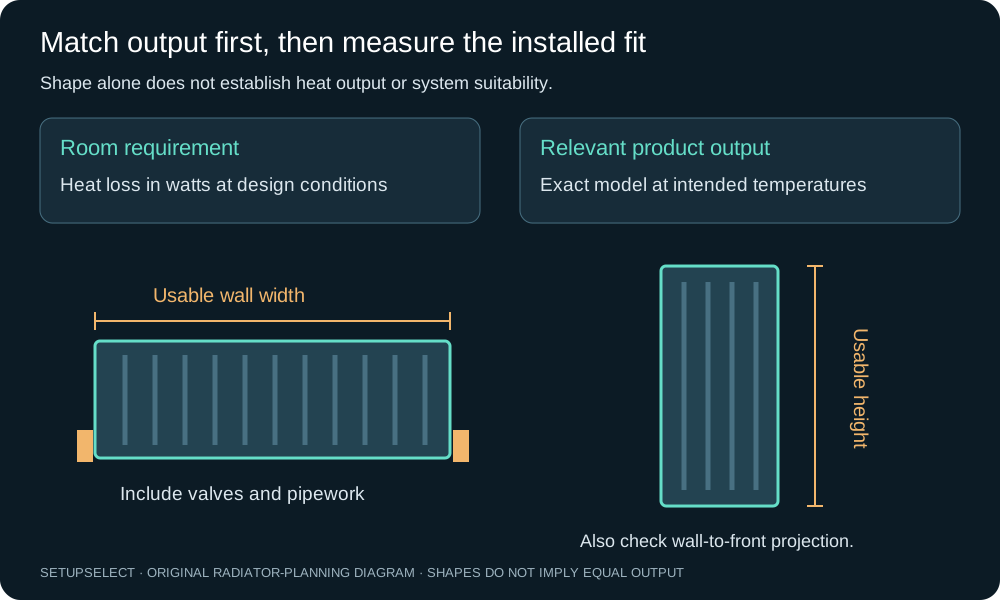
For either option, start with the complete installed outline. Include brackets, valves, pipe connections, manufacturer clearances and service access. A radiator body fitting between two obstacles is only the beginning of the fit check.
The user must still be able to operate controls, clean around it and have it maintained.
Use a like-for-like output comparison
Record both candidates' watts at the same relevant temperature condition. If one listing is in BTU/h, convert it using the BTU reference.
If the temperature conditions differ, obtain the correct outputs or manufacturer correction information before judging which is stronger.
Do not compare a tall decorative radiator with a horizontal Type 22 and attribute every output difference to orientation. Their internal construction, surface area, panels and convectors may differ as well.
The comparison is between two complete products, not a controlled experiment in turning the same radiator through ninety degrees.
If the question is really whether extra depth can deliver more output within the same width, use Type 21 versus Type 22.
If the question is lower-temperature performance, use Delta T explained. Those decisions intersect with orientation but should not be replaced by appearance-based assumptions.
A decision matrix for two workable orientations
| Constraint | Horizontal option to investigate | Vertical option to investigate |
|---|---|---|
| Wide space below a window | Low-height model with suitable output | May leave useful low wall unused |
| Narrow pier beside glazing | May have insufficient usable width | Tall model, checked for exact output |
| Door opens against the wall | Low projection and protected controls | Height and valve conflicts still matter |
| Sofa occupies a long wall | Consider another horizontal location | May release the sofa wall if another pier works |
| Sloping ceiling | Lower body may fit naturally | Verify full height and upper clearance |
| Existing pipe positions | Potentially simpler match, still verify | Often requires a different connection plan |
This table suggests investigations rather than automatic winners. A particular horizontal design can be deep or heavy; a particular vertical design can have insufficient output for the available width. Match the actual product to the actual constraint.
Read a documented vertical specification
Stelrad's Compact Vertical technical sheet, checked on 29 September 2026, lists K2 models at 1,800mm height with 400, 500 and 600mm lengths.
Their published Delta T50 outputs are 1,584, 1,980 and 2,376W respectively. The document also provides mounting, connection and technical information.
The useful lesson is that vertical does not describe one capacity. Width within the same height and range changes output materially. Those figures also apply at the sheet's specified condition; they are not ready-made lower-temperature heat-pump outputs.
Use the exact current sheet for a purchase. A similar name, finish or retailer image may represent another model or generation.
Keep the product code and drawing with the quote so the installer can confirm the intended radiator before pipework and decoration are arranged around it.
Draw a wall elevation, not just a rectangle
Measure from finished floor level to the sill, shelf, slope or other upper boundary. Record clear wall width between fixed obstacles. Mark skirting, sockets, switches, door trim and any projecting furniture.
Include curtains in their ordinary closed position, not only gathered at the side.
Place a paper outline of the candidate at the proposed position, using its installed drawing rather than guessed proportions. Add the required clearances and the valve envelope.
Stand where people normally sit or pass; a tall unit on a narrow pier may project into a route that looked open from the front.
Make a second outline for the alternative orientation. Comparing both in the same room with the same obstacles is more informative than comparing attractive catalogue photographs.
Keep the heating requirement visible on the drawing so the layout exercise cannot quietly replace a suitable emitter with a weaker one purely for symmetry.
Worked layout: a living room with a sofa wall
Imagine a living room with a long wall occupied by a sofa and an 800mm-wide pier beside glazed doors. Its professionally assessed requirement is hypothetically 1,600W at the intended system temperatures.
One proposal is a horizontal radiator on another available low wall; another is a vertical radiator on the pier.
The pier's 800mm width does not mean an 800mm-wide radiator fits. Valves, clearances, trim and access reduce the usable space.
The owner marks those elements and asks for a candidate whose verified relevant output meets the 1,600W requirement within the remaining envelope.
For the horizontal alternative, the owner checks whether moving a small cabinet would create an unobstructed location. That may preserve familiar pipework or simplify maintenance, but installation cost is confirmed by an installer rather than assumed.
The decision compares two feasible complete arrangements, not one unobstructed vertical unit against a deliberately hidden horizontal unit.
If neither single radiator fits with adequate output, the designer can assess two emitters, another panel construction or heat-loss improvements. Choosing the tall option solely because it looks large would bypass the main requirement.
Worked layout: a bedroom beneath a window
Consider a bedroom where the space below the window is broad but low, while a narrow wall beside the wardrobe is tall. A horizontal radiator may fit naturally under the sill, but full-length curtains and the bed position require attention.
The vertical alternative may conflict with wardrobe doors or put a valve in a walking route.
The owner draws both with furniture in use: wardrobe doors open, curtains closed and bedding hanging from the bed. The comparison often changes at this stage because the apparently spare wall area is not spare throughout the day.
The room requirement and water temperatures are the same for both proposals. Any output difference therefore belongs to the selected products, not to a different assumption about how warm the bedroom should be.
Preserve that consistency when comparing quotes so one orientation does not appear cheaper simply because it was assigned a lower design target.
Projection can matter more than visible width
Body depth and installed projection are different measurements. Brackets set the distance from the wall, and valve or pipe arrangements may project farther than the front panel.
Ask for the complete installed dimensions rather than subtracting body depth from an aisle measurement.
For an illustrative route 850mm wide before the radiator is installed, a total projection of 150mm leaves 700mm geometrically.
That subtraction does not establish that the remaining route is acceptable for access or any applicable requirement; it simply reveals a constraint that needs assessment.
A vertical radiator may save width while still occupying substantial depth. A horizontal one may spread its output along a wall while using a shallower profile.
Compare the actual drawing and the user's movement, including mobility aids, carried items and door operation where relevant.
Confirm the wall can support the selected product
Radiators have a dry weight and additional water content, with brackets transmitting the load to the wall. Wall construction and fixing design matter, especially for tall or heavy products.
Do not select fixings solely from the radiator's appearance or copy another household's screw choice.
The manufacturer installation information should identify the bracket arrangement and relevant restrictions. A competent installer must assess the actual substrate and suitable fixing system.
Plasterboard, masonry, studs and uncertain existing walls do not all accept the same approach.
Establish this before final decoration. Discovering that the intended pier cannot support the proposed installation after it has been tiled or painted can force a different product or location.
Keep access to the relevant wall information and ask the installer to confirm feasibility while the shortlist is still flexible.
Pipe connections and flow direction are model-specific
Check the connection positions and any specified flow and return arrangement. A vertical product may have internal features that depend on correct connection.
Do not assume it can be installed like an existing horizontal panel merely because both have familiar threaded ports.
Similarly, a horizontal radiator should not be rotated and treated as vertical unless the manufacturer explicitly supports it. The water path, mounting, venting and rated operation may depend on orientation.
The safe comparison is between products designed for their proposed position.
Ask whether existing pipes can serve the selected emitter at the required flow, and what alterations are needed. Pipe centres on a retailer drawing may not include the valve arrangement you intend to use.
A confirmed drawing and installer plan are more reliable than ordering from a tape measurement between old visible pipe ends.
Controls and airflow need room to work
Keep thermostatic and other controls accessible and positioned according to their instructions. A valve enclosed behind a curtain or tightly surrounded by furniture may not sense the room as intended.
Reach matters as well: a control that can only be adjusted by climbing around furniture is a poor everyday arrangement.
Allow the radiator's intended air movement. Avoid adding close shelves, decorative covers or furniture based on a general claim that every radiator needs the same gap.
Use the product and installation guidance; modifications can change useful heat delivery and may require a different design assessment.
Think about cleaning and venting. Tall products may place some service points higher, while wide low panels can be hard to access behind furniture. Neither orientation automatically wins maintenance convenience.
Judge the location with the actual user and the installer's service requirements in mind.
Compare complete installation cost
Collect quotes that identify the exact radiator, brackets, valves, pipe alterations, wall preparation, system work and finishing. There are no universal prices in this guide: the building and chosen products determine what is required.
A cheaper body can become the more expensive installation if it needs substantial relocation work.
Check lead time and finish availability before arranging other trades. A standard white stock item and a special-order finish can have different practical consequences even when their shape is identical.
Confirm cancellation and return arrangements before ordering a product made to a specific specification.
Compare like-for-like scope. If one quote includes balancing and making good and another does not, the difference is not simply the cost of vertical versus horizontal. Ask the installer to make exclusions explicit so the choice remains reviewable.
Keep lower-temperature plans in the decision
If a future heating change is planned, tell the designer now. A radiator chosen only from a hot catalogue rating may not deliver enough at lower water temperatures.
Conversely, an existing radiator may already have sufficient surface area once the room's actual heat loss is assessed.
Energy Saving Trust's room-by-room heat-loss guidance emphasises the importance of assessing rooms for low-temperature heating.
Orientation does not remove that requirement. Obtain relevant product outputs and check the complete system rather than adopting a blanket rule that heat pumps need one particular shape.
Use the radiator calculator for early research, retain the professional requirement for final selection, and keep Delta T guidance beside the product table.
The result should be a radiator that fits both the heating design and the room people actually occupy.
Does heat rising make vertical radiators ineffective?
That slogan is not a substitute for tested product output and a suitable room design. Both orientations can be designed to deliver useful heat.
Compare the manufacturer's rating at the intended conditions and consider placement, rather than assuming a tall radiator sends all useful heat straight to the ceiling.
Can I swap orientation without changing pipes?
Sometimes a compatible arrangement may be possible, but it depends on exact connection positions, valves and the existing circuit. Have the installer confirm it from the product drawing.
Similar overall width does not establish matching pipe centres or appropriate flow direction.
Will a vertical radiator always free more floor space?
It can release wall width for furniture, but it still projects into the room and needs clearances and access. Count the complete envelope and the furniture arrangement it enables. A narrow body on paper may still obstruct a door or walking route.
Which should I buy if both fit and meet output?
Compare installation scope, access, controls, cleaning, finish and the room layout you prefer. At that stage either orientation can be a sound choice.
Keep the exact verified specification with the order so the attractive design you choose remains the one assessed by the installer.
Continue researching