Buying guide
Radiator BTU explained: watts, conversions and product ratings
For radiators, BTU usually means BTU per hour: a rate of heat output. Watts express the same type of quantity. Multiply watts by approximately 3.412 to obtain BTU/h, or divide BTU/h by 3.412 to obtain watts.
The conversion changes the unit, not the radiator's performance.
The essential companion to any output figure is its temperature condition. A bare claim of 5,000BTU cannot establish whether a radiator will heat your room.
This guide focuses on units, catalogue reading and checking a product shortlist; use radiator sizing for room requirements and Delta T explained for temperature corrections.
Energy and heat-output rate are different quantities
A British thermal unit is a unit of energy. BTU per hour describes energy transferred each hour, so it is a rate. A watt is also a rate of energy transfer: one joule per second.
The showroom shorthand BTU generally refers to BTU/h when describing a radiator's output, but it is worth checking the actual specification.
This distinction is similar to the difference between kilowatts and kilowatt-hours on an electricity bill. A 1kW rate sustained for three hours represents 3kWh of energy.
A radiator's rated output, however, is not automatically its constant output throughout a heating session: water temperatures, room temperature, flow and controls can vary.
Stelrad's radiator FAQs state the familiar conversion of one watt to approximately 3.412BTU/h. Use that factor for ordinary catalogue comparisons.
More decimal places will not make an approximate room heat-loss estimate exact, so round sensibly once the arithmetic is complete.
A conversion table for common output values
| Heat output in watts | Equivalent BTU/h, rounded |
|---|---|
| 500W | 1,706BTU/h |
| 750W | 2,559BTU/h |
| 1,000W | 3,412BTU/h |
| 1,250W | 4,265BTU/h |
| 1,500W | 5,118BTU/h |
| 2,000W | 6,824BTU/h |
| 2,500W | 8,530BTU/h |
The rows are unit conversions, not recommendations for particular room sizes. A 1,500W entry does not mean a standard living room needs that output.
Establish room heat loss separately with the radiator calculator as an initial aid and appropriate professional design for the final selection.
For the reverse calculation, a listing of 4,500BTU/h gives 4,500 ÷ 3.412, approximately 1,319W. A listing of 6,000BTU/h gives approximately 1,759W.
Keep the stated temperature condition attached to each converted value; the conversion has not corrected either product to another water temperature.
Read a catalogue row in the right order
Find the exact product range, then the model type and height and length. Only then read across to the output column. Similar-looking rows may describe different panels, convectors, sections or orientations.
A retailer's photograph can represent a range rather than the exact size being sold.
Check the units in the column heading. Some catalogues provide watts and BTU/h side by side, while others place a second temperature condition nearby.
It is easy to read the right number from the wrong column if the table spans several pages or is viewed on a narrow phone screen.
Finally, record the condition that applies to the output: a Delta T label or the stated flow, return and room temperatures. Keep the product code as well as its descriptive title.
A code helps an installer or supplier identify the row without relying on abbreviated names that can change between listings.
A real manufacturer row, read carefully
Stelrad's Compact Vertical technical sheet, checked on 29 September 2026, lists a K2 model 1,800mm high and 400mm long with output of 1,584W and 5,405BTU/h.
The sheet identifies the rating as Delta T50, with 75/65/20°C conditions.
Multiplying 1,584 by 3.412 gives approximately 5,405. This is a useful consistency check: the two columns describe the same rated heat output.
They are not two separate heat contributions to add together, and the BTU number is not evidence that the radiator is more powerful than its watt figure suggests.
The same sheet has other widths and outputs. Copying the 600mm-wide row while ordering the 400mm-wide model would be a model-selection error, not a unit-conversion error.
Retain the exact dimensions, code and rating condition alongside the arithmetic so the full claim can be traced back to the manufacturer's document.
Keep room need and product output in separate columns
Suppose a hypothetical room assessment gives a 1,250W requirement. That is approximately 4,265BTU/h. A candidate advertised at 4,500BTU/h is about 1,319W at its stated condition.
It appears above the requirement only if that condition is appropriate for the proposed heating design.
Do not convert the room requirement to BTU/h and then compare it with a hotter product rating without checking the temperature basis. The units match, but the operating conditions may not.
This is one of the most common ways an apparently correct calculation produces an unsuitable shortlist.
The main radiator sizing guide includes bedroom and living-room examples that keep those columns separate. The room requirement describes the building under design assumptions; the product figure describes the emitter.
Changing from one unit to another does not make them automatically comparable.
Temperature correction is a separate operation
Radiator output depends on the difference between its water temperature and the room.
Manufacturers publish outputs or factors for different conditions. Stelrad's correction resource illustrates this separate step. The correct data must apply to the chosen product or range.
Unit conversion answers how to express a value in watts or BTU/h. Temperature correction answers how the product output changes at another operating condition. You may need both, but they should not be confused.
Keep the original rating, temperature basis and corrected result visible in your notes.
If the catalogue already gives output at the intended temperatures, do not apply a second correction. If it gives only a hotter condition, obtain the relevant data rather than estimating output by a simple ratio of temperature differences.
The detailed method belongs in Delta T explained, so this reference concentrates on reading and checking the resulting figures.
Worked shortlist with mixed units
Assume an illustrative room requirement of 1,400W. Three fictional candidate listings have already been confirmed at the same relevant temperature condition. Their labels differ, so convert them before deciding which have sufficient stated output.
| Fictional candidate | Published output | Converted watts | Arithmetic comparison with 1,400W |
|---|---|---|---|
| A | 4,600BTU/h | About 1,348W | Below the assumed requirement |
| B | 1,450W | 1,450W | Above the assumed requirement |
| C | 5,200BTU/h | About 1,524W | Above the assumed requirement |
This table does not rank B against C overall. Both pass only the stated arithmetic comparison. Physical fit, pipework, controls, installation and any professional design allowances remain to be assessed.
Candidate A's visually larger number does not make it more capable than a 1,450W label.
If candidate C later turns out to use a different rating condition, remove it from the direct comparison until its relevant output is established.
Do not preserve the original ranking simply because the calculation has already been placed in a spreadsheet or shopping list.
Adding outputs from more than one radiator
Outputs can be added when expressed in the same units and relevant conditions. Two hypothetical emitters delivering 900W and 1,100W have an arithmetic total of 2,000W, or approximately 6,824BTU/h.
This can be compared with a room design requirement on the same basis.
Do not add watts to BTU/h directly. Also do not add a Delta T50 output from one radiator to a lower-temperature output from another and treat the total as a design result. Convert units and establish the relevant condition for both first.
Even a correct total does not prove installed performance. Both radiators need adequate flow and suitable controls, and the room layout must make their heat useful. A system designer should confirm pipework and balancing.
Arithmetic is a necessary check in the selection process, not a substitute for hydraulic and room design.
Product dimensions do not convert into BTU by themselves
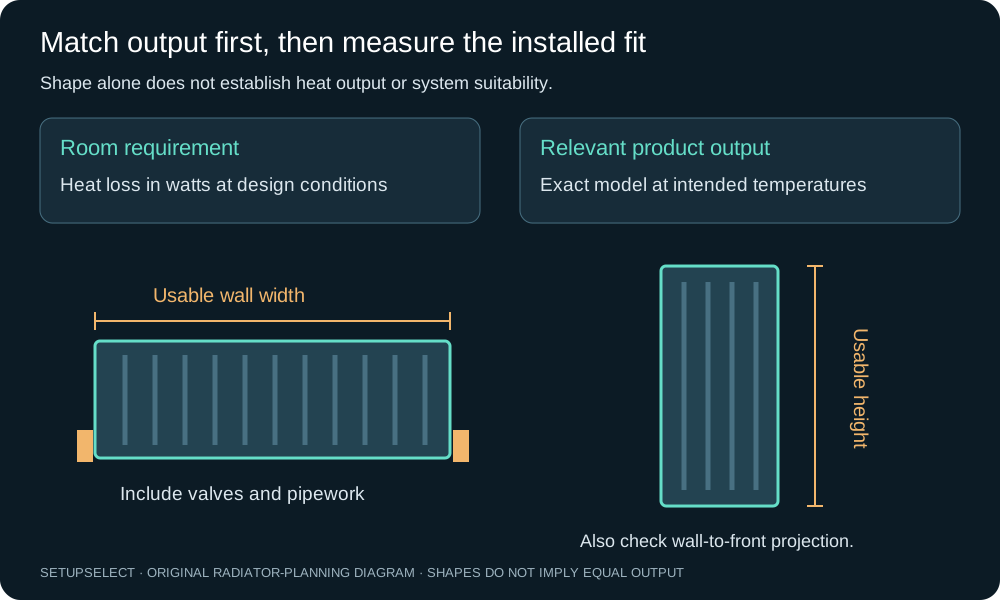
Height multiplied by width gives a face area, not a reliable heat-output formula. Construction, internal water paths, convector surfaces and temperature conditions affect output.
Two radiators with similar visible dimensions can therefore have different ratings without either label being wrong.
Use Type 21 versus Type 22 when comparing common panel arrangements, and vertical versus horizontal when deciding how to use the wall.
Those articles help with physical design choices, while the manufacturer table supplies the exact rated output.
The same caution applies to decorative sections. A per-section output must be applied to the correct product, height and stated conditions, with any manufacturer's rules for assembled lengths.
Do not borrow a section rating from a similar photograph or multiply by visible tubes without verifying how the model is specified.
Check whether a rating is per metre or per radiator
Technical sheets sometimes publish output per metre of length for a defined model and height. A retailer may instead give the total output of one complete radiator. These are different forms of data, and the units should make the distinction visible.
For an illustrative per-metre rating of 2,000W/m, a supported 0.8m product would give 1,600W if the manufacturer's method permits that direct calculation. It would not give 2,000W merely because that is the first number in the technical table.
Prefer the exact complete-product row where one is published.
Also check dimensions in millimetres versus metres. A length of 800mm is 0.8m, not 800m. Keeping the units on every intermediate line makes this otherwise obvious mistake much harder to make when copying data between a PDF, a calculator and a quote.
Do not turn radiator output into a fuel bill
A water-filled radiator's heat-output rating is not its electrical consumption, nor does it directly state how much gas a boiler burns. The heat source, system efficiency, temperatures, operating duration and controls determine energy use.
A radiator can deliver a changing output through the day rather than its catalogue maximum continuously.
For a purely illustrative energy statement, an emitter transferring 1kW for three hours transfers 3kWh of heat. That arithmetic does not establish three kWh of purchased electricity for a heat pump or three kWh of fuel for a boiler.
Those systems have different relationships between purchased energy and delivered heat.
If comparing an electric radiator, distinguish its electrical input rating from a water radiator's catalogue output and consider the relevant controls and room service.
Do not use a conversion calculator to imply that changing the unit or radiator style alone creates energy savings.
Audit a quote before ordering
For each room, request the assessed requirement, target temperature and proposed system temperatures. For each selected radiator, keep the exact product code, dimensions, type, output unit and temperature condition.
Ask whether the quoted output already includes any correction.
Check the number of units included. A quote line describing two radiators may show a per-unit output or a combined output; establish which. The same ambiguity can appear in a retailer bundle or a room schedule.
A correct value copied with the wrong quantity can be as misleading as a wrong conversion factor.
Flag unexplained differences between retailer and manufacturer values rather than choosing the larger one. They can arise from rounding, a different size, a different condition or a transcription error.
The manufacturer technical source for the exact model should anchor the discussion, with the installer confirming its suitability for the system.
A compact rating worksheet
Record these fields together: room name, required watts, exact model and code, height and length, type, original output, original units, stated temperatures, relevant corrected output if needed, and final watts for comparison.
Add the source link and date checked.
This worksheet is deliberately different from a full heat-loss calculation. It checks that a product claim has been interpreted consistently.
Use the radiator calculator for early room research, then replace the initial requirement with the professional design result before final purchase.
Why do watts and BTU/h differ slightly after conversion?
Catalogue rounding and the number of decimal places in the conversion factor can produce small differences. Check the exact model and temperature basis first.
A tiny rounding discrepancy is different from a substantial mismatch suggesting the wrong row or condition has been copied.
Does 5,000BTU mean the radiator stores that much heat?
In a typical radiator listing it means an output rate of about 5,000BTU/h at stated conditions, not a fixed store of energy inside the metal or water. Confirm the full unit in the technical specification if the listing is abbreviated.
Can I use an air-conditioner's BTU number for radiator sizing?
The unit describes a heat-transfer rate in both contexts, but heating and cooling loads are assessed for different conditions and gains. A room's AC capacity recommendation is not its winter radiator requirement.
Carry out the appropriate heating assessment instead of copying a familiar number from another appliance.
Is the highest BTU figure the best radiator?
It is the highest stated output only under its specified conditions. The best candidate must meet the actual requirement, fit the room and work with the system.
Once suitable output is established, installation and layout can decide between products that have different maximum numbers.
Continue researching