Buying guide
Long-flight comfort kit for economy: pack for seat access
A useful economy comfort kit fits within your luggage allowance and can be used without repeatedly opening the overhead locker. Start with the seat experience: what you need to hear, block out, reach, wear and put away.
A mask, suitable earplugs or headphones, a warm layer and a compact essentials pouch may help more than a large collection of travel gadgets.
The aim is a manageable journey, not a promise of sleep or relief from a medical condition. The examples here are packing exercises, not product tests.
For a specific health concern, medication question or increased travel-related clot risk, obtain advice from an appropriate healthcare professional before the trip.
Divide the kit into seat access and stored backup
Keep the items needed during an ordinary hour together: perhaps your glasses, headphones, mask, tissues, charging cable and any permitted personal essentials. The exact contents depend on your trip.
Put less frequently used clothing and other equipment in the main bag, while preserving access to anything that must remain with you if that bag is checked at the gate.
Do not plan to occupy the whole footwell with loose accessories. Under-seat storage must follow the airline and crew's instructions, and some seat positions have particular stowage rules.
An item you can reach during cruise may need to be put away for taxi, take-off or landing. Build the kit around easy collection and closure.
A zipped pouch is useful because it can move as one unit, but test its size against the bag and the intended storage space. A rigid case may protect glasses or headphones while wasting room for softer items.
Keep the pouch easy to identify in low light without relying on a complicated system of identical black bags.
Organise by problem, not by a prepacked bundle
| Problem at the seat | Candidate response | Fit or packing test |
|---|---|---|
| Light interrupts rest | Eye mask | Check nose gaps, strap pressure and eyelash clearance |
| Steady cabin noise is distracting | Suitable earplugs or headphones | Test comfort, controls and ability to hear instructions |
| Cabin temperature feels cool | Existing warm layer | Put it on while seated without disturbing neighbours |
| Head position is uncomfortable | Personally suitable support | Trial upright with the same outer clothing |
| Essentials disappear | One small accessible pouch | Retrieve and repack each item with limited space |
| Device power runs low | Verified charging plan | Check airline rules and actual cable compatibility |
Choose only the rows that describe a real need. If you already sleep comfortably with a folded layer supporting your preferred position, a bulky specialist pillow may add little.
If you dislike wearing an eye mask, do not assume a more elaborate one will become comfortable simply because it is designed for flights.
The carry-on packing planner helps include these items in the total mass. Comfort equipment still competes with clothing, technology and the bag itself.
A compact kit should make the journey easier to manage, not leave you struggling to carry everything through the connection.
Evaluate an eye mask while sitting upright
Try the mask in a chair with ordinary room light. Look for light entering around the nose and sides, then adjust it without over-tightening. Check whether the strap crosses a hairstyle, hearing device or part of the seat position that will become irritating.
A mask that feels acceptable for a few seconds may be less comfortable after half an hour.
If you wear glasses, decide where they will go before removing them. A protective case you can find without sight is more useful than putting glasses loose on a tray or inside a blanket.
Practise placing the mask and glasses in separate predictable positions so you can reverse the sequence when service begins.
Washability and drying matter for repeated trips. Follow the product's care instructions and allow it to dry fully before packing. Decorative features, added electronics or large moulded cups should justify their volume through actual comfort.
The simplest model that fits you is often easier to maintain and replace.
Choose audio equipment for the full journey
Noise-cancelling headphones may make steady cabin sound less intrusive, but their effectiveness and fit vary. Evaluate the equipment you already own during a comparable period of use.
Check pressure around the ears, heat, glasses compatibility and access to controls while seated. Do not judge only the first impression in a quiet room.
Earplugs take little space and do not require charging, but correct selection and use still matter. Follow their instructions and choose something comfortable for you. Keep them in a clean container rather than loose with coins and cables.
Do not use any noise-reduction setup in a way that prevents you following crew instructions.
If you want aircraft entertainment audio, verify the connection offered on the actual service where possible. A Bluetooth headset does not automatically connect to every seat system.
A suitable wired cable or adaptor may be useful, but do not buy several speculative connectors without checking the airline's information and the headset's supported wired operation.
Download permitted entertainment before leaving and test that it works offline. Confirm subscription downloads remain available for the journey and that storage is sufficient.
This is a more practical rehearsal than discovering after boarding that every saved programme needs an internet check.
Trial neck support in the position you will use
Sit upright in a chair with the layer you expect to wear. Test the pillow or support for a meaningful period, including looking sideways, reaching for water and removing it.
Notice whether it pushes your head forward, slips when relaxed or interferes with headphones. A sofa test does not reproduce an upright seat particularly well.
Consider the seat and your preference without assuming a universal best shape. A window position may offer a surface to lean towards, while an aisle position may make movement easier but provide less side support.
The actual aircraft, seat and journey can change, so avoid a kit that only works with one precise arrangement.
Inflatable products reduce stored volume, but their valve access, firmness and noise during adjustment matter. Do not overfill them or use them contrary to instructions.
If a product attaches to the seat, tray or cabin furniture, check airline permission and crew instructions before use; a marketing photograph does not establish that it is allowed.
Use clothing as part of the comfort system
An existing cardigan, fleece or light outer layer can handle temperature variation and remain useful after landing. Try putting it on and taking it off while seated.
A layer with a full opening may be easier to manage than one pulled over headphones and glasses, though personal preference and the rest of your wardrobe determine the choice.
Keep the layer accessible rather than at the bottom of the overhead bag. If it doubles as padding around another item, make sure retrieving it does not dismantle the bag.
Bulky clothing clipped outside luggage can alter its dimensions and become awkward in queues, so include it in the physical packing trial.
Avoid purchasing specialised heated or powered comfort equipment without checking its instructions and airline restrictions. Ordinary layers solve many temperature problems with fewer charging, packing and carriage questions.
If you know you have particular temperature or mobility needs, arrange appropriate assistance with the airline in advance.
Keep water and personal items manageable
A bottle should fit the kit when empty and remain manageable when filled.
Check security and airline requirements; CAA packing advice notes that empty water bottles can pass through security in hand luggage.
Fill only where the water is suitable, close it properly and keep it away from vulnerable electronics.
Choose toiletries for the actual journey rather than bringing full bathroom quantities to the seat. Check the current UK hand-luggage restrictions and the rules for every departure and transfer airport.
Necessary medicines may have different requirements from ordinary liquids; organise documentation and access according to the applicable guidance.
Keep personal medicines identifiable and follow the advice provided for them. Do not begin using sleep aids, unfamiliar supplements or compression products merely because they appear on a travel shopping list.
Ask a pharmacist or clinician about suitability when needed, particularly if combining medicines or managing an existing condition.
Understand the limits of comfort products and health claims
The NHS guidance on DVT identifies long journeys as a relevant context and advises measures including loose clothing, water and walking when possible.
Follow crew instructions about movement and seatbelts. A pillow, footrest or expensive sock should not be presented as a substitute for individual medical advice.
If you have previously had a clot, recently had surgery or have another reason to be concerned about travel, discuss the journey with a clinician. Ask specifically about the flight duration and any connections or long ground transfers.
The total period of travel can be more relevant to your planning than the scheduled flight time alone.
Keep this distinction clear when shopping: an accessory may make you feel more comfortable without establishing a medical benefit. Reject product claims that require evidence the seller does not provide.
Your packing list should implement appropriate advice you already have, rather than generate a treatment plan from marketing copy.
Build a compact example, then weigh your version
Consider a hypothetical kit containing a 60g mask, 25g earplug case, 250g headphones, 80g pouch and 85g cable. Those items total 500g.
Add a 180g empty bottle and a 350g layer, and the group reaches 1,030g before water, a pillow, personal medicines or the main bag. These figures demonstrate a calculation and are not measurements of recommended products.
The example explains why a “small” kit can become substantial. Weigh your own items and decide whether headphones and earplugs both have distinct roles.
A wired fallback may be reasonable; two complete premium headphone systems usually need a stronger justification. Likewise, a layer useful at the destination can be better value in space than a single-purpose blanket.
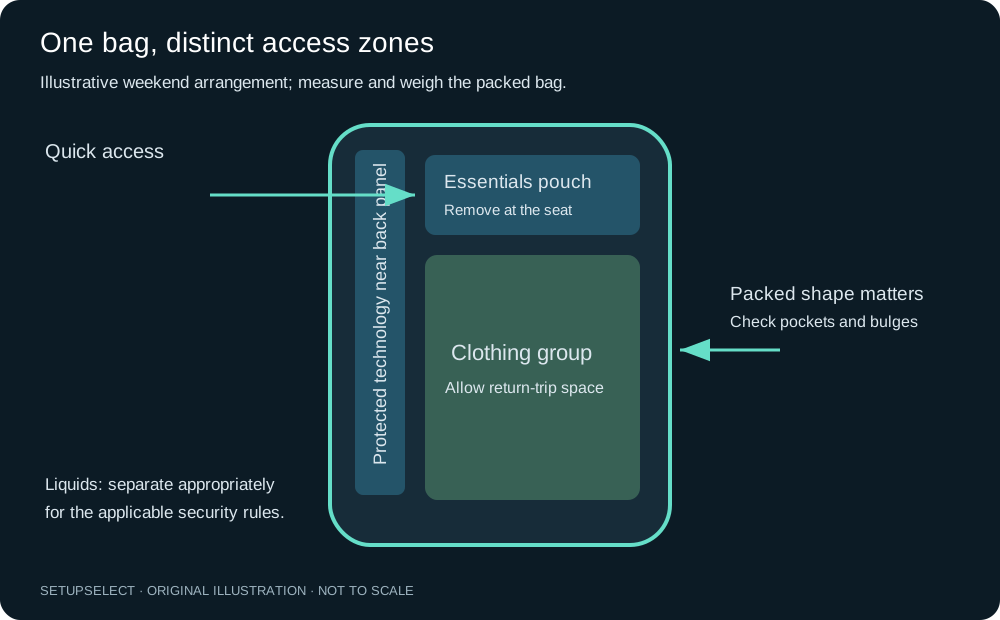
Use the diagram as an access principle, not a mandatory contents list. The one-bag layout guide explains how pockets and bag shape affect the arrangement.
A seat pouch that fits well in one backpack may require a different location in a small wheeled case.
Rehearse boarding before the airport
Pack everything, then remove the seat pouch and warm layer as if you were standing in a narrow aisle. Keep the remaining bag closed and controllable. If three separate accessories fall out, consolidate them or change the order.
You should be able to stow the main bag promptly and sit down without sorting loose objects across adjacent seats.
Keep documents and any essential items required during boarding accessible until they are no longer needed. Follow instructions if the bag must be checked, including removing items prohibited in hold baggage.
Check current battery rules with the airline; the travel tech guide covers the charging kit more fully.
Do not attach equipment to the seat in front or block another passenger's space. Ask crew when uncertain about an accessory. An arrangement that feels comfortable only while occupying shared space is not a dependable solution for a full flight.
Make the in-flight routine easy to reverse
Once permitted, take out only what you need for the next part of the journey. Put glasses into their case before using the mask, and keep headphone cables within your own space.
When food arrives or you need to move, return small items to the pouch instead of scattering them across the seat and tray.
Before descent, collect items deliberately: glasses, mask, headphones, cable, phone and personal essentials. Check the seat pocket and surrounding area without reaching into mechanisms. Keep your belongings stowed as instructed.
A consistent place for each item reduces the chance of leaving an expensive device behind after a tiring flight.
After landing, note which item was hard to reach and which was never used. Adjust the kit for the return rather than adding more equipment automatically. Comfort planning improves through a few useful observations about your own seat routine.
Questions about economy comfort kits
Is a foot hammock worth packing? First verify whether the airline permits it and whether its attachment method is suitable. Consider your own fit and the effect on neighbouring space.
Do not assume a product supported by a tray table is allowed because it is sold for flights.
Can noise-cancelling headphones replace earplugs? They may serve your needs, but fit, battery dependence and the kind of noise matter. Test your headphones for a realistic duration.
A small clean earplug case can be a useful fallback if it has a clear role.
Should I buy compression socks for every long flight? This guide does not make that medical recommendation. Seek individual advice where appropriate, including fit and suitability. Do not choose them from comfort-kit marketing alone.
Where should the kit go in an exit-row seat? Follow the airline and crew's stowage instructions for that seat. Do not assume ordinary under-seat access applies throughout the flight. Keep the kit compact enough to put away promptly when required.
What if the complete kit does not fit? Remove optional duplicate functions before compromising permitted luggage dimensions. Reuse clothing for warmth, reduce packaging and reconsider bulky support products.
The under-£50 travel guide offers budgets with explicit room to leave purchases unmade.
Continue researching