Buying guide
Carry-on travel essentials under £50: three useful budgets
Spend a £50 carry-on budget on the missing pieces of a trip you have already planned. If your bag, phone charger and headphones work, keep them.
A small amount of money can improve access, organisation and comfort; it cannot reliably buy a complete new luggage system, laptop charger, power bank and every travel accessory at once.
The three budgets below are illustrative spending limits, prepared in September 2026, rather than observed shop prices or product recommendations. Each totals £50 and includes an unspent reserve.
Replace the allowances with current prices, delivery charges and the weight of the exact items you choose. There are no claims of hands-on product testing or guaranteed availability at these amounts.
Decide what the £50 must exclude
These plans assume you already own a suitable cabin bag, normal clothing, a phone, a working charger and required personal documents. Tickets, baggage upgrades, insurance, medication, accommodation and food are outside the accessory budget.
If you lack a compliant bag or essential charging equipment, that requirement takes priority and the optional accessories should be reduced accordingly.
Write down the operating airline, booked bag allowance and every airport used on the outward and return journeys. A bag permitted by one carrier may exceed another carrier's allowance, and a fare may include only a small under-seat item.
Check the packed dimensions, including bulging pockets, instead of relying solely on the bag's marketing description.
For UK departures, GOV.UK's hand-luggage overview directs travellers to current liquid and electronic-item restrictions. Confirm the rules at each airport before packing containers.
An organiser is useful only when the items inside it are permitted and can be presented as required.
Allocation one: a simple weekend with existing technology
| Item or allowance | Illustrative spending cap | Why it earns space |
|---|---|---|
| Suitable liquids pouch or replacement containers | £8 | Keeps necessary toiletries together |
| One lightweight clothes organiser | £10 | Separates the main clothing group |
| Reusable bottle, only if none suitable is owned | £10 | Holds water after filling at an appropriate point |
| Small document or essentials pouch | £7 | Keeps frequently needed items accessible |
| Earplugs or basic eye mask | £5 | Addresses a known noise or light problem |
| Delivery, replacement or unspent reserve | £10 | Prevents small extras exceeding the total |
| Total | £50 | Existing bag, charger and clothes reused |
The order matters more than the categories. If you already own a bottle and a small pouch, do not spend their allocations on additional versions. Keep the money or redirect it to the one real weakness in the kit.
A clean, suitable pouch from home can perform the same organising job as a branded travel accessory.
For this trip, the organiser should fit the bag's available shape. A large rectangular cube may leave awkward gaps in a tapered backpack. Before buying, bundle the actual clothing and measure the approximate space it occupies.
The weekend packing list establishes what to bring; the organiser then serves that list.
Allocation two: a short international trip
| Item or allowance | Illustrative spending cap | Decision it supports |
|---|---|---|
| Destination-compatible travel adaptor | £15 | Connects an already compatible charger |
| Essential replacement or spare cable | £10 | Covers a specific connector need |
| Small cable pouch | £5 | Stops the cable and adaptor disappearing |
| Suitable toiletries containers or pouch | £8 | Fits the trip and security process |
| Simple luggage identification | £2 | Makes an existing bag easier to identify |
| Reserve | £10 | Allows for verified compatibility or delivery costs |
| Total | £50 | No new charger or power bank assumed |
This is an electrical-compatibility budget, not an invitation to choose the cheapest adaptor available. Use a traceable supplier and verify the destination plug system, charger input rating and adaptor instructions.
If the suitable adaptor costs more than the allowance, remove the cable pouch or another optional item. Do not make electrical suitability the part of the plan that absorbs a budget shortfall.
An adaptor changes the physical plug connection and does not automatically convert voltage. Electrical Safety First's travel advice separates those questions.
The international charging guide gives a label-reading workflow; do that before spending any of this allocation.
Allocation three: a long travel day with power already covered
| Item or allowance | Illustrative spending cap | Intended benefit |
|---|---|---|
| Eye mask selected for fit | £12 | Reduces unwanted light |
| Earplugs or replacement headphone accessories | £8 | Addresses the existing audio setup |
| Compact pillow, only after a fit trial | £15 | Supports a preferred seated position |
| Small accessible seat pouch | £5 | Keeps essentials together |
| Reserve | £10 | Covers a missing item or remains unspent |
| Total | £50 | Existing warm layer, bottle and headphones reused |
A pillow is optional. If it presses your head forward in an upright chair or occupies too much luggage, the £15 belongs back in the reserve.
Comfort equipment is unusually personal: a complete themed kit can contain several items that fit nobody particularly well. Select the individual problem you want to solve.
This allocation also assumes you have a workable charging plan for the journey. If essential devices cannot last through a realistic delay, reconsider that requirement before buying comfort extras.
The long-flight comfort guide focuses on seat access, noise, light and packing; it does not require every traveller to own the same bundle.
Give accessories a weight budget as well
A cheap accessory can still be expensive in luggage space. Use a kitchen or luggage scale to weigh each candidate and include the empty bag.
The following numbers are deliberately hypothetical, intended to demonstrate arithmetic rather than claim typical or measured product weights.
| Illustrative group | Mass | Approximate packed envelope |
|---|---|---|
| Empty backpack | 850g | Counted as the outer bag |
| Toiletries and pouch | 350g | 20 × 12 × 6cm |
| Clothes organiser, including clothes | 1,600g | 30 × 24 × 10cm |
| Existing charger, cable and adaptor | 300g | 15 × 10 × 5cm |
| Empty bottle | 180g | 24 × 7 × 7cm |
| Small comfort pouch | 170g | 18 × 12 × 5cm |
These groups total 3,450g before other clothing, footwear, electronics, documents and anything carried separately. Filling the bottle adds water mass, so weigh the bag in its actual travel state.
The listed envelopes are rough planning boxes; their volumes do not prove that the shapes will fit together inside a soft bag.
Enter your real figures into the carry-on packing planner. It is easier to remove an unnecessary organiser at home than discover that a tidy collection of pouches consumes the remaining allowance at the gate.
Keep some capacity for the return journey, when laundry and small purchases may pack differently.
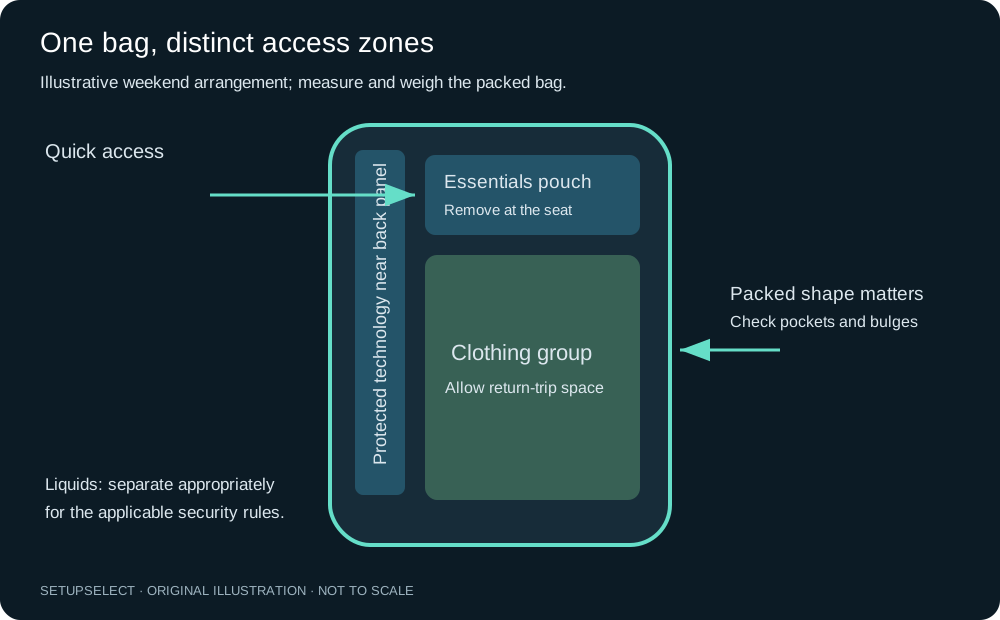
Buy a pouch only when it fixes access
An organiser earns its place when it groups items you use together or prevents one item damaging another. It does not earn its place merely by being labelled for travel.
Put charging equipment together if you normally retrieve it together; keep a boarding document separate if you need it while the main bag remains closed.
Avoid a pouch inside a pouch inside a compartment unless the extra layer has a clear function. Each zipper takes time and each rigid edge consumes space.
A single small seat pouch can work well, but a large electronics case for one cable and a plug adaptor can be disproportionate.
Test access with the bag upright, on your shoulder and on a narrow chair. Can you retrieve documents without exposing the entire contents? Can the toiletries pouch come out without removing clothing?
If a different packing order solves the issue, you may not need to buy anything. The one-bag layout guide explores these shape and access choices.
Reuse deliberately, rather than indiscriminately
Existing headphones, a familiar warm layer and a working phone lead are often better starting points than unfamiliar replacements. Test them before travel, including connectors, charging and any battery condition.
Reuse should save money without carrying a known failure into a journey where replacement will be inconvenient.
For toiletries, check whether accommodation provides what you would otherwise carry and whether that provision meets your needs. Decant only into suitable, identifiable containers that meet the applicable rules.
Do not relabel or mix medicines into anonymous cosmetic bottles to save space. Keep medical requirements separate from ordinary accessory optimisation.
Borrowing a bag can make sense if you can inspect its condition and pack it before departure. Borrowing unfamiliar charging hardware without checking ratings is less useful.
A successful reuse plan includes the time to verify fit and operation; it is not simply a pile of items discovered the night before leaving.
Avoid false economies at checkout
Compare the complete cost, including delivery, minimum-order thresholds and parts missing from the package. A low-priced cable pouch may be poor value if buying it triggers several other purchases to obtain delivery.
A multipack of bottles is not a saving when only one is needed and the rest occupy storage at home.
Keep a simple purchase worksheet: problem, proposed item, total cost, packed mass and evidence of compatibility. Add a final column for the item it replaces. If the answer is “nothing” for every purchase, the kit is growing rather than becoming more efficient.
That may be justified, but should be a conscious choice.
Check returns and any hygiene restrictions before selecting items that depend heavily on personal fit, such as earplugs or pillows. Trial equipment in the way the retailer permits, and retain packaging and model information.
This guide's allocations cannot establish whether a particular retailer's terms will suit you.
Keep batteries out of an impulse bundle
A power bank can be useful, but it should be selected from the device and journey requirements, not because it appears in an inexpensive accessories bundle. Its marking, condition, energy rating and your airline's carriage and onboard-use rules matter.
Consult current CAA baggage safety advice and the operating airline before travel.
If your cabin bag is taken for hold carriage, identify items that must remain with you and tell staff as needed. Make those items easy to remove.
The travel battery checker can help organise rating information, but the airline's current restrictions and approval requirements control what you may carry.
Do not assume an airport socket or aircraft USB port will be available, compatible or functioning. Equally, do not purchase a heavy backup for a trip where your existing equipment comfortably meets the need.
The useful middle ground is a tested plan with a specific contingency for the device you actually depend on.
Rehearse the whole travel sequence
Pack the bag as it will leave home. Retrieve documents, remove the relevant security items, put them back, sit with the bag near your feet and carry it for a realistic walk. Include stairs if your route involves them.
Check whether handles, clips or a pillow attached outside the bag alter the permitted dimensions or catch on surroundings.
Then rehearse the return trip. Put clothing into a laundry group, add the empty pouches and repack without carefully recreating every fold. If the bag closes only after a prolonged compression routine, remove an optional item or revise the layout.
The best £50 improvement may be a simpler system with £20 still unspent.
After travelling, note which accessory was used, which solved a problem and which was merely carried. Keep a small list for the next trip. Repeated actual use is stronger purchasing evidence than the number of features printed on a product page.
Budget travel questions
Does £50 include a new carry-on bag? Not in these allocations. If you need one, treat the bag as the first requirement and rebuild the accessory budget around its verified price and allowance compatibility.
Borrowing or reusing a suitable bag may preserve the budget.
Should I spend the reserve before departure? Only on a confirmed missing requirement. A reserve is useful even when it stays in your account. Filling the budget with optional extras can increase packed weight without improving the journey.
Are compression cubes essential? No. They may organise or compress suitable clothing, but add their own weight and cannot increase the airline's weight allowance.
Compare the bag with and without them using the same clothes and an ordinary repacking routine.
Is a universal adaptor better value than a destination adaptor? It depends on the destinations, appliance requirements and supported plug systems. One suitable destination adaptor can be simpler for a single-country trip.
Wider claimed coverage is useful only when the exact electrical and physical compatibility is established.
What should I remove first if the bag is too full? Start with duplicated organisers and optional accessories whose role overlaps with something already packed. Preserve documents, necessary medication and the equipment required for the trip.
Reconsider bulky footwear and clothing choices using the checklist, rather than forcing the zip closed.
Continue researching