Buying guide
International travel charging: plugs, input ratings and adaptors
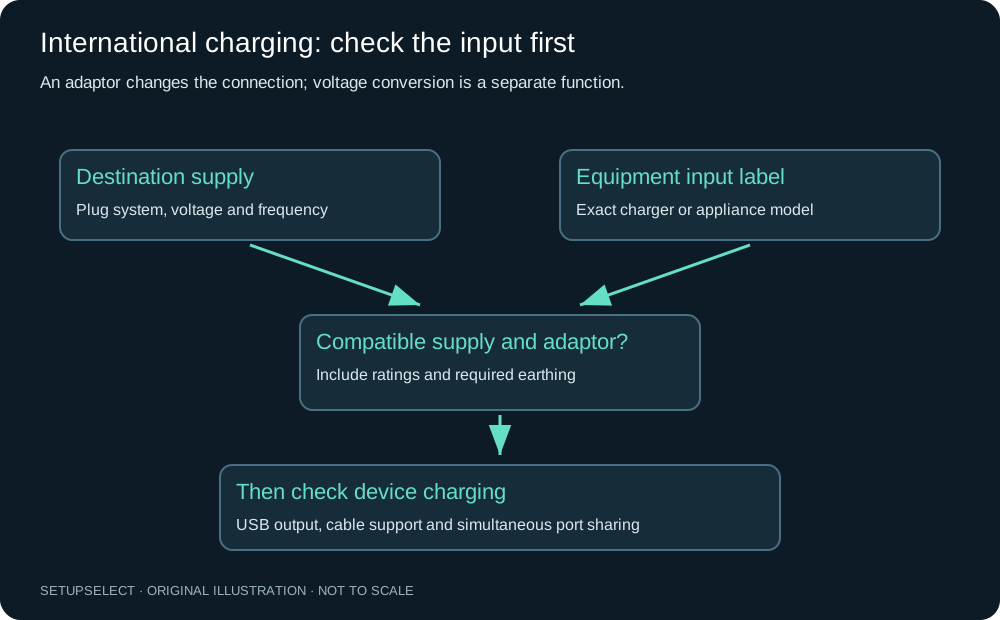
An international charging kit has to solve three separate compatibility questions: whether the plug fits, whether the equipment accepts the local electrical supply, and whether the charger can power the device. Start with the first two.
A plug adaptor that fits the hotel socket does not automatically make an appliance suitable for that country's voltage or frequency.
This guide is about destination compatibility, input labels, earthing and a practical packing check.
The separate carry-on tech guide covers charger wattage, simultaneous port sharing and USB cable capability in greater depth.
The examples below are label-reading exercises, not approval of an unidentified appliance or adaptor.
Make an appliance inventory before choosing an adaptor
List every item that connects to mains electricity directly: phone charger, laptop power supply, camera charger, electric toothbrush base and any personal-care appliance.
A phone itself may accept power from USB, but its wall charger is the component whose mains input must match the destination. Keep those two labels separate in your notes.
Record the exact model, input voltage range, frequency, power or current marking, plug arrangement and whether the equipment requires an earth connection. Photograph the label clearly enough to read later.
If the label is missing or unreadable, find the exact manufacturer's manual or ask the manufacturer; do not infer compatibility from a similar-looking version.
Then identify what can be omitted. Accommodation may provide a suitable hairdryer, and one verified charger may serve several devices. Removing a mains appliance eliminates its plug, rating and packing questions entirely.
However, do not replace necessary medical or accessibility equipment with an assumption about what a hotel supplies.
Read the input line, not the large output number
A hypothetical charger marked “Input: 100–240V AC, 50/60Hz” describes the supply it is designed to accept. A separate output line might list several low-voltage USB modes.
Those output modes tell you about charging devices; they do not change the destination socket's supply or establish the suitability of another appliance plugged into an adaptor beside it.
By contrast, a hypothetical appliance marked “220–240V, 50Hz” has a narrower stated input range. Do not assume it will work correctly on a supply outside that range.
A switchable appliance also requires its exact instructions: a selector is not permission to guess a setting while the equipment is connected.
For a documented example, Apple states that its USB power adapters accept 100–240V AC at 50–60Hz.
That statement supports those identified Apple products; it should not be extended to every charger, counterfeit item or unrelated personal-care appliance. Verify the specific equipment you are packing.
Understand what a travel adaptor changes
A basic travel adaptor changes the physical connection between one plug system and another.
It does not inherently transform mains voltage or frequency. Electrical Safety First's travel guidance makes this distinction central to using appliances abroad.
Similar-looking products labelled adaptor, converter or universal can have materially different functions.
An adaptor with built-in USB charging contains electronics for its USB outputs, but that does not necessarily mean its mains socket converts voltage. Read the instructions for each output.
The USB side may have a stated wide input range while the pass-through mains socket still supplies the local voltage to whatever is plugged into it.
Avoid solving an incompatible appliance by assembling a chain of plug adaptors. Multiple joints add mechanical and compatibility problems without establishing voltage conversion.
Choose a clearly supported arrangement for the actual appliance, or leave the appliance at home and use suitable equipment at the destination.
Use country information as a starting point
Check the destination's plug systems, nominal voltage and frequency using a reliable country-specific reference, then confirm any unusual accommodation or transport arrangements. A country may use more than one plug type.
An old building, airport lounge or vessel can introduce practical differences, so do not assume one photograph represents every socket you will encounter.
For example, Electrical Safety First's France guide identifies types C and E and a 230V, 50Hz supply.
A UK traveller still needs to establish the correct adaptor connection and equipment requirements even though the nominal voltage is familiar. Matching voltage does not make UK plug pins physically fit the destination socket.
Keep a destination table for multi-country journeys. Include overnight stops where charging is necessary, not just the final destination. If all the devices can last through an airport transfer, you may not need an additional adaptor purely for that transit.
Decide from the actual itinerary and device plan rather than buying a large set automatically.
A compatibility worksheet
| Item | Evidence to record | Decision before packing |
|---|---|---|
| Laptop power supply | Exact input label and manufacturer instructions | Supply range accepted; destination plug solution suitable |
| Phone charger | Input range plus supported output for phone | Can share the planned charger or needs its own |
| Camera charger | Model, input and battery compatibility | Correct charger and enough charging opportunities |
| Toothbrush base | Base input marking | Suitable abroad or can be charged before departure |
| Personal-care appliance | Voltage, frequency and load requirements | Use only with an explicitly suitable supply arrangement |
| Travel adaptor | Supported plug systems, ratings and earthing | Suitable for the exact connected equipment |
Fill the worksheet using manufacturer evidence, not assumptions from a retailer's broad description. A photograph of “worldwide use” packaging is insufficient if the required country or appliance type is excluded in the small print.
Keep the evidence accessible offline, especially if you depend on the equipment for work or an essential daily need.
Use the travel power planner to organise the device side of the kit once the input questions are resolved.
A planning result cannot certify damaged, unmarked or unsupported hardware; it is a way to make missing information visible before departure.
Earthing cannot be inferred from pin count alone
Some appliances require a protective earth connection, while others have a different approved construction. Identify the equipment's requirements from its marking and instructions.
The adaptor must preserve the required connection and be intended for the source plug and destination socket system. A socket that physically accepts a plug does not by itself establish correct earthing.
Electrical Safety First's country guidance distinguishes earthed equipment from equipment suitable for adaptors without an earth connection. If you cannot establish the requirement, obtain competent advice or use a supported alternative.
Do not remove earth pins, modify plugs or force a connection to make the travel kit smaller.
A universal adaptor's many sliding pins can make its operation less obvious. Read which configurations are supported and how unused pins are retained. Inspect the mechanism before travel and stop using damaged or loose equipment.
Convenience does not override the product's electrical and mechanical limits.
Check load limits without turning travel into an electrical project
Read the adaptor's rating and the restrictions on appliance types. A compact adaptor intended for charging electronics may be unsuitable for a high-power heating appliance.
Do not assume that a hairdryer is acceptable merely because a phone charger worked in the same adaptor. The two loads can be very different.
Where several outputs are provided, check the permitted total and any separate limits. The number of sockets is not an allowance to use every connected appliance at its maximum load.
Follow the exact product instructions, and avoid adding extension leads or further adaptors unless the manufacturers explicitly support the complete arrangement.
If voltage conversion genuinely appears necessary, obtain a suitable product and advice for the exact appliance, including power, frequency and operating requirements. A converter may introduce considerable size, weight and restrictions.
For ordinary short trips, using an appropriate local appliance can be simpler than carrying an uncertain conversion system.
Dedicated adaptor or universal adaptor
A destination-specific adaptor can be compact and straightforward when the itinerary uses one known plug system. It still needs suitable ratings, construction and support for the equipment's earthing requirements.
Small size is a practical benefit only after compatibility is established.
A universal adaptor may suit repeated travel across supported destinations, but check the actual coverage list. “Universal” is not a guarantee of every socket type in every country.
Consider the body size, sliding mechanism, weight when a charger is attached and whether it will fit a recessed socket without obstruction.
An approved interchangeable plug head for a compatible manufacturer's charger is another option. Use only the specified genuine or otherwise explicitly compatible components and follow their fitting instructions.
Do not treat removable-looking parts from different chargers as interchangeable because their shape appears similar.
Think about the hotel socket as a physical location
An adaptor and charger can form a long, heavy assembly. Check that it sits securely and does not obstruct an adjacent switch or outlet.
A loose, damaged, scorched or otherwise suspect socket should be reported to the accommodation; do not prop equipment into a failing connection or hold it at an angle to keep charging.
A suitable charger with an approved detachable lead may offer more placement flexibility than a large wall block, but it also adds a lead to the packing list. Compare the full arrangement.
Keep equipment supported, ventilated and away from water, bedding and places where a cable can be trapped or pulled.
Do not leave charging hardware buried under a pillow or inside a closed travel pouch. Follow the equipment's ventilation and operating instructions.
The neatest hotel-room photograph is not a useful target if it hides the parts you need to inspect or disconnect.
A worked two-device trip
Imagine a traveller taking a phone and laptop to France. Both identified chargers have verified 100–240V, 50/60Hz inputs, and the chosen destination adaptor is explicitly suitable for their plugs and electrical requirements.
The traveller can now compare whether one compatible multi-port charger will meet both devices' charging needs.
That second stage requires output and cable checks, described in the carry-on tech kit guide. The first stage has not proved that any two-port charger will power the laptop adequately.
Equally, a charger with ample USB output still needs an appropriate mains connection in the destination.
The traveller packs one verified adaptor, the selected charger and the required cables, retaining an appropriate fallback for the essential device. A photograph of the labels and a note of the normal port arrangement make troubleshooting easier.
The goal is a small, understood kit, not the fewest possible parts at any cost.
Test what you can before leaving
Connect the devices to the intended charger and cables using the appropriate home supply arrangement. Confirm charging during normal use and check that the cables reach comfortably. Inspect each lead and connector for damage.
This validates the device side of the kit, though it does not recreate an unknown foreign socket or certify the destination adaptor.
Read the adaptor's operation instructions and identify the destination configuration before departure. Keep protective covers or cases supplied for travel. Pack mains components so pins cannot damage other belongings, and keep liquids separate.
Do not carry damaged equipment as a backup merely because it sometimes works.
Record which component can be substituted if something fails. An essential phone cable may justify a compact spare; a second heavy charger may not.
The under-£50 travel guide helps allocate spending with compatibility taking priority over decorative organisers.
Plan for the journey's battery rules separately
A power bank solves a temporary lack of charging access, not destination mains compatibility. It also has its own carriage and onboard-use restrictions.
Check current CAA baggage safety guidance and the operating airline's rules for the exact battery before travel.
Keep required labels readable and make batteries accessible if a cabin bag must be placed in the hold. The travel battery checker can organise energy-rating information, but cannot override an airline's limits or approval process.
Do not rely on the physical smallness of a battery as evidence that it is permitted.
International charging questions
My adaptor has USB ports: does its mains socket convert voltage? Not necessarily. Read the specifications for the mains pass-through and USB outputs separately.
Built-in USB electronics do not establish that an appliance plugged into the mains socket receives a converted supply.
Can I take a UK extension lead to charge everything? Do not assume that is an appropriate arrangement. Check the complete system's instructions, ratings, earthing and destination suitability.
A verified charger with the necessary outputs may provide a simpler solution without additional mains connections.
Is 100–240V on the phone label enough? Inspect the actual mains charger you will use. The phone's charging interface and the charger's mains input are different parts of the system. Confirm the charger model, input range and suitable output for the phone.
What should I do if the adaptor feels loose? Stop using the connection and ask the accommodation for a suitable functioning outlet or assistance. Do not force pins, wedge the adaptor or leave it hanging at an angle.
Mechanical fit is part of a usable charging arrangement.
Do I need a new kit for every country? Often you can reuse verified wide-input charging equipment with the appropriate supported plug solution. Recheck each destination and appliance rather than rebuilding automatically.
Keep an inventory so the next trip begins with evidence you already have.
Continue researching