Documents and money
- Passport or accepted travel ID
- Tickets and booking references
- Accommodation address and contact details
- Payment method plus an independent backup
- Insurance and emergency details where relevant
Short-trip checklist
Build a list around the journey, activities and facilities you have confirmed. Quantities are editable planning prompts; weather, transport and personal requirements still need a live check.
Generated checklist
Research and worked examples · Reviewed 29 September 2026
By Benjamin Dickman. Illustrative scenarios, not hands-on product testing.
A useful weekend packing list starts with the days you will be away, what you will do and what your accommodation actually supplies. The generator above turns those decisions into a checklist.
Use it as a first draft, then remove unnecessary items and add your personal requirements before putting anything into the bag.
The method below explains how to turn the generated list into a realistic two- or three-night plan. It does not determine whether an item is permitted on a flight or whether a bag meets a particular fare's allowance.
Those checks remain separate and need current information from the organisations operating your trip.
A Friday-to-Sunday trip normally involves two nights but parts of three days. That does not necessarily mean packing three complete outfits: the clothes worn while travelling already cover one of those periods, and suitable layers can be reused.
It does mean thinking through the return day instead of packing only for the nights in a hotel.
The generator uses nights plus one as a planning day count. Treat the resulting quantities as prompts, not rules. Personal routines, weather, activities and access to washing facilities can change what is appropriate.
If the list offers more items than you need, remove them deliberately rather than following it mechanically.
Write the departure and return times beside the list. An early departure followed by an evening event creates different needs from arriving late and going straight to bed.
Similarly, returning after a full outdoor day may require somewhere to put damp or dirty clothing that the outbound packing plan did not account for.
Collect the booking information for every transport leg and the accommodation. Note what is included in the fare, how much luggage is permitted, the relevant dimensions and any weight limit.
Do not assume two airlines, or two fare types on the same airline, provide identical allowances.
For UK airport departures, GOV.UK hand-luggage guidance directs passengers to airline bag limits and current airport restrictions.
Liquids arrangements can vary by airport, including on the return or connecting journey. Check the actual route before choosing toiletry containers or deciding what must be accessible for screening.
Ask the accommodation about towels, toiletries, a hairdryer, laundry and any other facility you are relying on. A photograph of a bathroom or a general description such as “fully equipped” is not confirmation of a particular item.
Record uncertain facilities as questions rather than buying duplicates automatically.
This is also the moment to decide whether a laptop is genuinely necessary. A work obligation may justify it; an unexamined habit may not.
The weight and charging requirements of one device can reshape the entire list more than swapping one small packing accessory for another.
Start with a single plausible day from waking up to going to sleep. What will you wear, carry, charge and use for personal care?
Add the essential documents, payment arrangements and personal medication requirements separately so that they are not lost among optional clothing choices.
Then walk through the next day and identify what can be reused. A layer that suits both travel and dinner may cover two purposes. One pair of suitable shoes may be enough for a city break, while a specific event or outdoor activity may require a second pair.
The itinerary, not a universal minimalism rule, decides.
Add replacements according to your own needs and the trip conditions. Do not count on washing and drying clothes unless access and time are confirmed.
A sink and a few hours before checkout do not necessarily provide a reliable laundry plan, particularly for bulky items.
Finally, separate what you will wear while travelling from what must fit inside the bag.
This prevents double counting, but it also exposes an important return-journey question: if the weather changes, can a layer worn outbound fit in the bag when you no longer want to wear it?
Consider a fictional Friday-to-Sunday city break by train, with walking during the day and a casual dinner. The traveller has confirmed towels and basic toiletries at the accommodation and does not need a laptop.
The forecast remains a live check; this example assumes mixed conditions only to demonstrate the method.
The traveller wears one versatile outfit and comfortable shoes on Friday. In the bag, they put the additional tops, underwear, socks and sleepwear they personally need, plus a layer suitable for cooler or wetter conditions.
They choose bottoms that work with the planned tops instead of assembling an unrelated outfit for every activity.
| Part of the trip | Planning question | Result for this example |
|---|---|---|
| Friday travel | What is already being worn? | One outfit and the main shoes are outside the packed count |
| Saturday walking | Is the clothing suitable for the actual itinerary? | A change of top and necessary weather layer are considered |
| Saturday dinner | Is there a confirmed dress requirement? | No separate formal outfit is added without a reason |
| Sunday return | What happens to worn clothing? | A separate bag or compartment is reserved |
| Accommodation | Which supplies are confirmed? | Duplicates of confirmed non-essential items are removed |
The example is not a prescription for exact clothing quantities. Its value is showing how each item earns a place.
If dinner becomes a formal event or the forecast changes substantially, revise the list rather than trying to force the original bag contents to suit a different trip.
Now imagine a Thursday-to-Sunday trip that includes a Saturday event. The traveller selects three nights in the generator and enables the formal-event option.
That adds a planning prompt, but the actual outfit, footwear and garment-care requirements still need a decision.
Start with the event's confirmed dress expectations. Work out whether the event shoes can also serve another part of the trip and whether the outfit needs protection during transport.
If a garment will require pressing, confirm the available facilities rather than assuming they exist at the destination.
Lay out the event items as a separate group before choosing the rest of the clothing. This reveals the true space commitment.
Then make the casual items work together, instead of adding several alternative outfits around a fixed event outfit that already occupies much of the bag.
The traveller should also plan the morning after the event and the return journey. Shoes, worn garments and any fragile accessories must still fit when packed less neatly than at home.
Leave room for that realistic repacking condition, not just the tightly arranged outbound version.
If the resulting bag exceeds the transport allowance, change the list, the permitted luggage purchase or the transport plan before departure. Overfilling a soft bag does not make its actual dimensions irrelevant at boarding.
An outdoor activity can require footwear, weather protection or specialist equipment, but the right items depend on the activity provider and conditions.
A casual park walk and an organised mountain activity should not produce the same kit merely because both happen outdoors.
For swimming, confirm whether towels or other equipment are supplied and plan how wet items will be carried afterwards. A sealed container can protect other belongings during transport, but damp items still need appropriate drying and care.
Do not use the outbound fit as the only packing test.
For laundry, verify the process, opening times, cost and drying arrangements. On a short trip, washing may consume time you would rather spend elsewhere.
Select the laundry option because it supports a real plan, not because it makes the initial clothing count appear smaller.
If an activity has safety or admission requirements, obtain them from the organiser. The generator is deliberately a general packing aid; it does not certify that you have the equipment, clothing or preparation needed for a specialist activity.
Keep travel identification, tickets, accommodation details and payment arrangements in a distinct section.
Check the destination and carrier requirements for the actual traveller rather than assuming a domestic journey and an international journey need the same documents.
For medication and medical equipment, follow advice from your healthcare professional and the relevant authorities, carrier and destination.
The list should remind you to verify quantities, supporting documents and transport/storage requirements; it should not encourage changing medication use to save luggage space.
Have a plan for accessing essential booking details if your phone is unavailable. That might involve appropriate offline copies or another method suited to the information.
Avoid sharing sensitive personal details in a public checklist or a screenshot posted online.
Before packing optional comforts, confirm these essentials independently. An omitted spare top may be inconvenient; missing required documents or personal necessities can disrupt the entire trip.
Separating the checks reduces the chance that a long accessory list distracts from something important.
List each device and the charging connection it needs. A phone-only weekend and a laptop work trip require different decisions. Do not pack every charger you own because all the cables look potentially useful.
Match cables and chargers to the device requirements, and check destination plug compatibility where relevant.
The carry-on tech-kit guide addresses charging power and shared ports, while the international charging guide covers the destination-side checks.
If flying with batteries or power banks, consult current official and carrier rules for every leg. A packing-list checkbox is not permission to carry a particular battery or to place it in a particular bag.
Make any required access or removal arrangements before reaching the airport.
Give each cable a reason to be there: charging a named device, making a required connection or providing a justified backup.
This creates a smaller, more understandable kit than an unlabelled pouch of duplicates and makes it easier to notice something missing at checkout.
Use the actual bag, clothes and equipment for a rehearsal. Measure the packed bag at its fullest points, including handles, wheels and bulging pockets where the carrier's method requires them.
Weigh the complete contents rather than adding approximate item weights from memory.
Open the bag and retrieve the items you will need during the journey. If obtaining a ticket, personal essential or screening item requires emptying everything, change the access arrangement.
The one-bag weekend guide focuses on choosing a bag and organising that physical space.
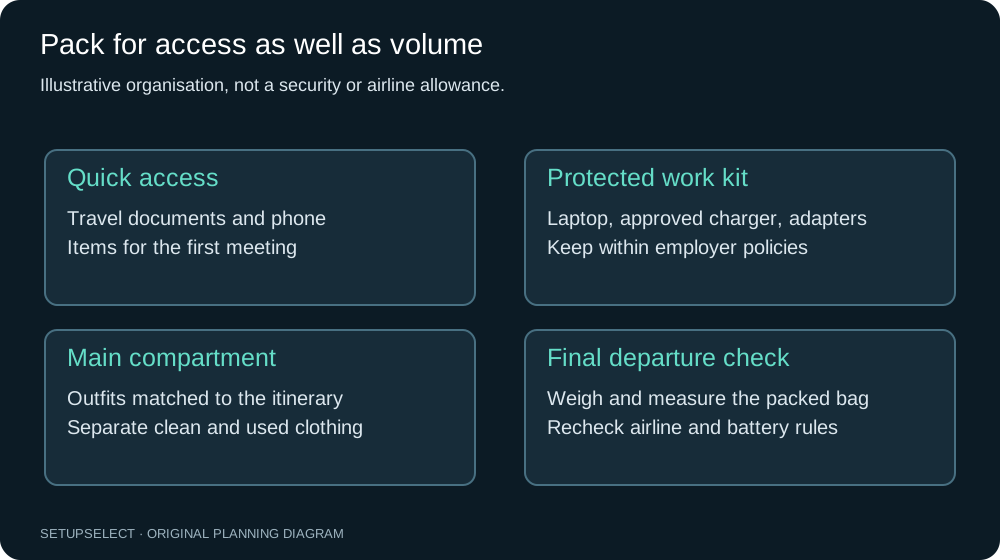
Reserve room for worn clothing and anything you are reasonably likely to bring back. This is not a recommendation to buy a larger bag automatically. It is a reason to remove an unnecessary outbound item or make a more realistic return plan before the trip.
Generate the list after entering the confirmed trip details, then print it if a paper checklist helps. Mark deliberate omissions as well as packed items so that you do not repeatedly reconsider the same decision.
Add personal requirements that a general tool cannot infer.
Run a final check shortly before departure for the forecast, transport rules and any itinerary changes. Revisit the most change-sensitive parts rather than treating a list created weeks earlier as permanently complete.
Keep the operating carrier and airport information close to the checklist for a flight.
After returning, note what you did not use and what you missed. Distinguish optional items that genuinely earned their place as contingencies from duplicates packed without a reason.
Those observations produce a better next list than copying a much longer generic list from another traveller.
Should I pack one outfit per day? Not necessarily. Start with the itinerary, personal needs and what you can appropriately reuse. The generator's quantities are a starting point, not an instruction to duplicate every garment.
Can a two-night list work for three nights? Often the same categories still apply, but quantities, events and laundry assumptions need reconsideration. Change the trip length and review the result instead of adding one arbitrary extra outfit.
Do I need packing cubes? Only if they improve organisation in your actual bag. Test with containers you already own before buying accessories. Cubes do not increase an airline's allowance or guarantee a lighter bag.
What should stay accessible? The items needed during the actual journey and any items that must be presented or removed under current rules. Decide from your route and personal requirements, not a fixed pocket arrangement copied from a photograph.
Return to the generator above when the trip changes. The best weekend list is a short, deliberate record of your own journey: essential needs covered, activity requirements confirmed, duplicates removed and the complete packed bag checked before leaving.