Buying guide
Bedroom dehumidifiers: placement, sound and sleep routines
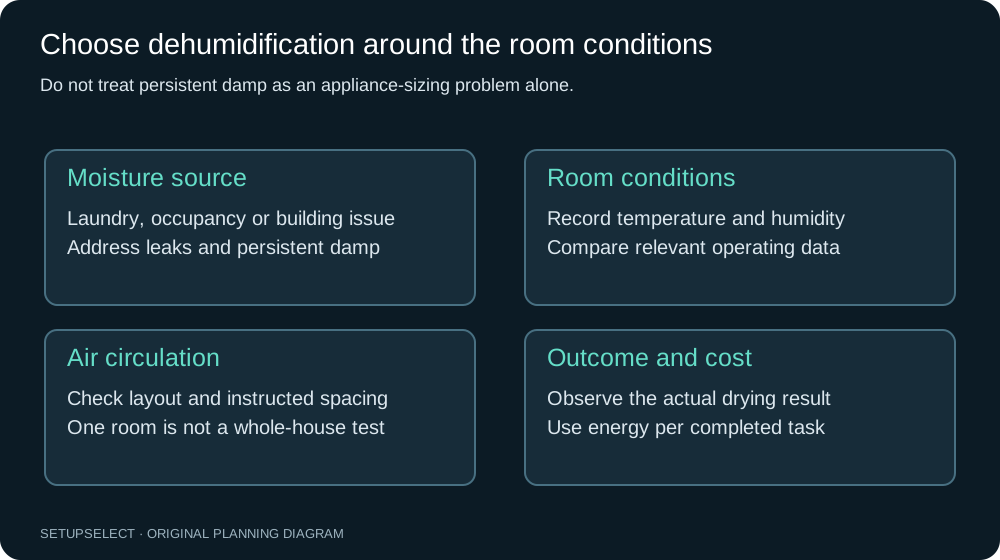
A bedroom dehumidifier should fit a safe position, control the observed moisture problem and work with your sleep routine. Start with the room's temperature, condensation pattern and door arrangements, then compare the noise and controls of suitable machines.
The largest extraction label is not automatically the most useful bedroom choice, particularly if its operating position or sound makes you avoid using it.
A dehumidifier can reduce airborne moisture; it is not a treatment for a health condition or a repair for a leaking window, roof or pipe. Keep the bedroom's ventilation working and investigate persistent damp.
The examples here are planning exercises, not tested homes or promises about sleep, mould removal or a particular collection rate.
Identify the bedroom's actual moisture pattern
Write down where moisture appears and when. Condensation confined to glazing on cold mornings presents a different investigation from a stained ceiling after rain.
Record whether the room has an en-suite, whether laundry dries there, and whether the door is closed overnight. Check behind furniture where accessible, but do not disturb suspect damaged materials merely to gather a more complete record.
The government's guidance on damp and mould in the home emphasises identifying and addressing underlying causes.
In rented accommodation, report persistent damp to the responsible housing provider. Buying an appliance should not be treated as evidence that the building problem has been resolved.
Use a thermometer and humidity meter to observe conditions at a consistent location and time. Avoid a position directly beside the dehumidifier outlet, on the cold glass or next to a radiator.
Record temperature alongside relative humidity: a change in room temperature can alter the relative-humidity reading without a matching change in the amount of water in the room air.
Describe the room as it is used overnight
Measure internal length, width and height. Note alcoves, a connected dressing area and any opening that normally remains unclosed. The bed size is not a useful substitute for those dimensions.
Include the normal occupancy and practical constraints without trying to assign a universal moisture allowance to each person.
Now record the night-time arrangement. A central landing machine may have access to the bedroom while the door is open during the day, yet little useful circulation when it is shut at night.
A unit moved between rooms cannot actively serve both closed rooms simultaneously. These are air-path limitations, not necessarily faults in the extraction capacity.
An en-suite should retain its appropriate extraction arrangements. Do not expect a machine beside the bed to substitute for removing shower moisture near its source.
Likewise, a wet laundry load turns a sleeping room into a drying room with a different short-term moisture burden. For that situation, use the clothes-drying workflow and decide whether it can finish before bedtime.
Choose a routine before choosing a night mode
There are three useful routines to evaluate. The first is daytime control followed by switching off for sleep. The second is a timed evening session and a morning check. The third is humidity-controlled operation throughout the night.
Which is practical depends on how quickly moisture returns, the room's temperature and how intrusive the appliance is for the people sleeping there.
An evening session may reduce the starting moisture level, but it cannot prevent new moisture arriving overnight. Check the next morning rather than assuming a comfortable bedtime reading proves the whole night was satisfactory.
Conversely, a machine need not run all night simply because it was bought for a bedroom; an effective quieter daytime routine may suit the observed problem.
Read what night mode actually changes. It may dim lights, reduce fan speed, silence button sounds or alter display behaviour. It may still permit compressor starts and stops.
Do not treat the word quiet, sleep or silent in a listing as a guarantee that the appliance will be inaudible at your pillow.
Interpret sound specifications with care
Compare sound figures only after identifying the mode and measurement basis. A low-speed figure should not be compared with another product's maximum-speed figure. Sound pressure and sound power are different quantities, even when both use decibel notation.
If the page does not state enough to make a fair comparison, ask for the supporting technical data.
As an example of setting-dependent specifications, Meaco lists Arete Two 12L sound figures of 35, 38 and 44dB(A) across its settings.
This is manufacturer information, not a measurement in a bedroom. It illustrates why the setting attached to a number matters more than selecting the smallest number in a shopping filter.
Noise character matters as well as the overall number. A steady fan can feel different from compressor cycling, cabinet vibration or a full-tank alert. Room surfaces, distance, furniture and floor construction affect what reaches the bed.
Avoid a universal promise that a particular dB figure will be comfortable for every sleeper.
When evaluating a machine at home under applicable return conditions, listen during a representative operating cycle, not just immediately after pressing the power button. Keep the intended fan setting, furniture arrangement and bed position.
Check that any vibration is not caused by the unit touching another object, while maintaining all manufacturer placement requirements.
Plan the position from the floor outward
Start by marking the walking route from the bed to the door and any route to an en-suite. Keep the appliance, cable and drain hose clear of those paths.
A position that seems harmless in daylight can become awkward when someone gets up in darkness carrying a glass or helping a child.
Next mark curtains at their full movement, the bedspread when it hangs down, wardrobe doors and drawers. Keep fabric away from inlets and outlets. Place the unit on the surface specified in its instructions, with its actual clearances.
Do not stand it on a bedside table or soft mat merely to bring controls within reach unless the manufacturer permits that arrangement.
Finally check service access: can the tank be withdrawn without tipping it against the bed, and can the filter be removed for cleaning? Can the plug be reached without moving heavy furniture?
Is the appliance protected from drinks, rain through an open window and splashes from an en-suite? These details decide whether the location remains practical after the first evening.
Two worked bedroom layouts
A 3.2 × 3.5m bedroom with one external window. In this illustrative plan, a double bed occupies the middle of one wall and a wardrobe stands opposite. The obvious space beneath the window conflicts with full-length curtains.
The owner instead tests a side-wall position near a suitable socket, checking the manufacturer's clearances and the tank-removal path before selecting a compact model.
The chosen routine begins with daytime humidity control and a bedtime stop, followed by morning observations. That is a trial of scheduling, not a claim that this room needs a specific litre class.
If moisture repeatedly returns during sleep, the owner has evidence to reassess the routine, ventilation and source, rather than buying a larger unit solely because condensation appeared once.
A 4.0 × 4.1m bedroom with an en-suite and laundry. The room is bigger, but the decisive difference is how it is used. Laundry occupies one corner in the afternoon; two people sleep there; shower extraction serves a separate wet area.
A permitted daytime laundry arrangement and a later ordinary humidity setting are treated as separate operating periods.
Here the shortlist emphasises tank capacity, accessible emptying and adequate performance at the recorded temperature. Noise is checked for ordinary bedroom mode, not judged from the high-airflow drying setting.
If the laundry cannot finish without blocking access at bedtime, the room plan needs revision even if a more powerful appliance could theoretically remove moisture faster.
Humidity targets and sensor differences
Follow the manufacturer's guidance for normal humidity control, then look at the room's response. Do not choose the lowest possible setting as a default.
A sensor in the machine and a separate meter elsewhere may disagree because they sample different positions, have different tolerances or respond at different speeds.
Place the separate meter consistently and allow readings to settle after moving it. Compare trends across similar conditions rather than adjusting the appliance every time the two displays differ by a few points.
Avoid concluding that either device is faulty from a single reading taken beside a cold window or within the dry outlet airflow.
The outcome to watch is wider than the display: recurring condensation, the pattern of operation, changes following showers or laundry, and whether a particular cold surface remains affected.
Persistent visible damp with apparently ordinary room readings can indicate a local surface or building issue that a central sensor does not describe adequately.
Tank use, drainage and night-time interruptions
Empty the tank before the intended operating period and reseat it as instructed. A full-tank shut-off can prevent collection continuing overnight, and some products signal that state with light or sound.
Check the behaviour in the manual rather than discovering it at two in the morning.
Do not choose continuous drainage purely to avoid one daily emptying task. A bedroom may have no suitable drain route, and a hose across a door or beside a bed introduces a practical obstruction.
Gravity drainage must follow the appliance instructions, with a reliable discharge point and inspection access. An en-suite sink at a higher level does not automatically provide a workable gravity route.
If emptying is difficult, compare the container's handling design and usable access, not just its litre capacity. A larger tank weighs more when full.
The 12L versus 20L comparison includes specific published tank and body dimensions to show how those choices change together.
Keep ventilation and moisture control compatible
The existing-home ventilation guide advises leaving trickle vents open and unblocked and maintaining extract and mechanical ventilation equipment.
Dehumidification is not a reason to tape over designed vents or disable the building's system. Moisture control and fresh-air provision are related but different jobs.
Where a household uses brief window ventilation, record that in the observation log because it changes conditions.
Do not assume outdoor relative humidity alone establishes whether ventilation will dry the room; temperature also affects how much water the air contains.
You do not need to calculate every exchange to recognise that a wide-open window changes the load presented to the appliance.
Keep routines understandable for everyone using the room. Agree when the appliance operates, who empties it, how laundry is handled and which ventilation features stay open.
A technically plausible setup that one person routinely switches off or blocks is unlikely to produce a useful repeatable outcome.
Review the first week before changing equipment
Use a brief record rather than memory. Note bedtime and morning temperature and humidity, appliance mode, whether it ran overnight, any tank stop and the observed condensation.
Add unusual events such as a wet load, a long shower or several hours with the window open.
| Observation | First thing to check |
|---|---|
| Condensation returns only after laundry | Drying schedule, rack arrangement and the extra moisture event |
| Unit stops before morning | Tank state, timer and documented control behaviour |
| Bedroom remains affected while landing dries | Closed-door circulation and appliance location |
| Noise appears intermittent | Compressor cycling, alerts and nearby vibrating objects |
| Damp patch follows rainfall | Building or window defect requiring investigation |
Use the dehumidifier finder with that clearer picture. For budgeting, the running-cost calculator accepts your appliance input and tariff.
A defined useful schedule gives a better estimate than assuming every bedroom machine operates at full power for twenty-four hours.
Can the appliance stay on the landing instead?
It may influence the bedroom when air can circulate between the spaces, but closed doors change that arrangement. Observe the bedroom itself rather than relying on the landing display.
If the room remains closed overnight, separate daytime and night-time expectations instead of assuming the same performance throughout.
Will night mode stop the compressor?
Not necessarily. The function varies by model and can concern lights, fan speed or controls. Read the exact description.
If complete silence is needed, evaluate a scheduled off period and its effect on morning conditions rather than assuming night mode means no mechanical operation.
Should I use the highest fan speed before bed?
Only if it suits the manufacturer's instructions and your task. Faster circulation may help during an active session, but it is not proof that the room has reached a useful endpoint.
Check the conditions and leave time to inspect and empty the tank rather than relying on a fixed last-minute burst.
Can a dehumidifier guarantee mould will not return?
No. Building defects, cold surfaces, ventilation and moisture sources can remain unresolved. The appliance may form part of moisture management, but recurring mould or damp requires investigation and appropriate remedial action.
Treat the condition of the bedroom, not just the meter display, as the reason to follow up.
Continue researching