Buying guide
What size dehumidifier do I need? UK room and laundry examples
For a heated room with mild condensation, a 10–12-litre-class dehumidifier can be a reasonable starting shortlist. A larger home, persistent moisture or regular indoor laundry may justify investigating a 20-litre class.
Those are starting categories, not a calculation that bedroom count alone can settle. Room temperature, moisture sources, air circulation and the exact product's published performance can change the answer substantially.
A dehumidifier also does not diagnose damp or repair leaks and building defects. Investigate the underlying cause of persistent moisture, preserve appropriate ventilation and seek qualified advice where needed.
The examples below are illustrative selection scenarios, not tested homes or guarantees of litres collected per day.
What the litre rating actually means
The litres-per-day figure describes extraction under specified test conditions. It is not the collection-tank size and it is not a promise that the appliance will collect that amount in your home every day.
Temperature and relative humidity are part of the rating, so compare models at matching conditions wherever the manufacturer provides them.
The tank is a separate container which may hold only a few litres. It can need emptying during use, or the appliance may support continuous drainage under stated conditions.
A 20L label therefore does not mean a 20-litre tank or an appliance that automatically removes 20 litres from an ordinary room every day.
For a concrete specification example, Meaco publishes condition-specific information for its Arete Two 12L and Arete Two 20L.
Use such tables to compare like with like; do not transfer one model's performance to every appliance in the same advertised class.
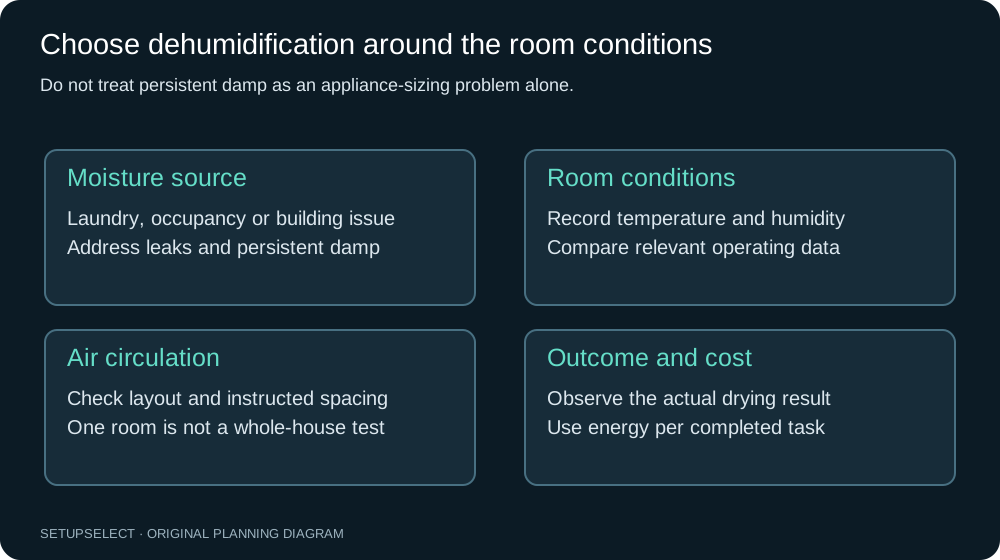
Measure the problem before selecting capacity
Record where condensation appears, when it happens and what activities precede it. Note indoor laundry, cooking, bathing and the number of occupants, alongside ventilation and heating patterns.
A room that becomes humid only during laundry presents a different task from moisture returning throughout an entire property.
Measure temperature and relative humidity with suitable equipment and note the location and time. A single reading beside a window or directly in the appliance's airflow may not describe the room.
Repeat observations and look for patterns rather than selecting a machine from one unusually high number.
Check for signs of leaks, water entry or other building problems.
The government damp-and-mould guidance emphasises addressing underlying causes.
Do not use an appliance purchase as a reason to postpone reporting or investigating a persistent defect.
One room versus a whole home
For a single room, measure its size and consider the specific moisture source, temperature and use. For a whole home, the appliance must also interact with air moving between rooms.
Door positions, corridors, separate floors and occupancy all affect how practical one central unit will be.
A machine in a hallway is not automatically controlling every closed bedroom. Equally, several appliances are not automatically necessary simply because the property has several rooms.
Observe where the problem occurs and compare the practical placement options before choosing a number or capacity.
If the main task is laundry, a suitable dedicated room may create a more manageable drying zone than distributing wet washing across the property. Follow ventilation and appliance instructions, and keep circulation clear.
Do not assume closing every vent improves the overall moisture problem.
Scenario one: a heated bedroom with occasional condensation
Imagine a normally heated bedroom with some morning window condensation and no identified leak.
A smaller compressor class may be worth investigating, but the selection should also consider noise at the setting that will actually be used, humidistat behaviour, placement and tank handling.
Check the room temperature against the exact operating range and compare published performance under relevant conditions. A small appliance that must run inconveniently long or is too noisy to use may not be a practical match.
Conversely, a larger unit may consume unnecessary floor space if the moisture task is modest.
Record whether reducing avoidable moisture and using the existing ventilation appropriately changes the pattern. A dehumidifier can be part of management, but the room and building context still matter.
See the bedroom guide for the additional placement and noise questions.
Scenario two: a two-bedroom flat
Bedroom count is a useful description, not a complete sizing input. Two flats with the same number of bedrooms can differ in floor area, occupancy, heating, ventilation and laundry habits.
Start with the affected rooms and whether air can move to a practical appliance location.
A 12L-class unit may be a candidate for a warm flat with moderate moisture and suitable circulation. A 20L class may offer more extraction headroom where several rooms are affected or indoor laundry is frequent.
Compare the exact models' data, physical size and use pattern rather than assuming either class is always correct.
If doors stay closed, consider whether moving the unit is realistic and safe according to its instructions. Check weight, handles, drainage and the route between rooms.
A plan that depends on moving a heavy appliance several times a day may not be followed consistently.
Scenario three: a house with regular indoor laundry
Laundry adds a concentrated moisture task, so a larger extraction class can be worth investigating in a normally heated home. The important comparison is not simply tank size.
Look at relevant extraction data, airflow, controls and whether the machine can be placed with the required clearances around the drying area.
Separate the laundry task from general whole-home humidity control. A machine used beside washing for several hours may not simultaneously address a distant closed room.
Plan the sequence and observe the results rather than assuming one published floor-area figure describes every situation.
For costs, compare energy and time for the actual task. A higher-power model may run for a different duration, so hourly wattage alone does not establish cost per finished load.
The running-cost guide and heated-airer comparison explain that distinction.
Scenario four: a cold garage or outbuilding
Temperature becomes a primary filter in a cold space. Check the lowest normal temperature and the exact appliance's operating range and performance data.
Compressor and desiccant technologies behave differently as conditions change, but a blanket statement that every garage requires one technology is too simple.
Investigate rain entry, ground moisture, leaks and uncontrolled outside-air exchange. An appliance may struggle to manage a space continually receiving moisture from an unresolved source.
Do not choose a larger capacity as a substitute for understanding the building problem.
Check drainage arrangements, electrical suitability, maintenance and whether the environment is within the product's intended use.
Read the compressor-versus-desiccant guide and garage guide before comparing headline litre ratings.
| Situation | Useful starting investigation | Why capacity alone is insufficient |
|---|---|---|
| Heated single room | Smaller compressor class and practical controls | Noise, temperature and source still matter |
| Flat with several affected rooms | Compare circulation and 12L/20L-class options | Doors, occupancy and laundry vary |
| Regular indoor laundry | Relevant extraction data and a dedicated task plan | Runtime and airflow affect the result |
| Cold garage | Technology and operating range first | Low temperature and moisture ingress dominate |
Bigger is not automatically more economical
A larger machine can have more extraction capability under comparable conditions, but may also cost more, take more floor space and produce different noise. Its controls and duty cycle determine how it behaves after reaching the target.
Do not compare only the maximum input wattage as if every appliance runs continuously at that level.
The opposite mistake is buying a very small device because its hourly power draw is low. Low input power does not prove it can complete the moisture task.
Small thermoelectric units should not be assumed equivalent to domestic compressor or desiccant machines for significant condensation or laundry needs.
Compare performance under matching conditions and calculate scenarios using explicit assumptions. If the necessary data is unavailable, say so. An honest range is more useful than a precise cost or collection prediction built from incompatible ratings.
Placement and air movement
Follow the manufacturer's required clearances and placement instructions. Keep intake and outlet paths unobstructed, avoid unsuitable surfaces and ensure the appliance cannot be knocked or exposed to conditions outside its intended use.
Do not place wet clothing where it can drip onto electrical equipment.
Choose a location that serves the actual task and permits tank access or approved drainage. An appliance hidden behind furniture may be awkward to empty and have poor circulation.
A central position may help connected rooms, but it does not remove the limitations created by closed doors and separate floors.
For general ventilation context, consult the existing-home ventilation guide.
A dehumidifier is not a universal replacement for the building's ventilation arrangements.
Tank, drainage and everyday use
Check how the tank is removed, carried and emptied. A larger tank can reduce interruptions but may be heavier when full. Verify automatic shut-off and any drainage options in the instructions.
Continuous drainage may require a particular hose route or arrangement; do not assume any hose can be led uphill or into any convenient outlet.
Think about the person who will use and maintain the appliance. Controls, display visibility, filter access and moving weight can be as important as a modest difference in extraction rating.
A machine that is awkward to operate may remain unused even if its specification looks suitable.
Follow cleaning and maintenance instructions and keep records of unusual behaviour. Reduced performance can have several causes, including changing room conditions, so do not diagnose a fault from a single low tank reading.
Consult the manufacturer where the behaviour is unexpected.
A practical observation period
After selecting a suitable appliance, record the room temperature, humidity trend, operating mode and usage period. Keep the measurement location consistent and note laundry or other moisture-producing activities.
This makes the observations more useful than comparing tank volume on unrelated days.
Look for whether the intended problem is improving, not whether the tank fills as quickly as the headline rating suggests.
Less collected water can reflect different conditions or successful humidity control, while persistent moisture may indicate an unresolved source or unsuitable circulation.
If damp or mould persists, do not endlessly increase runtime without reviewing the cause. Report relevant housing issues and seek appropriate advice. This article is a buying guide, not a diagnosis or a substitute for building and health guidance.
Your sizing checklist
- Identify the moisture source and investigate persistent defects.
- Record representative temperature and humidity patterns.
- Separate single-room, laundry and whole-home tasks.
- Compare extraction and power at matching published conditions.
- Check operating range, noise, placement, tank and drainage practicality.
- Use measured results to reassess rather than expecting a fixed daily collection.
Compare two rooms before assuming whole-home coverage
Imagine a heated living room and a cooler spare room connected by a hallway. A machine working in the living room does not establish that the spare room has the same temperature, humidity or air circulation.
Record the conditions in each room separately, together with the times doors are normally open or closed.
The comparison may show that the problem is local to one room or follows a particular activity. That information is more useful than simply adding up floor areas and choosing the next capacity label.
It may also show that a building or ventilation issue needs attention independently of the appliance choice.
If you trial a portable machine in different permitted locations, follow its moving, settling and operating instructions. Keep the conditions and duration in the notes; a warm dry afternoon should not be compared casually with a cold morning after laundry.
Use these observations to refine the shortlist, not to promise coverage. A suitable room appliance can still be unsuitable for a whole-home expectation, particularly when normal household doors, activities and temperature differences are restored.
Questions and next step
Is a 20L machine too big for a bedroom? Not necessarily, but size, noise, controls and the actual task determine whether it is a sensible choice. Does a 12L label mean a 12-litre tank? No; extraction rating and tank capacity are separate specifications. Can one appliance serve a whole house? Sometimes, but circulation, layout and moisture sources decide how well the plan works.
Use the dehumidifier finder to organise room, temperature, moisture and laundry inputs, then read the 12L versus 20L comparison.
Manufacturer data and official building guidance should resolve the remaining questions. The scenarios here are original planning examples, not guarantees of performance in your property.
Continue researching