Buying guide
Garage dehumidifiers: temperature, enclosure and drainage
A garage is suitable for domestic dehumidification only when the appliance is allowed to operate in its actual conditions, the main moisture sources are understood, and the space is enclosed enough for treating its air to be useful.
Record temperature first, inspect for water entry, then plan a dependable collection or drainage routine. A bigger litre label cannot compensate for a leaking roof, freezing drain or continually open vehicle door.
This guide deals with garage suitability and operation. For the underlying machinery choice, use compressor versus desiccant dehumidifiers.
The examples below are hypothetical inspection and planning cases, not surveys of real garages or guarantees about preserving vehicles, tools or stored materials.
Start with the building after wet weather
Walk the garage when it is safe to do so after rain and note where water appears. Check visible roof and gutter problems, door thresholds, wall junctions, plumbing and water carried in on vehicles. Photograph recurring areas and their timing.
A patch that grows after rainfall deserves a building investigation before an appliance selection exercise.
Distinguish liquid water entering the space from moisture condensing on cold surfaces. Both can occur together. A wet car may add moisture after arrival, while a roof defect keeps introducing water even when the garage is unused.
The collection tank cannot identify which source it has removed, and a lower humidity reading does not prove a leak has stopped.
The government's damp-and-mould guidance places importance on addressing underlying causes.
Although a garage has different uses from a bedroom, the same practical limitation applies: an appliance does not repair the fabric of the building. Obtain appropriate building advice where the source remains unclear or water threatens electrical equipment.
Record temperatures when you are not there
A comfortable afternoon visit does not describe the lowest temperature during a winter night. Use a suitable minimum-and-maximum thermometer or logger, positioned away from direct sun, the appliance outlet and immediate door draughts.
Record representative periods, and recognise that a mild week does not establish the worst conditions the garage can experience.
Record relative humidity alongside temperature, but avoid treating outdoor and indoor relative-humidity percentages as directly interchangeable water-content readings. Note door openings, rain, vehicle arrivals and heating use.
These events often explain abrupt changes more clearly than a daily average.
The key purchase boundary is the manufacturer's permitted environment. Check the temperature range and any restrictions concerning domestic use, dust, water exposure, ventilation or combustible materials.
An appliance within its temperature range may still be unsuitable for the work carried out nearby. If a limit is unclear, obtain a model-specific answer rather than interpreting a garage marketing category as blanket approval.
Allowed operation is not the headline extraction rate
Manufacturers may publish both an operating range and extraction at particular temperature and humidity combinations. Use each for its proper purpose.
The range determines whether the conditions are allowed; the extraction table helps judge whether performance at a realistic point is useful.
For example, Meaco's Arete Two 20L data lists a 5–35°C range and 3.35 litres per day at 10°C and 60% relative humidity, compared with 8.50 litres at 20°C and the same relative humidity.
Those are published test points, not a prediction for a particular garage. They show why a minimum-temperature claim and a 20L badge answer different questions.
Do not interpolate a reliable freezing-weather result from a warm test figure. If the logged conditions fall below the allowed minimum, choose a different permitted setup or reconsider whether dehumidification is appropriate.
The technology comparison explains the design trade-offs without assuming every cold outbuilding requires the same product.
Decide what part of the garage is actually enclosed
Look at the main door, side door, windows and intentional ventilation. A machine in a garage that is open for much of the day can continuously receive replacement outside air.
Its tank may fill without establishing the conditions you wanted around stored items. That can be evidence of a large ongoing load rather than impressive control of the space.
Repairing weather entry and damaged seals is different from blocking safety or designed ventilation. Preserve ventilation required by the building, combustion appliances and stored substances.
Do not tape over a vent simply because the machine seems to run less afterwards. If you cannot distinguish a draught gap from required ventilation, ask the relevant professional before altering it.
Consider usage too. A garage serving as a workshop with a frequently opened door and extraction for work processes presents a different control problem from a closed store visited twice a week. Plan around the real schedule.
It may be more realistic to protect specific items with their appropriate storage arrangements than to attempt a fixed whole-garage condition during every activity.
Make the contents part of the specification
List what you want to protect and look for its own storage requirements. Paper records, upholstered items, timber, bicycles, electrical equipment and valuable vehicles do not necessarily share one preferred humidity setting.
Avoid selecting a single universal target because it appears on a dehumidifier display.
Separate active moisture sources from stored possessions where practical. Allow inspection access and air movement around shelving, without compromising stability. Keep items clear of the appliance intake and outlet.
Do not aim warm dry discharge directly at sensitive finishes or materials if their care guidance advises against it.
If the goal concerns a valuable collection or vehicle, seek specialist storage or conservation advice.
A domestic humidistat cannot guarantee corrosion prevention in every hidden cavity, and the room reading does not describe the temperature of every metal surface. Existing damage also needs appropriate treatment; running a dehumidifier will not reverse it.
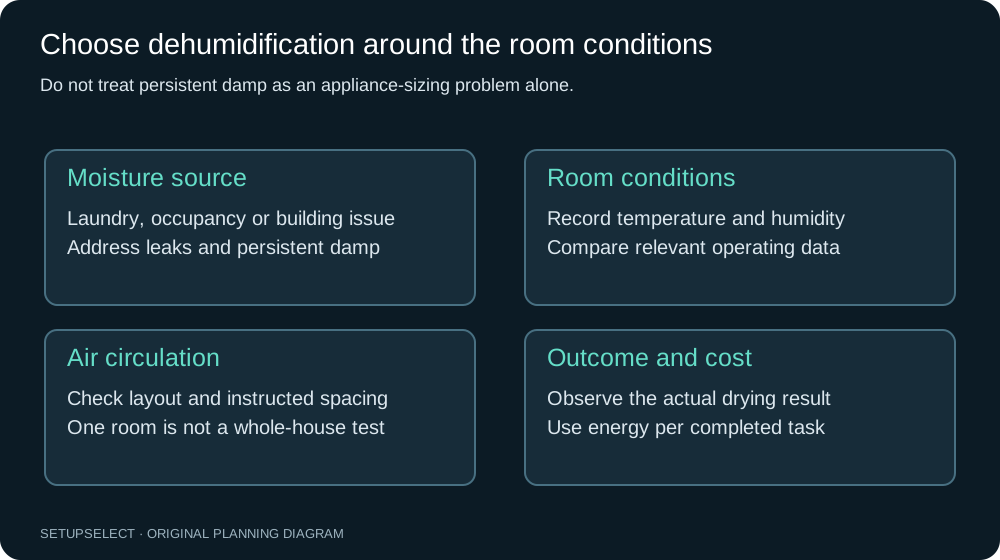
Plan tank emptying honestly
A tank-operated unit needs someone to inspect it and empty it before collection stops. Estimate how often you can actually visit, including weekends away.
Do not assume a large tank provides a fixed number of unattended days: collection varies with conditions and moisture events.
Check the shut-off and warning behaviour in the manual, and confirm that the tank seats correctly after emptying. A full-tank shut-off limits overflow risk, but it also ends useful extraction.
Remote control or a humidity display does not make a full container empty itself.
Keep the route to the disposal point practical. A water-filled container can be heavy, particularly when carried over a garage threshold or past a parked car. Compare handles, lids and pouring arrangements.
If physical handling is a concern, consider whether a permitted drain route is truly available before choosing a larger appliance with a larger container.
Trace a drainage hose all the way to its destination
Continuous drainage is a system, not merely a hose attached to a rear outlet. Identify the manufacturer's specified connection and allowed routing.
For gravity drainage, establish the necessary fall and avoid kinks, trapped sections or a discharge arrangement that can back up. Secure the route without damaging the hose or creating a trip hazard.
Inspect the destination as carefully as the connection. An open bucket simply replaces one container with another and may lack the appliance tank's shut-off protection.
A drain must be suitable, accessible for inspection and protected from foreseeable blockage. Keep the end positioned as the instructions require.
Freezing is a separate issue. A hose outside the building can freeze even while the appliance is in an allowed indoor temperature range. Do not infer drain reliability from the unit's minimum temperature.
If the route cannot be made dependable within the manufacturer's requirements, use a supervised tank routine or obtain a properly designed alternative rather than improvising heating or pumping accessories.
Before leaving a new arrangement in ordinary use, observe actual drainage while present. Check connections and the floor, and verify that the hose has not moved as nearby doors or stored items are used.
Recheck after vehicle parking, cleaning or workshop changes that could disturb it.
Protect the operating space from garage activities
Choose a position that cannot readily be struck by a vehicle, bicycle or moving tool. Mark the space the car occupies with doors open, not just its parked tyre position. Preserve access to exits, electrical isolation and the appliance's filter and tank.
Dust-producing work, sprays, solvents, fuels and other materials can create conditions outside a domestic appliance's permitted use. Follow the exact safety instructions and keep the machine out of incompatible activities and environments.
Do not assume a dust filter makes it suitable as workshop extraction or that an ordinary domestic product is approved for flammable atmospheres.
Use the electrical connection specified by the manufacturer and have a competent person assess unsuitable or damaged garage wiring. Keep the unit and connection away from liquid water.
Remote scheduling should not override a physical inspection after a leak, impact or other event that could have changed the safety of the installation.
Three garage cases with different outcomes
| Illustrative garage | Decisive evidence | Appropriate next step |
|---|---|---|
| Attached store, enclosed and consistently within product limits | Temperature log and manageable door openings | Compare realistic extraction, tank access and energy |
| Detached garage with overnight frost and an outside hose | Minimum temperature and freezing exposure | Reject unsupported operation and redesign the arrangement |
| Workshop with frequent open-door work and airborne dust | Use pattern and appliance restrictions | Resolve suitability before attempting a capacity choice |
In the first case, the owner measures a 3 × 5.5m footprint and records when a wet bicycle is stored.
That does not produce a universal litre requirement, but it provides a defined space and moisture pattern for the dehumidifier finder. A candidate is then checked against its own conditions and installation requirements.
In the second, a warm afternoon reading would have hidden the main failure. Neither a larger tank nor a stronger compressor makes operation below the manufacturer's minimum acceptable.
The owner pauses that product shortlist and considers a permitted cold-space solution and a reliable collection route.
In the third, the first question is whether and when the appliance can safely operate at all. Treating the workshop as an ordinary spare room would ignore both air exchange and the nature of the work.
A suitable plan may involve separate operating periods, different storage or specialist equipment, depending on the activity and its instructions.
Judge success from conditions, not tank volume
Keep a simple weekly record: temperature range, humidity at a consistent position, door-open events, water entry, tank stops and any visible condensation on relevant surfaces.
If an energy monitor is suitable for the appliance and connection, record kWh over the same period.
Compare periods cautiously. A wetter week with a car arriving every evening is not equivalent to a dry week when the garage stays closed.
A machine collecting less water may be maintaining a drier space, operating in colder conditions, or spending hours stopped with a full tank. Interpret collection alongside the other observations.
Use the running-cost calculator for an initial budget, then review actual energy where possible. Avoid claiming a fixed cost per day from a nominal input multiplied by an assumed duty cycle.
The useful question is whether the permitted arrangement maintains worthwhile conditions at an acceptable observed cost.
Should I seal every gap around the garage door?
No. Identify weather defects and distinguish them from intentional or required ventilation. Repairing water entry may help, but altering ventilation can have consequences for the building and its contents or appliances.
If the purpose of an opening is uncertain, establish it before blocking it.
Is an automatic restart enough for unattended use?
It only describes one control behaviour after power returns. The appliance must still permit the intended operation, the tank or drainage must remain dependable, and the environment must stay within limits.
A restart feature cannot detect every blocked hose, displaced object or new leak in the garage.
Can I run the hose through the door to the drive?
Only if the complete arrangement is permitted, has a suitable destination and stays protected from crushing, blockage and freezing. A door threshold commonly introduces several of those problems.
Do not assume that water leaving the appliance connection proves the entire route will remain reliable in winter.
Why does condensation remain on one metal object?
Local surface temperature, exposure and retained moisture can differ from the air around the machine's sensor. Check the object and its storage requirements rather than repeatedly lowering the whole-room set point.
Valuable or sensitive items may need specialist assessment and storage measures beyond a domestic dehumidifier.
When should I stop increasing capacity?
When the main constraint is uncontrolled water entry, unsuitable temperature, open-air operation or an incompatible environment. Those are not simply extraction deficits.
Resolve them first, then compare 12L and 20L compressor specifications only if both classes are appropriate to the permitted operating conditions.
Continue researching