Buying guide
Dehumidifier running costs: hourly, daily and laundry examples
To estimate dehumidifier electricity cost, divide input watts by 1,000, multiply by operating hours, then multiply by your electricity unit rate. For example, an assumed 200W running continuously for six hours uses 1.2kWh.
At an illustrative £0.25/kWh, that costs 30p. Use your own tariff and a realistic power/runtime estimate rather than treating this example as a current national rate.
That arithmetic is straightforward; choosing honest inputs is the difficult part. A compressor may cycle, a fan may continue running and the moisture task can change from day to day.
This guide explains the assumptions so a precise-looking result does not imply more certainty than the evidence supports.
Use electrical input, not extraction capacity
The litre-per-day rating describes extraction under stated conditions, not electrical consumption. A 12L or 20L label cannot be converted directly into watts.
Use the input power listed for the exact model and operating mode, together with any relevant test conditions.
Also distinguish normal operating input from a maximum rating or a separate air-purifier mode. A product may provide several figures which answer different questions.
Record the source and condition for the number you use rather than choosing the smallest wattage from a specification table.
As one current manufacturer example, the Meaco Arete Two 20L page lists 207W at 20°C and 60% relative humidity.
That is a condition-specific figure for that model, not a prediction that it draws exactly 207W every minute in every home.
The basic formula, step by step
First convert watts to kilowatts. An assumed 250W equals 0.25kW. Next multiply by time: five hours gives 1.25kWh. Finally multiply by price: at an example £0.25/kWh, 1.25kWh costs £0.3125, which rounds to about 31p.
Keep units visible throughout. Multiplying watts directly by a price per kilowatt-hour makes the result a thousand times too large unless the conversion is included. Similarly, a tariff written as 25p must be entered as £0.25 in a calculator expecting pounds.
The standing charge is not included in the appliance estimate because it applies independently of whether this one device runs.
If comparing time-of-use tariffs, split the energy across the relevant periods rather than using one rate for a task that crosses different prices.
Hourly cost examples
The following inputs are hypothetical wattages used to demonstrate the formula. They do not represent a tested product range or a statement that every appliance in a capacity class has the same input. All prices use the illustrative £0.25/kWh rate.
| Assumed continuous input | Energy in one hour | Calculated hourly cost |
|---|---|---|
| 150W | 0.15kWh | 3.75p |
| 200W | 0.20kWh | 5p |
| 300W | 0.30kWh | 7.5p |
| 600W | 0.60kWh | 15p |
Hourly cost alone does not tell you which appliance is cheaper for the required task. A suitable higher-input unit might finish a defined task in less time, while a lower-input unit might run longer or fail to achieve it under the room conditions.
Compare relevant performance and total task energy.
Daily, weekly and monthly examples
At an assumed 200W for six hours per day, the daily energy is 1.2kWh and the example daily cost is 30p. At seven days per week, that becomes £2.10 per week. For an average month using 52 weeks divided by 12, the modelled cost is £9.10.
That monthly convention is an average, not a claim that every calendar month has the same number of days. If you need a specific bill-period estimate, multiply by the actual days and usage pattern instead.
A seasonal appliance may also run very differently across the year, so annualising one damp week's use can exaggerate typical spending.
Keep the schedule explicit. “Six hours per day, seven days per week” is interpretable; “about £9 a month” without assumptions is not. The running-cost calculator keeps those inputs separate so they can be changed.
Continuous operation versus cycling
An appliance with a humidistat may not draw its full dehumidifying power continuously after reaching the target. The compressor or heater can change state while a fan or sensor continues.
The exact control behaviour depends on the model, mode and conditions, so a universal duty-cycle percentage would be misleading.
For a simplified hypothetical cycle, suppose a device spends three hours at 200W and three hours at 30W. Its energy is 0.6 + 0.09 = 0.69kWh, costing about 17p at the example tariff.
That is not a measurement of a named product; it shows how separate operating states can be added.
Do not assume the same cycle every day. Laundry, weather, heating, occupancy and ventilation can change the moisture task.
If accurate cost matters, suitable measured energy over representative use is more informative than multiplying the maximum input by every hour the appliance is switched on.
Measuring energy sensibly
Use only monitoring equipment suitable for the appliance and follow its ratings and instructions. A plug-in energy monitor can report accumulated kilowatt-hours over a period, which avoids guessing the exact duty cycle.
Do not improvise mains measurements or use damaged, unsuitable or overloaded adapters.
Record the period, appliance mode, room conditions and activities such as laundry. Compare similar tasks where possible. One day's energy measurement may be accurate for that day while still being a poor forecast for another season or room.
If the monitor shows average power, distinguish it from accumulated energy and instantaneous input. A momentary low reading during a pause does not establish low task cost. Use the total kWh for the complete period and multiply by the applicable tariff.
Laundry cost per load
For laundry, define the load and a consistent stopping point. The same appliance can use different energy for light shirts and heavy towels, even when both are described as one load.
Washing-machine spin, garment spacing, room temperature and any additional heat also affect the task.
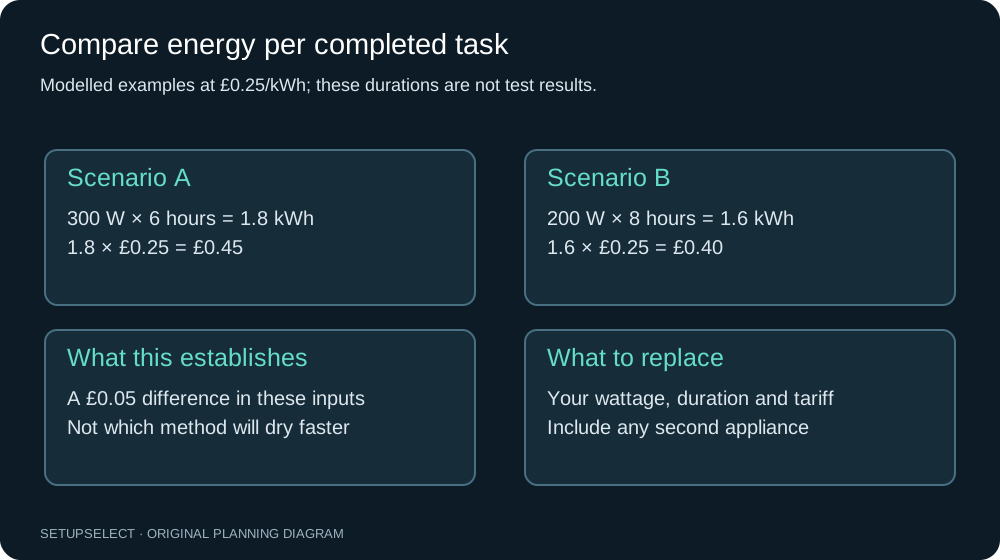
Imagine an assumed average 200W for eight hours: that is 1.6kWh and 40p at the example tariff. If the task takes ten hours, it becomes 2kWh and 50p. Those are modelled scenarios, not drying-time predictions.
Replace duration and input with measured values or clearly sourced assumptions.
If a heated airer is used as well, add its energy rather than attributing the complete result to the dehumidifier alone.
The dehumidifier-versus-heated-airer guide explains why a fair comparison needs the same load and outcome.
Temperature and humidity affect interpretation
Published extraction and input figures belong to stated conditions. A cooler or less humid room can produce a different result from the headline rating.
Do not divide a rated litre-per-day figure by a wattage from another test condition and present the result as measured efficiency in your home.
Compare like-for-like manufacturer data where available, and keep missing fields visible. A model that suits a heated living space may not be the practical choice for a cold garage.
Read the compressor-versus-desiccant guide before treating all technologies as interchangeable.
The capacity guide also explains why room size alone cannot determine the task. A cost estimate is only useful if the appliance can realistically address the intended conditions.
Tariff sensitivity
For a fixed energy use of 1.2kWh, the cost is 24p at £0.20/kWh, 30p at £0.25/kWh and 36p at £0.30/kWh. These are example prices chosen to show the relationship, not current regulated rates or a recommendation to change tariff.
If the unit rate changes, the energy requirement does not automatically change with it. Keep energy and price separate so the calculation can be updated without rewriting the operating assumptions.
A cost claim should state both the kWh and the price used where practical.
For variable time-of-use prices, consider the actual schedule and any constraints on safe appliance use. Do not run equipment unattended or in unsuitable conditions solely to capture a lower rate.
Follow the manufacturer's instructions and the household's practical requirements.
Ways to improve the task, not just the number
Investigate moisture sources and building issues rather than relying on ever-longer runtime. Preserve appropriate ventilation and follow the appliance's placement and maintenance instructions.
A blocked intake or an inaccessible tank can undermine practical use, but maintenance requirements are model-specific.
For laundry, use an appropriate washing-machine spin and garment arrangement consistent with the clothing and equipment instructions.
Keep the drying task organised and avoid making unsupported claims that one simple change always cuts energy by a fixed percentage.
Choose controls and capacity that suit the actual use. A machine that is too awkward or noisy to run as intended may be a poor practical choice regardless of its calculated hourly cost.
Do not optimise a spreadsheet while ignoring whether the setup will be used consistently.
Costs the formula does not include
The simple calculation covers electricity consumed by the appliance under the stated assumptions. It excludes purchase price, replacement filters or other maintenance, repairs and any additional room heating.
Include those separately if comparing ownership costs over time.
Do not allocate the household's entire standing charge to one appliance, but do not hide genuine additional costs either. If a proposed setup needs another device, adapter or professional work, state that scope clearly.
A cheap hourly estimate is not a complete buying decision.
Resale value, lifespan and future tariffs are uncertain. If modelling them, use transparent scenarios rather than a precise payback date presented as a promise. This guide is appliance arithmetic, not personal financial advice.
A record you can reuse
| Input or observation | Your value | Evidence |
|---|---|---|
| Exact appliance and mode | ______ | Manual or model label |
| Input power or measured energy | ______ | Condition-specific source or suitable monitor |
| Hours and days used | ______ | Actual schedule |
| Electricity unit rate | ______ | Applicable tariff |
| Room/task conditions | ______ | Temperature, humidity and activity notes |
| Additional devices or heat | ______ | Included separately or explicitly excluded |
Update the record when the mode, room or tariff changes. Do not silently reuse a previous estimate for a different task. A dated set of assumptions makes a modest estimate more useful than a more precise number whose origin is unclear.
Build a sensitivity check rather than one precise forecast
Start with a transparent base case: a hypothetical 200W input, six hours of use and an example tariff of £0.25 per kWh. That gives 1.2kWh and £0.30 for the day. Now change only the duration to ten hours. Energy becomes 2kWh and the cost £0.50.
The extra four hours matter more than a few decimal places in the original answer.
Next, keep the six-hour duration but try an example tariff of £0.30. The same 1.2kWh costs £0.36. Finally, test both changes together: ten hours at £0.30 gives £0.60. These are input scenarios, not estimates of how long a real machine must run in your home.
This small exercise makes the uncertainty visible. If you do not know the real operating duration, an answer shown to the nearest penny can still be a weak forecast.
Improve the evidence about usage before debating tiny differences between two advertised power figures.
For a variable tariff, separate the energy used in each price period. If a task uses 0.8kWh at £0.20 and 0.4kWh at £0.35, the calculated total is £0.16 plus £0.14, or £0.30.
Entering a single rate is only equivalent if it represents the energy-weighted average for that task; a simple average of the two prices would not necessarily do so.
Do not change a safe operating routine solely to chase a modelled saving. Follow the appliance instructions and relevant household safety guidance, and keep any scheduling assumption explicit.
The calculator answers what the supplied energy inputs cost, not whether a particular unattended schedule is suitable.
Questions and sources
Does a 20L dehumidifier always cost more than a 12L model? Not for every task.
Input, duration, controls and relevant performance all matter. Can I multiply maximum watts by 24 hours? It produces a continuous-input scenario, not necessarily expected daily use. Label it accordingly.
Why is my collected water different from the rating? Ratings use stated conditions and do not promise a fixed daily tank volume at home. Does the calculator include the standing charge? No; it estimates appliance energy cost from the inputs provided.
Use the calculator with your own tariff and evidence, and the drying comparison mode for two task scenarios.
For broader moisture management, consult the government ventilation guide.
All worked costs here are transparent calculations, not personally measured appliance tests or guaranteed household savings.
Continue researching