Buying guide
Compressor vs desiccant dehumidifiers for heated and cold rooms
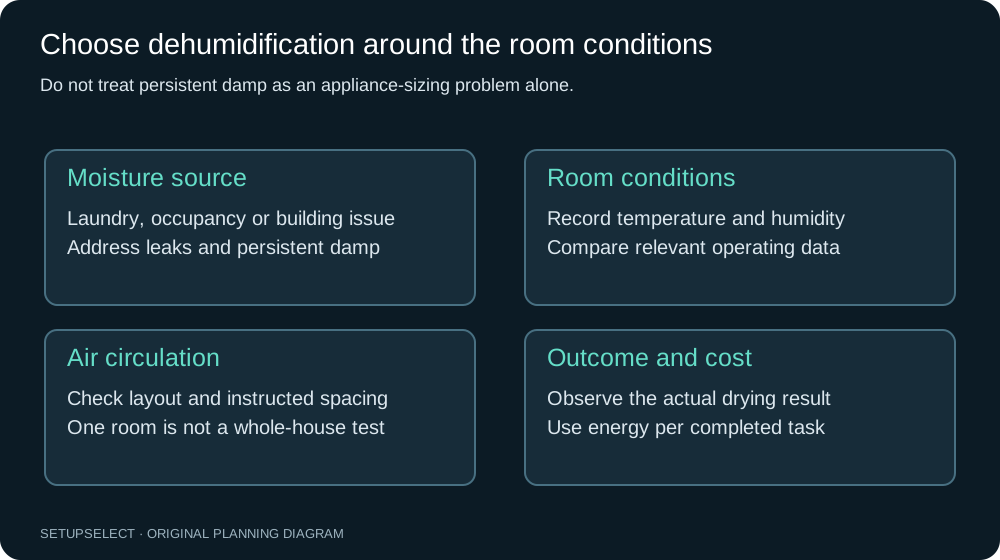
Choose between compressor and desiccant dehumidifiers by the conditions in which the appliance will run, not by a brand preference or a litre rating alone. A normally heated room often makes a compressor model a useful starting shortlist.
A consistently cold space deserves closer investigation of low-temperature performance, where a suitable desiccant model may be practical. The exact operating range and published data decide the comparison.
Neither technology fixes a leak, penetrating damp or an unsuitable building arrangement. Investigate the moisture source and preserve appropriate ventilation.
This article explains a selection method with illustrative room scenarios; it does not claim personal testing or guarantee performance in a particular property.
The practical difference in operation
A compressor dehumidifier uses refrigeration to condense moisture from air under suitable conditions. A desiccant appliance uses a moisture-absorbing material which is regenerated as part of its operating cycle.
These different processes lead to different performance and input-power characteristics as temperature and humidity change.
That broad distinction does not make one technology universally superior. Products vary in controls, airflow, operating range, noise and maintenance.
Compare exact models at conditions relevant to the task rather than assigning every compressor or every desiccant appliance the same behaviour.
Manufacturer explanations such as Meaco's technology comparison provide useful context, but remain manufacturer guidance rather than independent testing of every product.
Keep any numerical claim attached to its specific model and test conditions.
Record the lowest normal room temperature
Measure the space during the periods when the appliance would actually operate. A garage briefly warmed during a visit can be much colder for the rest of the day. A bedroom described as heated may still cool substantially overnight.
Use representative observations rather than one convenient daytime reading.
Record temperature alongside humidity and the moisture-producing activity. A high relative-humidity reading in a cold space cannot be interpreted in exactly the same way as the same reading in a warm room.
Do not select capacity from a single percentage without considering temperature and the task.
Check the exact operating range before comparing costs or tank size. An appliance outside its intended conditions is not a sensible choice merely because its headline input power is low.
If the specification is unclear, ask the manufacturer rather than assuming the technology label supplies the missing limit.
Compare extraction at matching conditions
The headline litres-per-day rating is measured under stated conditions. Two products may use different conditions, and performance can change substantially in cooler or drier air.
Seek a table showing extraction and electrical input at the same temperature and relative humidity for both candidates.
Do not compare one model's warm, humid extraction figure with another model's lower-temperature input figure. That produces a numerical ratio which looks precise but is not like-for-like.
If matching data is unavailable, retain that limitation instead of filling the gap with an invented conversion.
The dehumidifier sizing guide explains the difference between extraction rating and tank capacity. A larger tank can improve convenience but says little by itself about performance in your room.
Scenario one: a normally heated living space
Imagine a living room or hallway that is normally heated and affected by everyday moisture rather than an identified leak. A suitable compressor model may be worth shortlisting because relevant performance data is often available for domestic room conditions.
Compare the exact model's controls, noise and extraction at those conditions.
Check whether the intended location serves the affected area. A central appliance cannot automatically influence closed rooms or another floor effectively.
Consider door positions, circulation and the practical task before assuming a larger litre class solves the whole property.
A desiccant model is not automatically wrong in a heated room, but its input, heat contribution and control behaviour should be evaluated against the need.
Do not pay for a capability which is unnecessary while ignoring everyday issues such as tank access or acceptable operating noise.
Scenario two: a cool garage
For a garage, first investigate rain entry, ground moisture, leaks and uncontrolled outside-air exchange. An appliance can be an inefficient response to an unresolved source.
The garage guide helps separate the building problem from the appliance selection.
Record the lowest normal temperature and verify the operating range of each candidate. A desiccant model may be worth investigating where cool conditions undermine the practical performance of a particular compressor model.
However, do not assume all compressors have the same low-temperature behaviour or that every garage needs a desiccant machine.
Check drainage, electrical suitability and maintenance access for the environment. The appliance must be intended for the conditions, not merely capable of being placed there.
If the garage experiences temperatures or moisture exposure outside the instructions, choose an appropriate alternative with professional advice where necessary.
Scenario three: intermittent heating and indoor laundry
A room used for laundry may be heated for part of the day and cooler at other times. Compare the actual drying schedule, not an average temperature that hides those changes.
A machine's performance during the coldest part of the task can affect total time and cost.
Consider whether the appliance also serves general moisture control between loads. The best practical choice may depend on controls, noise and moving weight as much as maximum extraction.
If it must be moved repeatedly, assess the handling route and the manufacturer's instructions.
Do not translate a litre-per-day rating directly into a laundry drying time. Garment mix, residual water, airflow and room conditions all matter.
Use the drying-method comparison to distinguish modelled costs from actual observed drying performance.
Input power versus energy per task
Hourly cost comes from electrical input multiplied by the tariff, but total task cost also depends on duration and changing operating states.
A lower wattage does not prove a lower cost to achieve a comparable result, particularly if the appliance is poorly matched to the conditions.
For a hypothetical comparison, 200W averaged over eight hours uses 1.6kWh, while 500W averaged over three hours uses 1.5kWh. At an example £0.25/kWh, those are 40p and 37.5p respectively.
These are arithmetic scenarios, not measured compressor or desiccant drying times.
The example shows why duration matters; it does not establish a technology winner. Use relevant performance evidence or suitable measured energy and a consistent endpoint.
The running-cost calculator lets you keep power, schedule and tariff explicit.
Heat added to the room
The appliances can affect the room's thermal conditions, but their heat contribution should not be treated as free energy or a substitute for a heating design.
If additional warmth is welcome, that can be a practical consideration; if the room is already warm, it may be less desirable.
Do not claim a heating saving without a defined comparison. The result depends on the existing heating system, controls, schedule and room conditions. A simple appliance-cost calculation does not establish whole-home energy savings.
Keep the selection focused on the moisture task and acceptable room conditions. If the proposed appliance makes the space uncomfortable or difficult to use, revisit the location or technology rather than relying on an abstract efficiency ratio.
Noise and overnight use
Compare noise data for the operating modes you intend to use. A minimum figure may relate to a low setting or a different function from the one needed for the moisture task.
Manufacturer measurement methods and distances can also differ, so isolated decibel figures are not always directly comparable.
The character of the sound matters as well as its level. Fans, compressors, controls and water movement can be noticed differently by different people.
Where possible, use a sensible trial and understand returns rather than treating a small numerical difference as a guarantee of comfort.
Follow the instructions for unattended or overnight use, placement and maintenance. Do not put an appliance inside furniture or cover it to reduce sound. A quieter-looking installation which obstructs airflow or access is not an appropriate solution.
Capacity, tank and drainage
Once the technology suits the conditions, compare capacity using relevant extraction data. Keep room size, occupancy, moisture sources and circulation in the decision.
A single square-metre coverage claim may not reflect a property with closed rooms or regular indoor laundry.
Tank size affects how often emptying is required and how heavy the container becomes. Check removal and carrying in the actual location. A large capacity class with an awkward tank may be less practical than expected, especially where access is constrained.
Continuous drainage must follow the exact instructions, including hose route and any required fall or equipment. Do not assume all products can drain to an elevated outlet or that an improvised hose arrangement is suitable.
Resolve that before relying on unattended operation.
Controls and maintenance
Compare humidistat behaviour, timers, restart settings and filter access against the intended routine. A feature list does not explain every interaction, so read the manual where control behaviour matters.
For example, distinguish an appliance that stops a dehumidifying component from one that stops all fan activity.
Follow cleaning and maintenance requirements. Dirty or obstructed components can affect practical operation, but procedures vary by product. Do not use a cleaning method from another model without checking compatibility.
Keep access for inspection and emptying. A machine placed in the best theoretical circulation point can become impractical if it is difficult to maintain there. Selection should include the daily routine, not just the initial output calculation.
A comparison table to complete
| Field | Compressor candidate | Desiccant candidate |
|---|---|---|
| Exact model and source date | ______ | ______ |
| Supported temperature range | ______ | ______ |
| Extraction at relevant shared conditions | ______ | ______ |
| Input at those same conditions | ______ | ______ |
| Intended mode and control behaviour | ______ | ______ |
| Noise information and measurement basis | ______ | ______ |
| Tank and approved drainage arrangement | ______ | ______ |
| Physical size, weight and placement clearance | ______ | ______ |
Do not average conflicting specifications or borrow a value from another revision. Ask for clarification or mark the field unknown. A comparison with visible uncertainty is more useful than a complete-looking table based on mismatched evidence.
Test the result in the intended conditions
Record temperature, humidity trend, operating mode and usage period in the real location. Keep measurement placement consistent and note activities which add moisture.
Observe whether the intended problem improves rather than judging success only by how quickly the tank fills.
A low collection volume can reflect different conditions or successful control, while persistent high moisture can have several causes. Do not diagnose a fault or declare the technology unsuitable from a single day's tank reading.
Use the manual and manufacturer support where behaviour is unexpected.
If damp or mould persists, review the underlying cause and seek appropriate advice.
The government damp-and-mould guidance is relevant context.
An appliance is not a reason to delay reporting a building issue.
Read performance tables as pairs of conditions
A helpful comparison sheet gives each extraction figure its temperature and humidity conditions. Keep the corresponding input-power figure beside it when the manufacturer supplies one.
Separating those numbers can accidentally create a fictional specification made from the strongest extraction figure and the lowest power figure in different rows.
If one shortlisted product publishes a detailed table and another publishes only a headline rating, mark the second as lacking comparable evidence. Do not fill the blank with the first product's behaviour or a general assumption about the technology.
For a room that changes temperature substantially through the day, identify which part of that range matters to the actual task.
A machine selected mainly for occasional cold-room use may be judged differently from one that normally dries laundry in a heated room.
This approach may narrow the choice without producing a precise numerical winner. It is still an improvement over choosing by the technology label alone, because the unresolved question becomes specific enough to ask the manufacturer.
Questions and decision summary
Is desiccant always better in a garage? No. Measure conditions and check exact model ranges and performance. Is compressor always cheaper? No universal task-cost claim follows from technology alone. Input, runtime, controls and suitability matter.
Can I compare two litre labels directly? Only with an understanding of the test conditions and relevant performance. Does a warmer exhaust mean free heating? No; the energy and whole-room comparison must be accounted for transparently. Which should I buy first? Neither until the source, conditions and practical placement are understood.
Use the dehumidifier finder to organise those inputs, then compare the exact product documentation.
Preserve appropriate ventilation as described in the existing-home guide.
All scenarios here are original planning models, not personal appliance tests or guarantees of extraction, drying time or savings.
Continue researching