Buying guide
Dehumidifier vs heated airer: drying time and cost per load
Compare a dehumidifier and heated airer by the energy needed to finish a comparable laundry load, not by hourly wattage alone. A heated airer supplies heat to the drying arrangement, while a dehumidifier removes water from room air.
Drying time, room conditions, clothing and airflow affect the result, so there is no honest universal cost-per-load winner without defined conditions.
SetupSelect has not performed a controlled drying test for this article. The calculations below are explicitly hypothetical scenarios which you can replace with measured values.
They show how to compare methods fairly, not how long your washing will take or what a named appliance will cost in your home.
What each method contributes
A heated airer warms parts of the drying arrangement, encouraging water to leave the clothing. That moisture still needs an appropriate route out of the indoor environment.
A dehumidifier extracts moisture from air under suitable conditions, which can support drying when the laundry and air movement are arranged appropriately.
Neither appliance repairs leaks or resolves every cause of damp. Keep the home's ventilation working as intended and investigate persistent problems.
The existing-home ventilation guide explains the broader role of ventilation; an appliance comparison should not be read as advice to seal a room indiscriminately.
A combined arrangement may be possible where the products' instructions permit it, but two appliances also consume energy. Do not assume that adding heat always saves total cost by shortening runtime.
Measure or model the complete task, including both devices and any additional room heating used.
Define a comparable laundry load
Start with the same dry clothing mass, fabric mix and washing-machine spin programme. Thick towels, light shirts and mixed synthetic items do not dry identically.
A higher residual water content after washing can change the drying task even when the number of garments is the same.
Use the same definition of finished. A load that feels dry on exposed edges while seams remain damp is not equivalent to a fully usable load.
Decide how you will check before comparing methods, and avoid changing the stopping rule because one appliance appears to be performing better.
Record how the clothes are spaced and whether they are rearranged during drying. Airflow between garments and contact with heated rails can affect the task.
A fair comparison should describe those actions rather than attributing every difference to the appliance alone.
Calculate energy before cost
For a constant-input scenario, energy in kilowatt-hours equals watts divided by 1,000, multiplied by operating hours. Multiply that energy by the electricity unit rate in pounds per kilowatt-hour to estimate the appliance energy cost.
Keep the standing charge separate because it is not created by this one drying task.
For example, an assumed 250W device operating for five hours uses 1.25kWh. At an illustrative tariff of £0.25/kWh, that costs £0.3125, or about 31p.
Neither the wattage, runtime nor tariff is presented as a current national average or a measurement of a particular product.
If power varies during operation, measured energy from suitable equipment can be more useful than multiplying a maximum label rating by time. Use monitoring equipment only in accordance with its ratings and instructions.
Do not improvise electrical measurement or use a monitor unsuitable for the appliance.
Worked comparison one: different hourly power and duration
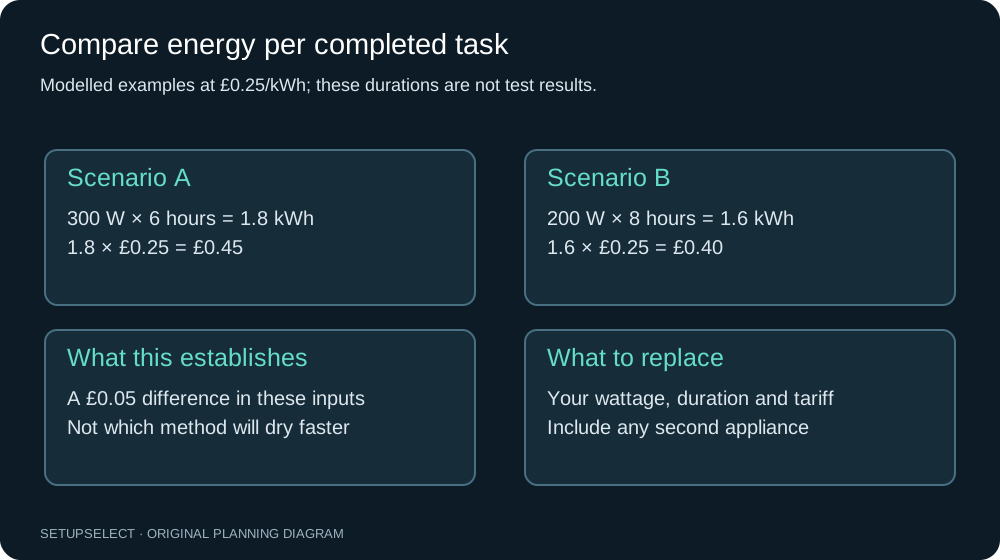
Suppose a heated-airer scenario uses 300W for six hours. Its modelled energy is 1.8kWh. Suppose a dehumidifier scenario uses an average assumed 200W for eight hours. Its modelled energy is 1.6kWh. At £0.25/kWh, the respective costs are 45p and 40p.
This example favours the second scenario on energy cost even though it runs longer. It does not establish that a dehumidifier actually dries the same load in eight hours or that a heated airer finishes it in six.
Those durations are inputs which need measurement or defensible evidence.
If the dehumidifier instead needs ten hours at that assumed average input, its modelled cost becomes 50p. A small change in task duration reverses the result. That is why quoting a universal cheapest method from wattage alone is misleading.
| Hypothetical method | Assumed input | Assumed time | Calculated energy | Cost at example £0.25/kWh |
|---|---|---|---|---|
| Heated airer A | 300W | 6h | 1.80kWh | £0.45 |
| Dehumidifier B | 200W average | 8h | 1.60kWh | £0.40 |
| Same B, longer task | 200W average | 10h | 2.00kWh | £0.50 |
Worked comparison two: a combined arrangement
Imagine an approved arrangement where an airer uses an assumed 250W for four hours and a dehumidifier uses an assumed average 180W for the same four hours. The combined energy is 1.00 + 0.72 = 1.72kWh. At the example tariff, that is 43p.
The combined method is only economically useful relative to an alternative if it delivers the desired result with an acceptable total cost and practical benefit.
A shorter elapsed time may matter to someone with limited drying space even if the electricity cost is similar. Keep time and cost as separate outcomes rather than forcing one overall score.
Do not infer that the illustrative combination is safe or recommended for any two products. Follow their instructions for spacing, covers, ventilation and electrical use.
Clothes must not drip onto electrical equipment, and neither device should be placed or covered contrary to its intended use.
Room temperature changes the comparison
Dehumidifier performance depends on room conditions and technology. A compressor model's extraction changes with temperature and humidity, so its headline litre rating cannot be converted directly into a guaranteed laundry time.
A cold room may create a different comparison from a normally heated room.
A heated airer also operates within a room environment that affects drying. If one trial includes substantial room heating and another does not, the energy boundary has changed.
Decide whether the comparison counts only the drying appliances or all additional energy used to complete the task, and state that clearly.
Read the compressor-versus-desiccant guide for technology selection. Do not choose a machine solely because its hourly input is lower if it is unsuitable for the room's normal operating conditions.
Covers, spacing and airflow
Use covers only where they are intended and approved for the exact airer. An improvised cover can change heat and moisture conditions and may conflict with the instructions.
Do not enclose electrical equipment or block ventilation to copy a faster-looking drying setup from a photograph.
Space garments so the arrangement matches the intended use. Overlapping thick fabric changes the task and can leave hidden damp areas. If you rotate or rearrange items, record that as part of the method.
A comparison involving regular manual intervention should not be described as unattended convenience.
Follow the dehumidifier's placement clearances and keep its intake and outlet unobstructed. The airer's shape, room layout and appliance position all affect circulation.
A room-size label does not establish that every corner of a crowded drying arrangement will behave identically.
Noise, space and daily handling
Cost is not the only practical difference. A dehumidifier may produce fan and compressor or desiccant-system noise, while an airer occupies a different shape of floor space.
Check the noise information for the actual operating mode, not a minimum figure associated with another setting.
Measure the airer both open and folded, and include the space required to load it. Measure the dehumidifier's operating clearances and the route to remove its tank.
If either blocks a doorway or makes the room unusable for hours, that practical cost belongs in the decision.
Consider carrying, emptying and storage. A heavy full tank or an awkward folding mechanism may make an otherwise economical method inconvenient.
The best choice is one that can be used consistently and according to instructions, not one that wins a simplified spreadsheet but is rarely used properly.
A small home trial you can document
Choose comparable loads and keep the washing programme, spin setting and garment mix as consistent as practical. Record room temperature and humidity at the start and during the task, using the same measurement location.
Note ventilation, heating and weather-related differences which could affect the comparison.
Record start time, stopping rule, any garment rearrangement and measured energy if suitable monitoring is available. Do not claim laboratory precision from a household trial.
The useful outcome is a transparent observation for your own conditions, with limitations stated.
Repeat the comparison before drawing a strong conclusion. One load can be unusually wet or arranged differently. If results vary, report the range rather than selecting the best run for the preferred appliance.
Never fabricate a test or label a calculation as measured drying performance.
A recording worksheet
| Field | Trial A | Trial B |
|---|---|---|
| Fabric mix and dry load description | ______ | ______ |
| Wash and spin programme | ______ | ______ |
| Starting room conditions | ______ | ______ |
| Appliance model and mode | ______ | ______ |
| Clothing arrangement and intervention | ______ | ______ |
| Elapsed time to the same endpoint | ______ | ______ |
| Energy measured or modelled | ______ | ______ |
| Tariff and calculated cost | ______ | ______ |
Mark energy as measured only if it was actually measured with suitable equipment. If it is derived from assumed power and time, label it modelled.
Keep appliance cost separate from any additional room heating included in the trial, so the comparison can be interpreted correctly.
Buying without a personal test
If you cannot trial both methods, compare independent testing that explains load, conditions and stopping criteria, together with manufacturer instructions and specifications.
Be cautious about articles which multiply one wattage by an unexplained drying time and call the result a test.
For a dehumidifier, use published extraction and input data at relevant conditions, while recognising that extraction in a controlled test is not the same as a laundry drying rate.
For an airer, check the actual input, permitted loading and accessory requirements. Neither set of data alone proves cost per completed load.
You may decide based on the broader household need. If moisture control is already required, a suitable dehumidifier may serve more than one task. If the main need is a compact clothing arrangement, an appropriate airer may be useful.
Do not assign extra value to a function that the product or room cannot actually support.
Common misleading comparisons
Comparing one appliance at maximum power with another at an unexplained average is not like-for-like. Comparing different laundry loads, room temperatures or definitions of dry can also distort the outcome.
A low cost per hour is not automatically a low cost per load.
Similarly, a claimed annual saving depends on the number of loads, the alternative method and the tariff. Do not multiply an uncertain one-load difference across an entire year and present it as guaranteed household savings.
Keep the assumptions visible and update them when use changes.
Avoid treating the electricity price used here as a current regulated rate. It is an example for arithmetic. Replace it with the applicable unit rate from your bill or tariff, and account for different rates if the task crosses time-of-use periods.
Make a fair household comparison
If you compare methods at home, keep the load as similar as practical: fabric mix, approximate quantity and washing-machine spin setting all affect the task. Use a consistent definition of finished drying, including thicker seams and cuffs.
A dry-looking surface is not necessarily the same endpoint as clothing ready to put away.
Record room conditions and whether any other heating or ventilation changed during the comparison. If one method uses both an airer and a dehumidifier, count the energy of both rather than attributing the outcome to just one.
Repeat observations before drawing a strong conclusion. The purpose is to improve your household estimate, not to claim a controlled product test.
Use the comparison calculator to explore how a longer duration or higher tariff changes the arithmetic, then replace those assumptions with representative observations where available.
Questions and next step
Which is cheaper? The method using less total energy for the same acceptable result at your tariff is cheaper on appliance electricity.
The answer needs comparable runtime or measured energy, not wattage alone. Can they be used together? Only where the exact products and arrangement comply with their instructions; the modelled example is not installation approval.
Will a dehumidifier stop all condensation from laundry? No guarantee can be made. Capacity, conditions, ventilation and moisture sources matter. Persistent damp needs investigation rather than simply longer appliance operation.
Use the drying-method comparison on the running-cost page to enter separate powers and durations.
Read the dehumidifier cost guide and laundry guide for the remaining assumptions.
This article contains calculations and a proposed trial method, not personal test results or a universal performance ranking.
Continue researching