Buying guide
How to dry clothes with a dehumidifier: a repeatable routine
To dry clothes with a dehumidifier, first remove as much water as the fabric's suitable washing-machine spin allows, spread the washing so air can reach it, and run the appliance in a suitable room with unobstructed airflow.
Check the thickest parts of the garments before stopping. The useful outcome is a finished, dry load with controlled room moisture, not a large number on the tank or a laundry-mode button left running indefinitely.
This guide is about arranging and repeating the drying process.
Use the dehumidifier size guide to shortlist extraction capacity, and dehumidifier versus heated airer when comparing different drying methods.
The room plans and observation sheets below are original illustrative examples, not measured drying trials.
Follow the water from the wash to the room
The dry weight printed for a washing machine is not the amount of water remaining in a finished load. Fabric, programme, loading and final spin all affect retained water. As that water evaporates from clothes, it enters the room air.
A dehumidifier removes some moisture from that air and returns air that can support further evaporation; it does not directly suck water from the fabric.
The tank can collect moisture that was already in the room and furnishings as well as water originating in the clothes. Conversely, not all water leaving the clothes necessarily reaches the tank: some may leave through ventilation or move into other spaces.
Tank volume is therefore useful operational information but not a precise laundry-water measurement.
The government's existing-home ventilation guidance identifies washing and everyday household activities as moisture sources and says background ventilation should remain effective.
A dehumidifier does not remove every indoor pollutant or replace that ventilation. Keep the building's designed vents and extract systems working while choosing a practical location for laundry.
Prepare the load before switching anything on
Check care labels and select an appropriate spin programme. A high spin may remove more water from suitable robust items, but it is not appropriate for every fabric. Separate items that need reshaping, flat drying or special handling.
Do not treat an appliance's laundry programme as permission to ignore garment instructions.
Shake out garments and open folds. Turn cuffs and pockets so they are not pressed against another wet surface. Hang trousers with room around their waistbands, and avoid laying thick towels over several neighbouring rails in a solid stack.
Small items can fill spare gaps, but a rack that appears efficient because every centimetre is occupied may provide poor access for air.
Prepare the next part of the routine as well. Have somewhere to put already dry items and a way to identify slower pieces. Removing dry shirts while leaving a few damp waistbands can reduce crowding without pretending the whole load has finished.
If you routinely wash more than the rack accommodates, a larger drying surface may be a more direct improvement than a larger dehumidifier.
Choose a drying room you can actually use
A practical room has a safe electrical position, enough space for the open airer, a reliable way to empty the tank, and a temperature within the appliance's operating range. It should also remain usable by the household.
A corridor that blocks the only route to a bedroom is not made suitable by good extraction performance.
Consider the room during the entire session. Will the door have to stay open for access? Will cooking or showering add a separate moisture load? Will the heating switch off and substantially change conditions?
These changes do not automatically prevent drying, but they explain why yesterday's successful timer setting may not work today.
A separate utility or spare room can make the drying volume easier to manage. Where a bedroom is the only option, aim to finish before sleep and clear the rack from night-time routes.
See bedroom dehumidifier placement for the different noise and access priorities. Keep ordinary portable appliances out of wet and splash-prone positions unless their exact instructions allow the installation.
Lay out the rack and appliance as one system
Place the dehumidifier on its instructed stable surface and keep every inlet and outlet clearance. Arrange the airer so clothing cannot drop onto the unit or drip into it. Use an adjustable outlet only as the manufacturer intends.
A laundry rack is not a cover, and the top of the appliance is not a drying shelf.
For an illustrative 2.4 × 2.8m spare room, start by marking the door swing and the path to the window. Place the airer in the remaining open zone and the appliance beside that zone, subject to its clearance instructions. Mark the tank-removal direction.
If emptying requires lifting wet clothes away from the unit, revise the layout before the first load.
Now inspect the air path. A sheet draped across the entire rack can become a curtain between the outlet and every other garment. Spread large items differently or dry them separately.
Aim for circulating air around exposed fabric rather than a forceful jet into one thick folded item while the rest stays shielded.
Understand what the laundry programme changes
Laundry mode is a control choice, not a separate extraction technology. Read whether it changes fan speed, humidity target, stop time or sensor behaviour. Do not assume it detects that the clothes are dry.
A timer can end because the programmed hours have elapsed while thick fabric remains damp.
For a concrete example of why this matters, Meaco's Arete Two 12L product information describes an adjustable louvre, an additional fan setting and a laundry timer adjustable between one and twelve hours.
Those controls help arrange a session, but they do not establish a drying time for your clothes. Other models may implement the same marketing label differently.
If there is no dedicated programme, consult the manual for ordinary dehumidification operation suitable for the task. More aggressive settings are not automatically more economical.
A faster fan might improve air movement while changing sound; a very low target might continue treating room moisture after the clothes have finished. Start with a documented setting and change one aspect at a time.
Build an observation log around finished clothes
Write down enough information to compare sessions without turning laundry into a laboratory exercise. The most useful baseline is a familiar load with a similar spin programme, rack arrangement and room schedule.
Note unusual conditions such as a cold day or a door left open, rather than hiding them inside an apparently precise average.
| Record | Why it helps | Example entry, not a test result |
|---|---|---|
| Load description | Thick fabric and mixed loads behave differently | Shirts, socks and two towels |
| Washing programme and spin | Explains changes in retained water | Same suitable programme as previous week |
| Room temperature and RH at start | Makes the starting conditions visible | Read from the same meter position |
| Rack arrangement | Reveals crowding changes | Towels separated; pockets opened |
| Mode and start time | Makes the appliance routine repeatable | Laundry programme, 10:00 |
| Tank interruptions | Identifies stopped extraction | Empty or full; time checked |
| Dry endpoint | Prevents ending on timer alone | Waistbands, seams and towels checked |
| Energy, if measured | Supports cost per completed session | Difference between final and initial kWh |
Do not compare one tiny synthetic load against another full rack of towels and call the difference appliance efficiency. Group broadly similar sessions.
Three or four ordinary observations can reveal useful routine problems, but they still do not prove a performance claim for all households or weather conditions.
Check progress without repeatedly disturbing the setup
At sensible points during the session, check whether clothes are overlapping, the tank has reached its shut-off level, and the appliance is operating normally. Use the manual's instructions for any warning lights.
Keep the meter away from the immediate outlet so a reading represents the room more usefully.
When most items feel dry, inspect the slow areas: waistbands, pocket seams, cuffs, doubled towel edges and fabric folded over rails. A cool feeling alone is not a reliable substitute for checking moisture, especially if the room is cold.
Separate the remaining damp items rather than leaving every finished garment on the rack until the slowest piece catches up.
Avoid assigning an exact completion time in advance. Use earlier observations to plan a window, then confirm the actual endpoint.
If a deadline matters, such as uniforms needed next morning, leave time for a different permitted drying method rather than assuming a larger extraction label guarantees success under changed conditions.
Troubleshoot the specific bottleneck
The tank fills and drying stalls. Begin with an empty tank, check it during the session, or investigate the manufacturer's continuous-drain option if a suitable drain exists.
An unattended tank shut-off is protective behaviour, but it also means extraction has stopped. A bigger tank may address this interruption without changing drying technology.
Clothes on one side finish first. Inspect the rack arrangement and available air paths. Rotate suitable items or change spacing before deciding the appliance lacks capacity.
A blocked inlet or a sheet acting as a partition can create uneven conditions even in a small room.
The room gets colder during the session. Record the temperature rather than comparing the outcome with a warmer day. Check the allowed operating range and realistic extraction conditions.
Refer to compressor versus desiccant dehumidifiers if the chosen room is consistently cold; this is a technology and location issue as much as a timer issue.
Condensation persists outside the laundry room. Check whether moisture is escaping into connected spaces and whether there are other sources. The appliance may be helping the clothes while a separate ventilation or building issue remains.
Persistent damp should be investigated rather than treated as evidence that laundry mode needs an indefinitely lower target.
Calculate the session you actually completed
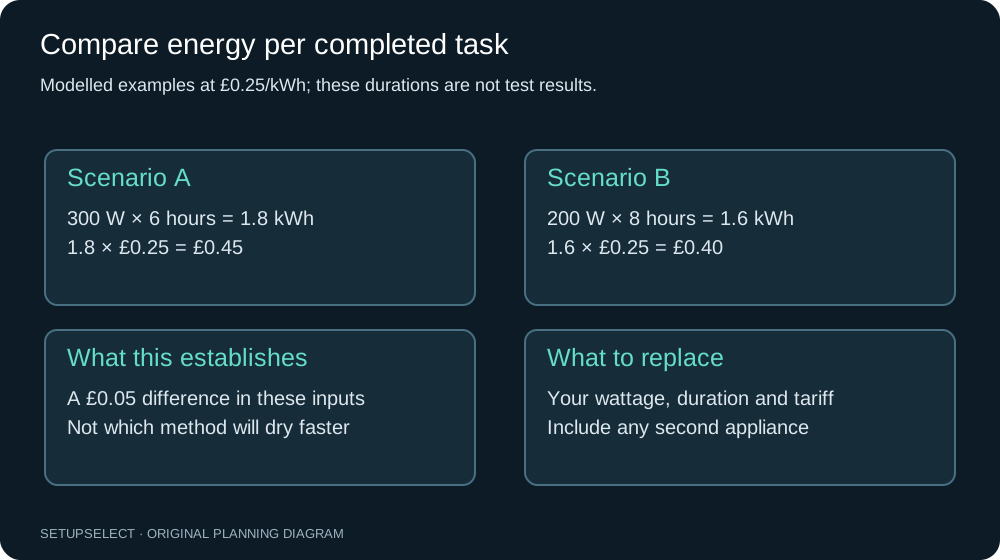
Input watts describe a rate of electricity use; a session total is energy in kWh. If a suitable monitor records 1.2kWh from setup to the chosen dry endpoint, an illustrative tariff of £0.25/kWh makes that session £0.30.
Neither the energy nor the tariff in this example is a claim about your appliance or current electricity contract.
Record interruptions and the endpoint alongside the reading. Stopping one method while clothes remain damp produces an artificially flattering cost.
Including several hours after everything is dry produces an inflated cost for the method, although it still reflects money spent under that routine.
The running-cost guide explains rated-input estimates and measurement. The heated-airer comparison considers complete-method costs.
Use these when choosing equipment; use the session log here to improve the process you can actually repeat with your room and clothes.
Finish and reset the room
Return the appliance to its ordinary humidity-control setting if it will continue serving the room. Follow the cleaning instructions for the tank and filter, and inspect the drain connection if fitted.
Put dry clothes away only after checking the slower parts; closing damp garments into a wardrobe simply moves the moisture problem.
Clear the rack and restore access routes. Note one useful observation while the session is fresh: a towel folded too thickly, a tank interruption, or a timer that finished early.
A small adjustment applied consistently next time is more useful than changing capacity, room, fan mode and load size simultaneously and not knowing which change helped.
For a purchase shortlist, enter laundry frequency, real room conditions and the broader moisture problem in the dehumidifier finder.
Follow with the 12L versus 20L comparison when both classes look plausible. Keep the rack, storage and emptying routine in that choice, not only extraction.
Should I put the dehumidifier under the airer?
Only use positions allowed by the instructions, with the required clearances and protection from drips or falling fabric. In many rooms, beside the drying zone is easier to inspect and empty than underneath wet clothing.
Saving a little floor space is not useful if the inlet is obstructed or water can reach the appliance.
Can a closed door replace ventilation?
No. Managing the space being treated does not mean disabling the home's ventilation. Preserve designed background ventilation and follow the building's ventilation arrangements.
If closing a particular door interferes with those arrangements, choose another layout or seek advice about the room instead of treating a generic drying tip as overriding the system design.
Is the amount in the tank proof the clothes are dry?
No. It includes moisture from the room as well as potentially from the load, and it does not show the moisture remaining inside thick fabric. Inspect the garments.
Tank collection is useful for managing emptying and observing general behaviour, not for certifying a completed load.
Why do towels still feel damp after the shirts finish?
They may retain more water or have thick folded sections with less air exposure. Separate slower items, open folds and continue a suitable drying method until they are dry.
This is one reason a single timer setting for every mixed load is less reliable than an observation-led routine.
Continue researching