Buying guide
12L vs 20L dehumidifier: compare real extraction and fit
A 20L dehumidifier offers more extraction capacity than a comparable 12L model, but the useful difference is the water removed at your room's temperature and humidity, together with the space, noise and emptying routine you can accommodate.
Choose between actual specifications, not two numbers on the boxes. A smaller machine that maintains the intended conditions can be sufficient; a larger one may provide valuable recovery capacity for repeated moisture loads.
This comparison concerns domestic compressor capacity classes. If you have not established the size and conditions of the area to be treated, start with what size dehumidifier do I need?.
For an unheated space, resolve the compressor versus desiccant decision before comparing nominal litre ratings across different technologies.
Read the complete extraction rating
The litre label describes water extraction over 24 hours under specified test conditions. It is not the tank volume. A machine can have a 20L extraction label and a tank that holds less than five litres.
Nor is the headline extraction an amount that the machine ought to collect from every home: there may be much less available moisture, and a humidistat may stop active extraction after the target is reached.
Temperature and relative humidity belong beside the extraction figure. Comparing one machine's result at 30°C and 80% relative humidity with another's result at 20°C and 60% tells you little about their relative performance.
Ask for both products' tables at the same conditions. Where one manufacturer publishes only a headline maximum, record the missing comparison instead of estimating a domestic result from the badge.
There is another distinction between permitted operation and useful performance. A stated minimum temperature means the manufacturer allows the appliance to operate there, subject to its instructions.
It does not promise the headline extraction at that temperature. This becomes especially relevant if a room cools substantially overnight or the appliance moves between heated and unheated rooms.
A documented 12L and 20L example
The following specifications were checked on 29 September 2026 against the manufacturer's Arete Two 12L page and Arete Two 20L page.
They illustrate one product family, not every appliance carrying those capacity labels. These are published specifications; we have not independently tested the machines.
| Published specification | Arete Two 12L | Arete Two 20L |
|---|---|---|
| Extraction at 20°C, 60% RH | 5.40 litres/day | 8.50 litres/day |
| Input at that condition | 136W | 207W |
| Extraction at 10°C, 60% RH | 1.97 litres/day | 3.35 litres/day |
| Input at that colder condition | 111W | 176W |
| Height × width × depth | 472 × 319 × 237mm | 618 × 366 × 272mm |
| Appliance weight | 10.9kg | 15.1kg |
| Tank capacity | 2.5 litres | 4.8 litres |
| Published operating range | 5–35°C | 5–35°C |
At the warmer comparison point, the difference is 3.10 litres per day; at the colder point it is 1.38 litres. That arithmetic demonstrates why simply subtracting 12 from 20 does not describe the extra water available in a particular room.
Conditions change the practical value of moving up a class.
The larger example also adds 146mm of height, 47mm of width and 35mm of depth. Those increments may look small on a product page but matter beneath a shelf or beside a narrow passage.
The body dimensions exclude whatever access is needed to empty the tank, clean the filter and maintain the specified airflow clearance.
Compare extraction per unit of energy carefully
You can use matching test points to calculate a limited efficiency comparison. Taking the published 20°C, 60% values above, constant operation at 136W for 24 hours would use 3.264kWh; 5.40 litres divided by that energy gives about 1.65 litres per kWh.
For the 20L example, 207W for 24 hours gives 4.968kWh, and 8.50 divided by that is about 1.71 litres per kWh.
These are calculations from published steady conditions, not measured household daily totals. A real room dries, changes temperature, receives new moisture and triggers different control states.
The small difference between those calculated ratios should not be sold as a precise household saving. It does show why lower input watts alone cannot identify which appliance removes a given amount of water using less energy.
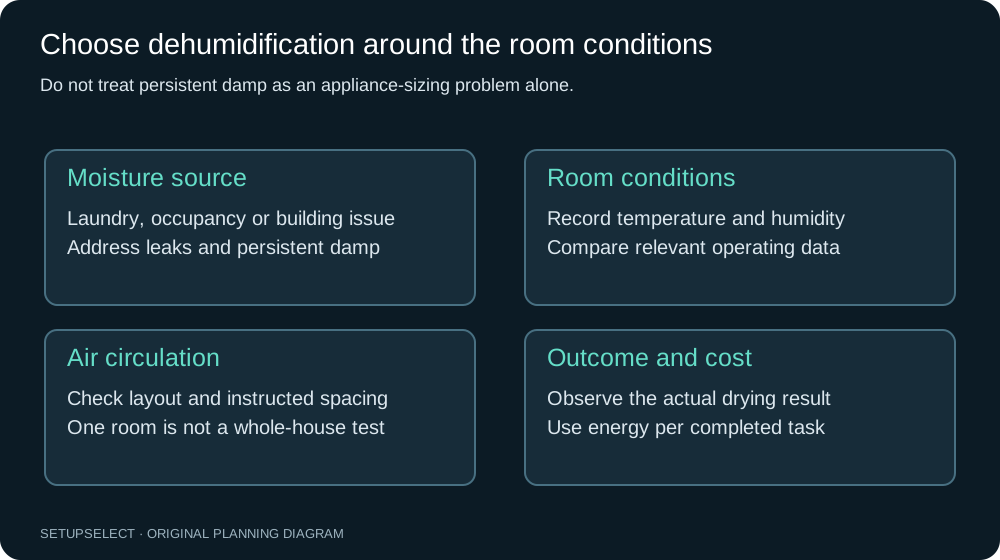
Keep three questions separate: how much water the machine can remove, how quickly your room needs moisture removed, and how much energy the actual routine uses.
For electricity budgeting, use the running-cost calculator and your own tariff.
For a laundry comparison, record energy until the clothes reach the same dry endpoint rather than assigning both products an arbitrary equal runtime.
Decide whether recovery speed matters
A humid room after one wet load presents a different purchase decision from a room that needs gentle background control throughout the week.
Capacity headroom can matter if you need the drying room free again before evening, have another load waiting, or can only run the appliance during a limited part of the day.
It matters less if a smaller machine already reaches and holds the target during the hours available.
Do not translate the extraction ratio into a guaranteed drying-time ratio. Laundry evaporation also depends on fabric, retained water, spacing, temperature and air movement. A 20L machine will not necessarily finish a load in 12/20 of the time.
The clothes-drying workflow explains how to make the surrounding setup repeatable before judging capacity.
For background use, note what happens after a moisture event. Does the reading return towards the previous level during a reasonable operating period? Does condensation recur elsewhere behind closed doors? Does the machine stop because the tank is full?
These observations distinguish inadequate extraction from a practical limitation that buying a larger badge may not address.
The tank can change the buying decision
A bigger collection tank can be more useful than an extra control feature when the appliance runs while you are working. In the example family, the 20L model's tank is almost twice the volume of the smaller tank.
That does not imply twice the time between emptying: the larger appliance may also collect water faster under the same conditions.
For an illustrative routine, suppose a particular session collects 3 litres, regardless of which machine eventually completes it.
A 2.5-litre tank cannot contain that entire amount without an interruption; a 4.8-litre tank has room, assuming it starts empty and the usable shut-off volume permits it.
This is a container comparison, not a prediction that your next load will release three litres into the tank.
Lift and pour a realistic volume before assuming a larger tank is easier. One litre of collected water adds approximately one kilogram to the container.
Grip shape, a cover, a pouring spout and the route to the sink may matter more than capacity for someone with limited strength. Confirm how the tank withdraws when the unit stands in its intended position.
Continuous drainage can remove emptying interruptions, but it introduces a hose route, a suitable discharge point and regular inspection. Follow the model's hose specification and drainage instructions; a larger appliance does not solve a hose running uphill.
For garage installations, the garage guide covers enclosure and drain reliability.
Footprint and handling: compare the complete routine
Make two paper rectangles matching the candidate bodies and put them on the floor. Add the required clearance around the intake and outlet, the tank-removal path, and the space occupied by a connected hose.
Walk past with the items normally carried through that room. A machine that fits only when pushed against a curtain or placed across a doorway has failed the fit check.
Moving between floors is a separate test from rolling between rooms. Consider the empty appliance weight, grip, stairs, landing turns and where it can be set down safely. Check transport and upright-rest instructions for the exact model.
Castors do not make a heavy compressor appliance convenient to carry, and a full tank should not become part of the moving routine.
Storage matters too. Measure the cupboard opening as well as its interior. Leave space for the cable and drainage accessories without crushing them.
If you will use the machine for most of winter, an accessible working position may be more valuable than a nominally compact storage footprint that requires dismantling furniture every time.
Noise and controls are not capacity ratings
The quietest advertised sound figure may describe a low fan setting, while your laundry routine needs a faster setting. Ask which mode, fan speed and measurement basis each figure represents. A decibel value without those details is an incomplete comparison.
Do not infer a fixed noise penalty from the step between 12L and 20L; construction and control behaviour vary.
Consider what you hear when the compressor starts and stops, whether furniture can rattle nearby, and whether the display or full-tank alert is intrusive. A showroom or a short online recording cannot reproduce your bedroom acoustics.
For overnight use, check the practical routine in choosing a bedroom dehumidifier, including running before bed and reviewing morning conditions.
Control features should solve a stated need. A humidistat helps maintain a target; a timer supports a schedule; automatic restart changes behaviour after a power interruption.
App access may help someone check a remote room, but it does not verify that the tank is seated correctly or the hose is clear. Decide which functions you will actually use before paying more for them.
Three decisions using the same comparison method
Compact heated flat, occasional condensation. The owner records several rooms but finds that one bedroom is the recurring problem. A 12L candidate fits a safe position, its published conditions are relevant, and daytime operation is practical.
The reason to shortlist it is that the specific task and routine fit, not a universal rule assigning a capacity to one-bedroom flats.
Family laundry room with consecutive loads. The available room is warm enough for both compressor candidates, but drying takes place within a limited daytime window. The 20L candidate offers higher published extraction and a larger tank.
The owner still checks rack spacing, high-speed sound and the drying endpoint before assuming the extra capacity will translate into the desired schedule.
Cold detached store. Both badges are initially attractive, but the logged overnight conditions are outside a candidate's allowed range. That product is rejected before price, tank size or maximum extraction is considered.
The choice returns to operating limits and appropriate technology; the larger compressor label is not an exemption from its instructions.
Use the dehumidifier finder to keep those inputs together.
Its result is a shortlist aid, so retain the conditions and product evidence behind your eventual decision rather than treating the suggested capacity as a performance guarantee.
Will a 20L model make a room excessively dry?
A larger maximum extraction rating does not itself set the final humidity. Humidistat settings and the control programme determine how the appliance responds.
Check that the intended mode uses humidity control: a continuous or laundry programme may behave differently. Choose a sensible target using the appliance guidance and actual room needs, rather than setting the minimum by habit.
Is a 12L machine faulty if it collects less than a litre overnight?
Not on that observation alone. A cool room, a target already reached, a short active runtime or limited available moisture can explain modest collection. Check room readings, settings, filter condition and any fault indicators.
Persistent condensation with little collection deserves investigation, but the badge is not an overnight collection quota.
Can two smaller units replace one larger unit?
They may help separately closed spaces because each has access to its own room air. They also mean two tanks, two electrical appliances, additional floor space and separate maintenance. Adding nominal capacities cannot establish whole-home performance.
Compare the actual layout and routines, particularly if doors normally stay closed, before deciding whether one central machine can do the intended job.
Should I upgrade a working 12L appliance for laundry?
First record what the existing machine fails to achieve. If the problem is a full tank, poor garment spacing or laundry being added halfway through a session, address that before attributing everything to extraction capacity.
An upgrade becomes a reasoned choice when the current arrangement is sound but cannot meet a repeatable time or moisture-control requirement.
What should I copy into a final shortlist?
Record the exact model, extraction and input at matching conditions, permitted temperature range, tank volume, body dimensions, required clearance, handling weight, relevant sound setting and drainage arrangement. Mark unavailable evidence clearly.
The best comparison is the one that explains why a machine suits your routine, including the limitation you are accepting.
Continue researching